 Research.Checkpoint
 Clipboard Hijacker Campaign Manipulates Reputation to Steal Cryptocurrency
Article Content

- •The malware campaign targets crypto traders and online gamblers with fake tools.
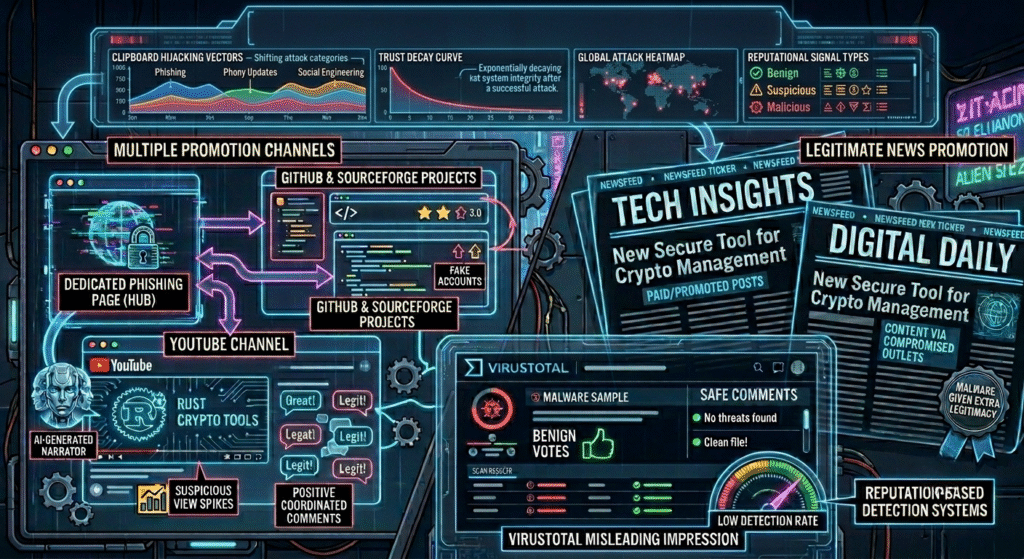
- •Fake engagement metrics are used to create a false sense of legitimacy across platforms.
- •The clipboard hijacker replaces copied wallet addresses with those controlled by the attacker.
A clipboard hijacker malware campaign has emerged, targeting cryptocurrency traders and online gamblers. The operation employs fake software tools, including sniper bots and game predictors, to lure victims. It utilizes a WordPress phishing site as a hub, with malware hosted on GitHub and SourceForge, and promoted through AI-narrated YouTube videos. The threat actor employs 'ghost networks' of fake accounts to inflate engagement metrics, such as GitHub stars and VirusTotal votes, creating a false sense of legitimacy. The malware, written in Rust, monitors the clipboard for cryptocurrency wallet addresses and replaces them with attacker-controlled addresses. This campaign has raised concerns about the potential for broader exploitation tactics that could impact enterprises. The current status is ongoing, with the campaign actively distributing its malware via social media and forums.
Ask AI about this cluster
Answers cite the sources they use
Timeline
More articles in this cluster (6)
Following this threat?
Track CryptoRipper and YouTube in your own feed — you're alerted when they show up in new reporting, leak sites or exploitation.
Free account · no card needed
Continue Reading
 Critical WSO2 API Manager Vulnerability Under Active Exploitation A critical vulnerability (CVE-2026-5430) in WSO2 API Manager is being actively exploited, allowing unauthenticated attackers to forge admin tokens via JWT authentication bypass. This flaw, which has a CVSS score of 10.0, affects multiple WSO2 products including API Manager, Universal Gateway, Traffic Manager, and API…
  Critical Linux Kernel Vulnerability CVE-2025-39682 Under Active Exploitation A critical vulnerability (CVE-2025-39682) in the Linux kernel allows remote code execution through mishandling of zero-length TLS records. This flaw affects kTLS-enabled hosts running vulnerable kernel versions, exposing them to attackers without authentication. CISA added this vulnerability to its Known Exploited…