 www.vulncheck.com
ToolJet Before 3.21.96-LTS Vulnerable to Cross-Organization IDOR and SSRF
Article Content

- •ToolJet versions before 3.21.96-LTS are affected by a cross-organization IDOR in App-Builder component, page, and event APIs (CWE-639).
- •A second flaw allows SSRF through the data source test connection endpoint in the same product versions.
- •The IDOR issue is tracked in GitHub Security Advisory GHSA-4wr6-43pg-rq78.
- •The articles do not report exploitation in the wild or a public proof of concept.
- •Upgrading to 3.21.96-LTS or later is the remediation both advisories point to.
VulnCheck published two advisories on 2026-11-28 covering ToolJet versions before 3.21.96-LTS. The first describes a cross-organization insecure direct object reference (IDOR) in the App-Builder component, page, and event APIs, classified as CWE-639 (authorization bypass through a user-controlled key).
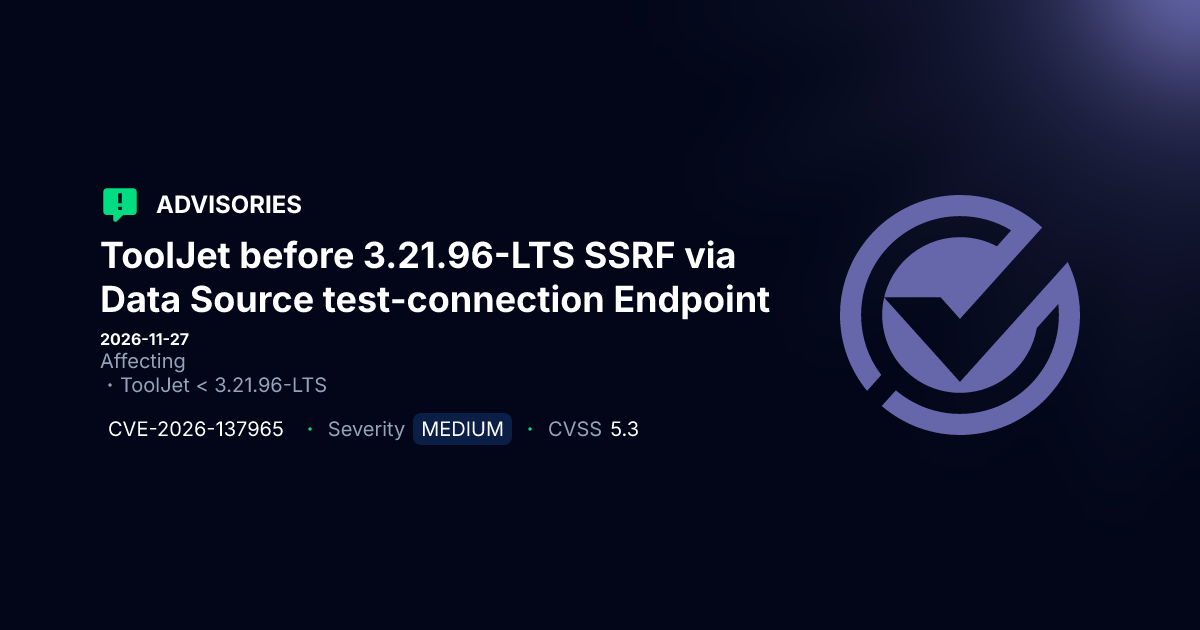
The second describes a server-side request forgery (SSRF) via the data source test connection endpoint. The advisories reference a GitHub Security Advisory (GHSA-4wr6-43pg-rq78) for the IDOR issue. The source text does not state CVSS scores, CVE identifiers, exploitation status, or the number of affected deployments.
The fixed version is 3.21.96-LTS. No exploitation is reported in the articles.
Ask AI about this cluster
Answers cite the sources they use
Timeline
More articles in this cluster (2)
Common questions
Which ToolJet versions are affected?
Is there evidence this is being exploited?
What should administrators do first?
Continue Reading
 Broadcom patches critical VMware vCenter auth bypass flaws Broadcom disclosed VMware Security Advisory VMSA-2026-0009 on November 19, 2026, covering vulnerabilities in VMware vCenter, Tools, and SDDC Manager. CVE-2026-123890, a CVSS 9.8 authentication bypass in the VMware Directory Service, is listed in CISA's KEV catalog, which the verified record gives as 2026-11-20.…
 CVE-2026-123890: Auth bypass in VMware vCenter exploited by Armory Castle before patch CVE-2026-123890, a flaw in VMware vCenter Server rated CVSS 9.8, allows an unauthenticated remote attacker to obtain an administrator session on the platform. According to the Google Threat Intelligence Group, the flaw was exploited by the espionage group Armory Castle (formerly UNC5221), which has suspected China…