 asec.ahnlab.com
Trojanized Q-Dir and DesktopOK Installers on SoftwareOK Site Deliver Python RAT
Article Content

- •Official SoftwareOK installers for Q-Dir and DesktopOK were trojanized, affecting both direct downloads and update processes.
- •The malware drops a Python RAT that supports shell and Python command execution, file transfer, screenshots, and system reconnaissance.
- •The RAT checks for and reports numerous security products, including AhnLab, CrowdStrike, and SentinelOne.
- •Users should verify SHA-256 hashes of installed Q-Dir or DesktopOK files and hunt for the scheduled task and dsv2_py39_agent components.
- •The mechanism by which SoftwareOK's distribution was compromised has not been disclosed.
AhnLab disclosed that installation files for Q-Dir and DesktopOK distributed via the official SoftwareOK website were tampered with to include malicious content.
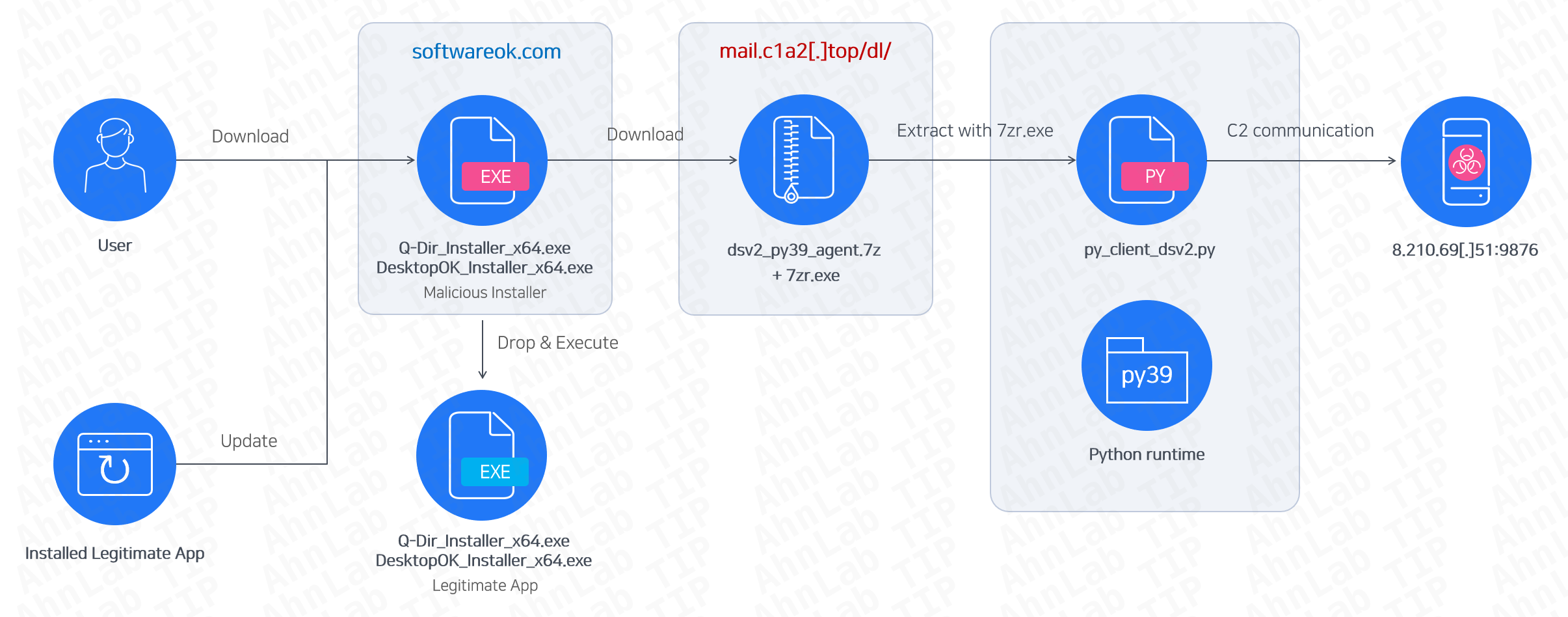
According to AhnLab, malicious files were generated both when users downloaded the programs from the official download page and during the update process of previously installed legitimate programs.
The trojanized installer launches the genuine application to reduce user suspicion while downloading a Python-based remote access trojan from the external domain mail.c1a2[.]top, including the legitimate 7-Zip binary 7zr.exe and a package named dsv2_py39_agent.7z.
The RAT establishes persistence through a scheduled task disguised as Microsoft Edge and communicates with C2 server 8.210.69[.]51:9876. Its capabilities reportedly include shell and Python code execution, file transfer, screenshots, and system information collection.
The RAT also checks running processes against a list of security products, including AhnLab, CrowdStrike, SentinelOne, Kaspersky and others, and reportedly sends this information to the C2 server. Per the articles, the exact mechanism that allowed the installers to be replaced remains unknown.
AhnLab advises users of Q-Dir or DesktopOK who installed or updated these programs to verify file hashes and check for RAT traces. No CVEs are involved, and the articles do not report on the number of affected users or the threat actor's identity.
Ask AI about this cluster
Answers cite the sources they use
Timeline
More articles in this cluster (6)
Following this threat?
Track Python RAT and AhnLab in your own feed — you're alerted when they show up in new reporting, leak sites or exploitation.
Free account · no card needed
Common questions
Am I affected?
How do I check for infection?
What should I do first?
Continue Reading
 Broadcom patches critical VMware vCenter auth bypass flaws Broadcom disclosed VMware Security Advisory VMSA-2026-0009 on November 19, 2026, covering vulnerabilities in VMware vCenter, Tools, and SDDC Manager. CVE-2026-123890, a CVSS 9.8 authentication bypass in the VMware Directory Service, is listed in CISA's KEV catalog, which the verified record gives as 2026-11-20.…
 CVE-2026-123890: Auth bypass in VMware vCenter exploited by Armory Castle before patch CVE-2026-123890, a flaw in VMware vCenter Server rated CVSS 9.8, allows an unauthenticated remote attacker to obtain an administrator session on the platform. According to the Google Threat Intelligence Group, the flaw was exploited by the espionage group Armory Castle (formerly UNC5221), which has suspected China…