 dev.ua
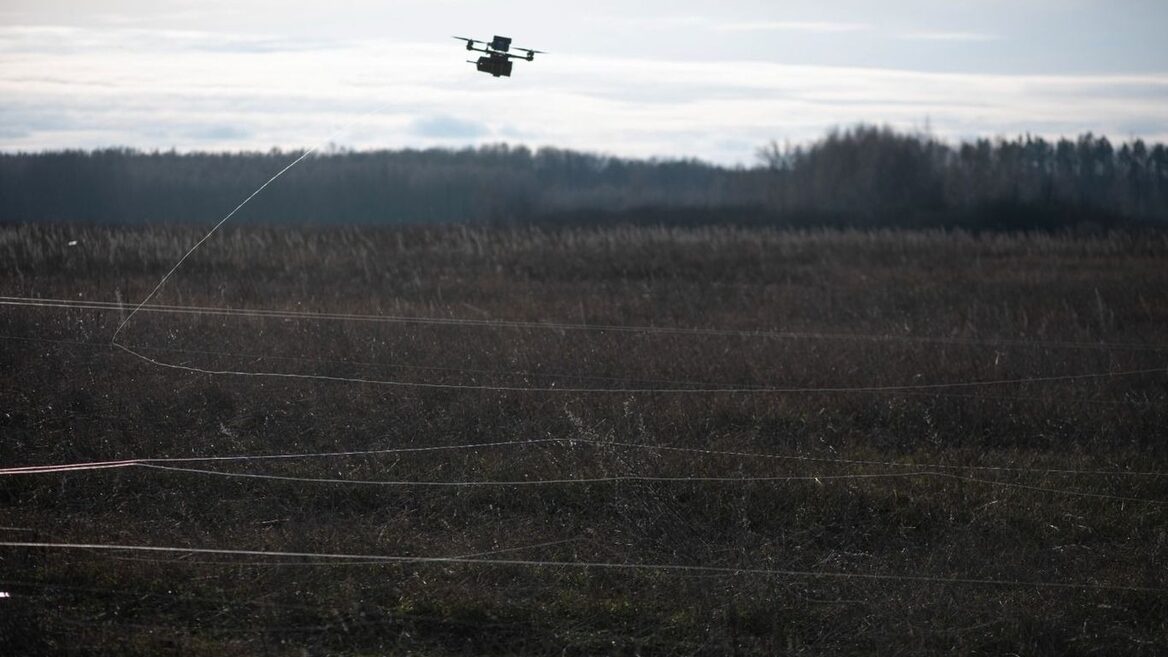
 Ukraine Develops Innovative Barriers Against Fiber-Optic Drones
Article Content

- •Ukraine has developed barriers to combat fiber-optic attack drones.
- •The Chaharnyk system reportedly has a 95% success rate in severing drone cables.
- •Approximately 60% of Russian FPV drones are now fiber-guided, increasing the threat level.
Ukrainian forces have introduced new barriers to counter fiber-optic attack drones, which have become increasingly prevalent in the conflict with Russia. These barriers, including the Chaharnyk system, utilize motorized wire fences and barbed wire to sever the drones' control cables, disrupting their operation. The Chaharnyk system can be set up quickly and has a reported 95% success rate in cutting cables. As of 2026, approximately 60% of Russian FPV attack drones are fiber-guided, posing a significant threat to Ukrainian installations. The barriers are designed to protect vulnerable sites such as electrical substations and supply routes. The effectiveness of the acoustic detection system used in these barriers is still under evaluation. Reports indicate that these innovations are gaining attention, with Russian bloggers discussing the new technology.
Ask AI about this cluster
Answers cite the sources they use
Timeline
More articles in this cluster (2)
Common questions
How effective are the new barriers?
What types of drones are targeted?
What are the implications for Ukrainian defenses?
Continue Reading
 Critical Zero-Day Exploits Target F5 and Check Point Products F5 Networks released emergency hotfixes for a critical zero-day vulnerability, CVE-2026-94127, in its BIG-IP Access Policy Manager on September 22, 2026, after confirming active exploitation. This flaw allows unauthenticated remote code execution (RCE) and has a CVSS score of 9.8. Concurrently, Check Point disclosed…
  Critical Citrix NetScaler Zero-Day Vulnerabilities Exploited Citrix disclosed two critical zero-day vulnerabilities, CVE-2026-88771 and CVE-2026-88772, affecting NetScaler ADC and Gateway systems, which are being actively exploited. Both vulnerabilities have a CVSS score of 9.5 and allow unauthenticated attackers to execute arbitrary commands remotely. CVE-2026-88771 arises…