 News.Ycombinator
Windows 11 Telemetry Tracks AI Coding Agents Usage
Article Content
Browse articles 
- •Windows 11 tracks usage of AI coding agents and developer tools via telemetry.
- •Data is sent to Microsoft if users do not opt out of diagnostic data collection.
- •The discovery was made by researcher Xusheng Li and shared on November 16, 2026.
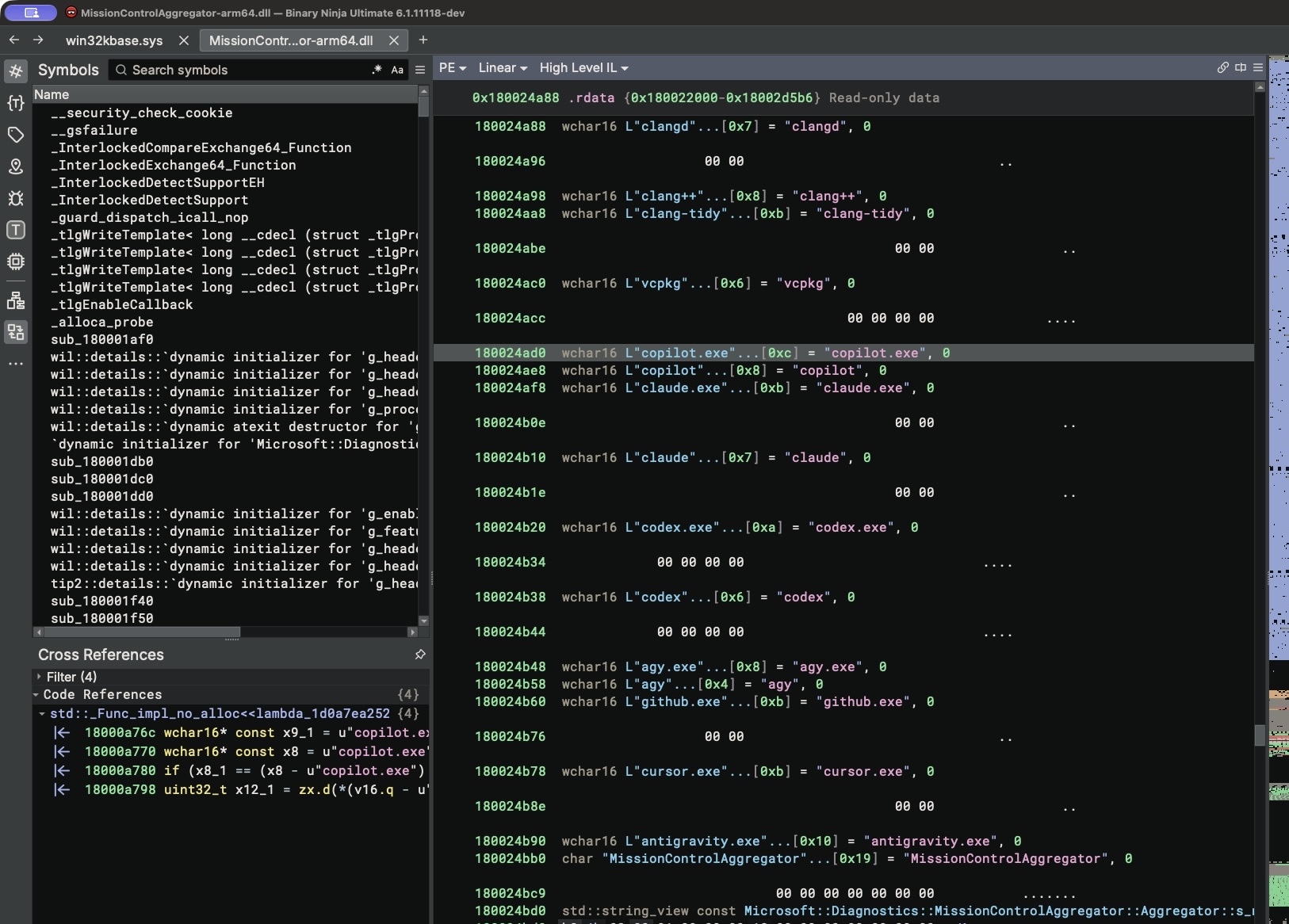
Windows 11 includes a telemetry feature that records the usage of AI coding agents and developer tools, sending this data to Microsoft if optional diagnostic data is enabled. Security researcher Xusheng Li discovered this functionality embedded in the MissionControlAggregator.dll component, which checks for various executables like codex.exe and copilot.exe. The data collection occurs unless users opt out of the default setting. This finding was shared publicly on November 16, 2026, and highlights concerns about user privacy and data collection practices by Microsoft. The feature is not classified as a vulnerability but raises questions about transparency in data handling.
Ask AI about this cluster
Answers cite the sources they use
Updated 3h ago How this analysis works
Timeline
2026-11-16
Discovery of telemetry feature
Researcher Xusheng Li revealed that Windows 11 tracks AI coding agent usage through telemetry in MissionControlAggregator.dll.
News.Ycombinator2026-11-17
Article published on tracking issue
Cybersecuritynews reported on the telemetry feature and its implications for developer privacy.
CybersecuritynewsMore articles in this cluster (4)
Common questions
How does this telemetry work?
The telemetry feature records the usage of specific AI coding agents and developer tools, sending data to Microsoft unless users opt out.
What should developers know about this?
Developers should be aware that their usage of certain tools may be tracked and reported to Microsoft, impacting their privacy.
Is there a way to disable this tracking?
Yes, users can opt out of the optional diagnostic data collection in Windows 11 settings.
Continue Reading
 Critical Code Injection Vulnerability in Staggs Plugin for WordPress A critical code injection vulnerability, CVE-2026-78287, has been identified in the Staggs plugin for WordPress, affecting versions up to 3.3.0. This flaw allows unauthenticated attackers to execute arbitrary code remotely, posing severe risks to affected sites. The vulnerability stems from improper control over code…
 Lazarus Group Targets 30 South Korean Servers Using PHP Vulnerabilities North Korea-linked Lazarus Group has targeted 30 servers in South Korea as part of a larger cyber operation involving 581 servers across 10 countries. The attacks exploit two critical remote code execution vulnerabilities in PHP (CVE-2026-109618 and CVE-2026-109619), allowing unauthorized server command execution. The…