Indicators that go where you need them.
Every article that enters the pipeline is extracted for IOCs, validated for confidence, and made available wherever your analysts and tooling need them. STIX, MISP, REST, RSS, CLI.
Every article, extracted twice.
The unambiguous indicators come out first. IPs, domains, URLs, hashes, CVE IDs, crypto wallets. Anything with a predictable shape gets captured with a script, not a model.
AI then handles the contextual layer. Threat actors, malware families, MITRE techniques, tools, industries, and targets. Benign domains, invalid hashes, and known false positives are filtered out up front, so the validation queue stays clean.
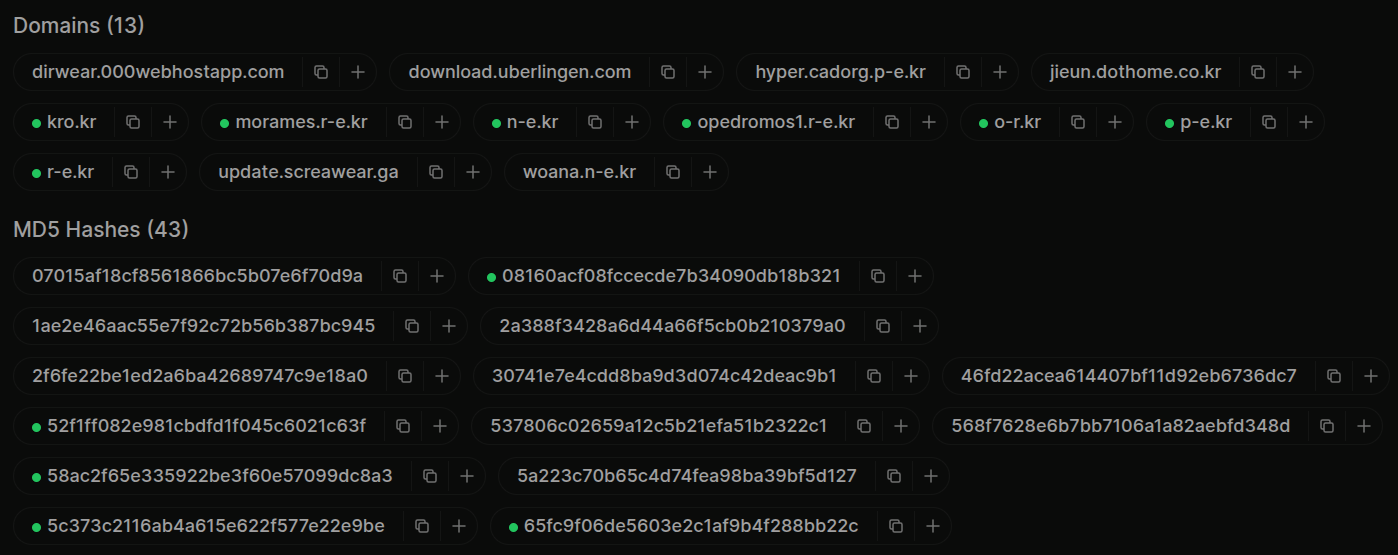 click to expand
Confidence on every indicator.
Every IOC is assigned a confidence level. High, medium, low, or false positive. Each carries a written justification so analysts know why the model graded it that way.
Confidence feeds every downstream filter, so analysts only see what's been verified. Pending IOCs surface separately for the analyst on triage duty, with an X-IOC-Pending-Count header on every API response so SIEM ingestion can see the validation lag in flight.
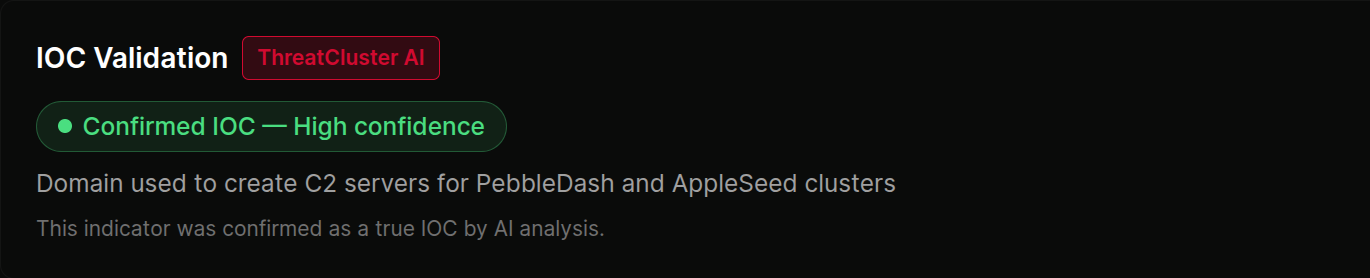 click to expand
Per-cluster or in bulk.
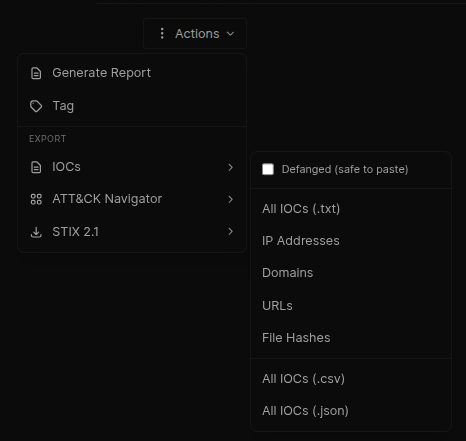
One cluster's IOCs as TXT for a firewall blocklist, CSV for a spreadsheet, JSON for a script, or STIX 2.1 with TLP marking for a TIP. Or query in bulk by type, confidence, and time window.
Defang on or off per request. ATT&CK Navigator layer for the techniques in the cluster. The full format matrix with auth, tier, and confidence defaults sits at /formats.
 click to expand
Native MISP feed.
ThreatCluster ships a native MISP-compatible feed with manifest, hashes index, and event JSON. UUIDs are stable across regenerations, so MISP correlation works cleanly and event re-pulls don't generate duplicate records.
Authenticated tier carries 50 events with historical replay via ?since= and ?days=. Public tier carries 10 recent events. MISP Galaxy clusters auto-attach for recognised threat actors and ransomware groups.
 click to expand
Into your SIEM, however you ingest.
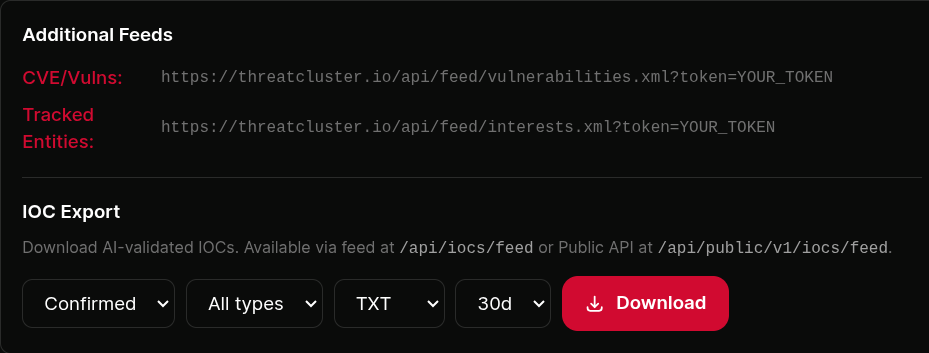
REST API for direct pulls. RSS for feed-based ingestion. Webhook push into Splunk, Microsoft Sentinel, Elastic, or OpenSearch. Filter by confidence, type, and freshness on the wire so you don't have to filter post-ingest.
Hunting queries for the same IOCs export natively in KQL, SPL, and Lucene from the Hunt page.
 click to expand
More of the platform
- Exposure ManagementAsset inventory ranked by CISA SSVC
- Threat HuntingIndustry threat models with SIEM-ready queries
- Dark Web MonitoringIn-house collection across leak sites and forums
- The Exploits DatabaseCVEs ranked by what defenders care about
- CLI and HeadlessREST API, tc command, agent tool
- Format matrixEvery IOC endpoint, format, and tier in one table
IOCs and exports FAQ
What IOC types do you extract?
IPs, domains, URLs, file hashes, email addresses and crypto wallets, extracted from every article and clustered against the incident and entities they belong to.
How do you keep the feed clean?
Indicators are filtered hard on the wire before publication rather than after ingestion, so you are not filtering noise post-load. Each indicator carries a confidence level and the reason behind it.
What formats and destinations are supported?
Eleven consumption surfaces across REST, STIX, a native MISP feed, CSV and the CLI, built to drop into the SIEM, TIP or firewall you already run.
Will MISP correlation duplicate my indicators?
No. UUIDs are stable across regenerations, so MISP correlation matches the same indicator over time rather than creating duplicates.
Can I pull IOCs per cluster or in bulk?
Both. Export a single cluster's indicators, or pull in bulk via the API and feeds. Pending extractions are surfaced via an X-IOC-Pending-Count header.
Pipe the IOCs where they need to go.
Eleven consumption surfaces, one entity graph behind them. STIX for your TIP, MISP for your sharing community, REST for your scripts, RSS for your dashboard.