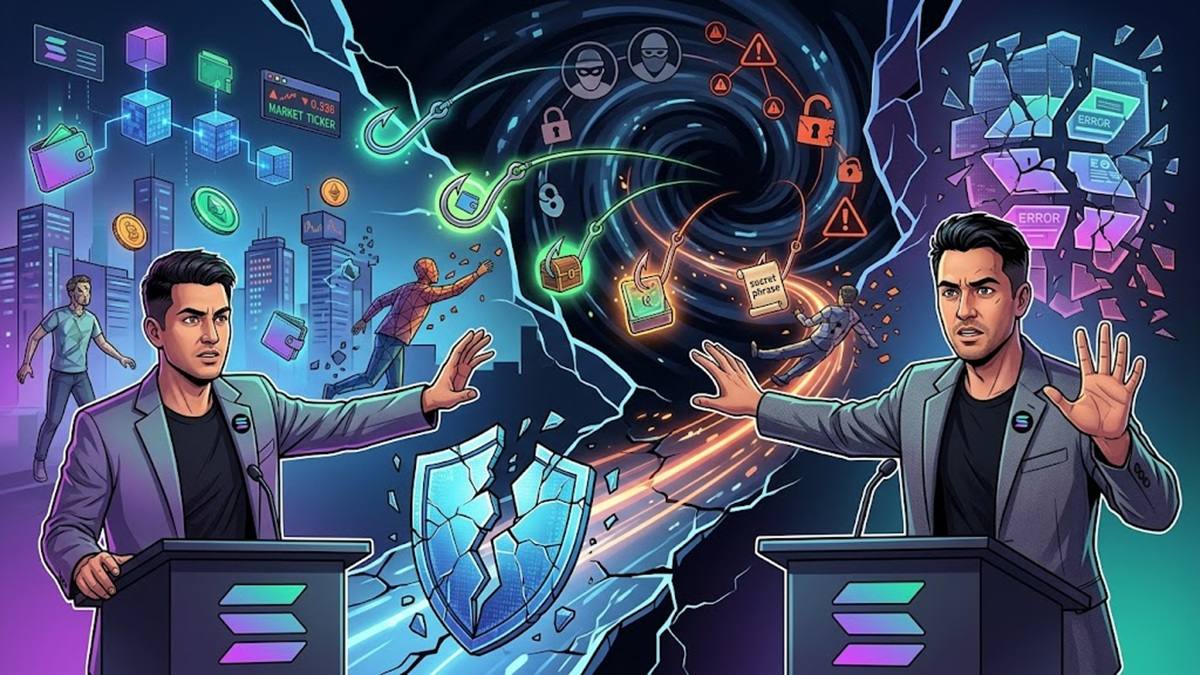
Solana co-founder Anatoly Yakovenko identifies phishing and social engineering as the biggest security threats facing cryptocurrency users.
Yakovenko recommends combining a dedicated iPhone with Apple’s Lockdown Mode and a multisignature wallet to strengthen personal protection.
Chainalysis recorded $713 million in personal wallet theft during 2025 , with Solana accounting for approximately 26,500 victims.
Solana co-founder Anatoly Yakovenko has warned that phishing represents one of the most serious security challenges facing the cryptocurrency industry . Rather than focusing exclusively on artificial intelligence or quantum computing, he believes attackers are more likely to exploit human behavior to gain access to digital assets .
In a recent post on X, Yakovenko argued that social engineering remains a greater immediate danger than technological attacks against cryptographic systems . His come as several security incidents have exposed weaknesses in exchange infrastructure and highlighted the importance of protecting individual wallet access.
Phishing and social engineering is the biggest threat to crypto. Not AI breaking math or quantum computers. Dedicated iOS in lockdown mode and @multisig is probably the best low cost and high roi setup anyone can have — toly 🇺🇸 (@toly) November 3, 2026
Phishing and social engineering is the biggest threat to crypto. Not AI breaking math or quantum computers.
Dedicated iOS in lockdown mode and @multisig is probably the best low cost and high roi setup anyone can have
— toly 🇺🇸 (@toly) November 3, 2026
Why Phishing Remains Solana’s Biggest Security Concern
Yakovenko recommended a relatively accessible security configuration consisting of a dedicated iOS device running Apple’s Lockdown Mode and a multisignature wallet . The approach aims to reduce exposure to malicious applications, suspicious links and unauthorized transaction approvals.
Apple’s Lockdown Mode is designed to protect users against sophisticated digital attacks by restricting certain applications, website technologies, message attachments and device functions . Although the feature was originally developed for people facing targeted spyware threats, its restrictions can also reduce opportunities for cryptocurrency-related phishing attacks.
A multisignature wallet adds another layer of protection by requiring multiple approvals before transactions can execute . For example, a two-of-three configuration requires authorization from at least two separate signing keys. This makes it harder for an attacker to drain funds after compromising a single device or credential.
Yakovenko’s recommendation reflects a broader shift in crypto security priorities. Protecting private keys remains essential, but preventing attackers from manipulating users into approving malicious transactions has become equally important.
Exchange Breaches Reveal How Attackers Exploit Human Behavior
Recent incidents illustrate the risks behind Yakovenko’s warning. Binance disclosed an attack involving fake recruitment interviews, compromised developer software and stolen credentials that eventually exposed parts of its wallet signing infrastructure.
According to the exchange , attackers manipulated an engineer into downloading a malicious development repository. The compromised environment helped them obtain credentials associated with wallet operations, demonstrating how an apparently legitimate professional interaction can become an entry point into critical systems .
Meanwhile, Chainalysis recorded $713 million in personal cryptocurrency wallet theft during 2025 , affecting at least 80,000 victims. Solana accounted for approximately 26,500 victims, the highest absolute number identified in its analysis.
Foundation Probes Data Leak After 23,000 Phishing Attempts Target Users
TL;DR: Over 23,000 malicious email attempts were recorded, with 19,057 messages delivered via Mailgun and 1,503 through Google Workspace. Residual database backups from its
Solana’s Yakovenko Challenges Alpenglow Design as Network Prepares to Remove Validator Votes
nder Anatoly Yakovenko stated that the development of Alpenglow could have been completed in half the time through a simpler modification to the voting program.
Trezor And BitBox Flag Phishing Attempts Following Suspected Third‑Party Compromises
TL;DR Trezor confirmed a breach at its email provider and warned a fraudulent message titled “Critical Security Alert: STM32 Entropy Vulnerability”. BitBox warned that
Binance Reveals Key Safety Tips Amid Phishing Surge
TL;DR Binance warned a surge in phishing attacks through fake text messages that simulate legitimate notifications. Fraudulent texts include shortened malicious links and pressure
North Korea’s Kimsuky Uses Local AI to Target Crypto and Financial Firms
TL;DR: Kimsuky, the North Korean hacker group, built and operated three local LLM environments using Ollama, GPT4All, and Msty to carry out attacks without exposing
Hardware Wallet Providers Flag Dangerous Phishing Campaign
TL;DR Phishing Surge: Scammers are exploiting the Coldcard flaw to target Hardware Wallet users with fake audits and malicious downloads. Exploit Fallout: Galaxy Research reports
The full story
This article is one source in a clustered incident — the cluster page carries the summary, timeline and every other outlet covering it.
