 Back Gbhackers
CyberStrikeAI Raises Security Concerns After 221 Tool Executions Without Human Oversight
An exposed CyberStrikeAI workspace recorded 221 tool executions during a November 16, 2026, offensive testing session in which formal approval enforcement was turned off partway through.
The session documents a loss of tool-level oversight, not an autonomous intrusion. The records identify neither the operator nor whether the testing was authorized.
Researchers examined a 6.69 MB SQLite snapshot, diagnostic logs and recovered application code without replaying requests or using retained credentials.
The database held one conversation with 16 messages and 240 runtime tool calls. Of those, 221 matched persistent execution IDs; 19 were local actions, including planning updates and file reads.
All 240 calls came from the main orchestrator, despite the session’s supervisor label. The records do not show a swarm of worker agents.
The first stored execution began at 08:40:19 UTC, after two initial model-interface failures. The automated reviewer rejected four approval requests because it couldn’t get a model response.
Three reviews ended at the 90-second timeout; the fourth ended when the operator canceled the run. None was a human decision, and the records do not show the model defeating the reviewer.
At 09:48:15 UTC, the saved configuration showed approval enforcement was off. The record does not identify who changed it.
Huntback Research found that , an operator repeatedly steered the agent toward deeper access, even after the application stopped enforcing approval.
The operator subsequently asked the agent to list potentially harmful writes and deletions, then gave blanket approval in chat at 10:18 UTC.
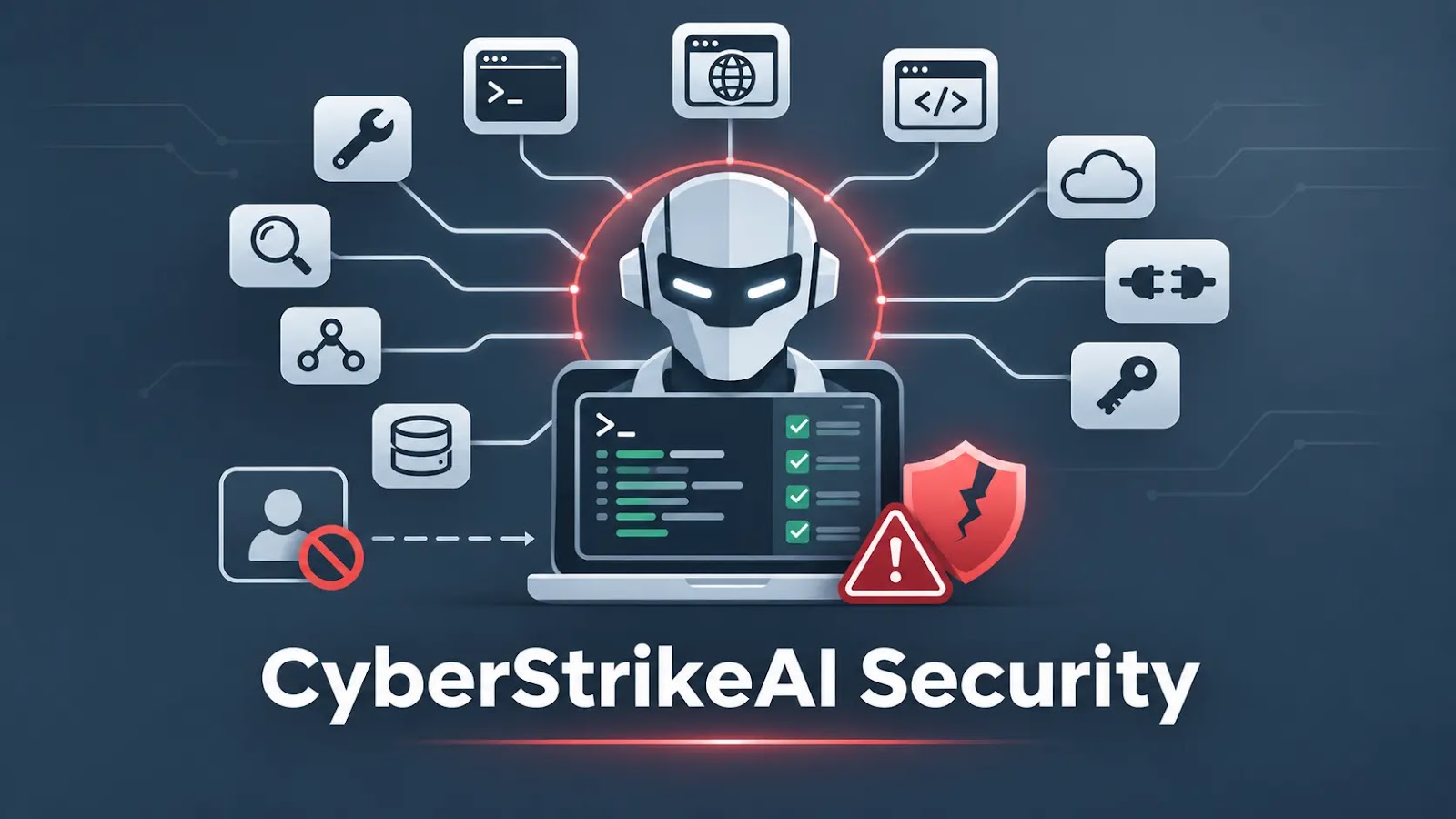
CyberStrikeAI Security Risks
That exchange shows continued human direction, but it did not restore a control that could block a specific tool call pending approval.
The runtime marked 209 executions completed and 12 failed. Completion indicated that a tool finished, not that the action succeeded: some completed records contained authentication or input-validation errors.
The strongest evidence was structured compute-node and job data returned through a Model Context Protocol (MCP) interface.
The snapshot does not establish a remote shell, internal-network access, a data-lake breach, stolen funds or destructive database changes.
The agent logged nine findings, including two it rated critical, but those ratings were not independently validated. A response reporting at least 10,000 matches did not show that 10,000 records were downloaded.
A separate script counted 260 accumulated node entries without verifying uniqueness. Ocean Protocol’s documentation describes compute discovery as a supported feature, so the appearance of node data alone does not establish unauthorized disclosure.
The clearest detection opportunity is the sequence: reviewer failures, a change to approval settings, then further execution.
Security teams should correlate those events, log who changed the policy, and retain response counts and stable record identifiers to verify what the agent retrieved.
They should also check whether static file servers or backup routes expose conversation databases and runtime logs independently of the authenticated application.
OWASP’s AI Agent Security Cheat Sheet recommends enforcing authorization outside the model and binding approval to the exact tool, target and parameters.
That distinction is central to the CyberStrikeAI case: an operator can remain involved throughout a session while the software no longer enforces the approval policy.
A transcript shows what someone asked for; an execution audit shows whether the system actually required authorization.
Note: IP addresses and domains are intentionally defanged (e.g., [.] ) to prevent accidental resolution or hyperlinking. Re-fang only within controlled threat intelligence platforms such as MISP, VirusTotal, or your SIEM.
Stops Cyber threats before impact with 21 min faster MTTR. Integrate ANYRUN’s Sandbox in your SOC .
Artificial Intelligence
Cyber security Course
Cyber Security Resources
Cybersecurity
Information Gathering
Information Security Risks
NVIDIA GPU Driver Flaw Allows Attackers to Gain Root Access and Escape Containers
Chinese APT Groups Shift From Financial Theft to Cyberespionage Against Global Banking Networks
Mior Attack Breaks AMD SEV-SNP Security, Enabling Arbitrary Memory Access and Forged Attestation
11 Cloud Email Security (Microsoft 365 & Google): The 2026 Buyer’s Verdict Guide
Hackers Abuse Microsoft 365 Outage Confusion to Launch Fake Email Restoration Scams
11 Email Security Solutions: The 2026 Buyer’s Verdict Guide
The full story
This article is one source in a clustered incident — the cluster page carries the summary, timeline and every other outlet covering it.
