 Back Link.Springer
Deepfake detection in the era of generative AI: a systematic review, research challenges ...
The detection and analysis of deepfakes and multimedia content have emerged as key areas of study in recent years, driven by the growing use of generative Artificial Intelligence (AI) systems to deceive people and manipulate multimedia content. Although progress has been considerable, poor generalization, limited dataset diversity, and susceptibility to novel attack methods remain significant limitations in today’s detection systems. This article presents a systematic review conducted using a novel analytical framework that encompasses and assesses all 16 recent research prototypes published between 2023 and 2025, classified into three layers: Fake Data Monitoring, Detection and Analysis, and Decision and Response. Our survey is organized through this analytical framework that allows system-level comparison of deepfake detection prototypes using a set of 15 criteria that we identified, including dataset source, training paradigm, monitoring technique, selectivity and relevancy of data, filtering techniques, modality, deepfake type, representations, model architecture, metrics, performance, generalizability, explainability, and response. The review also discusses various open research challenges and trends, including multimodal analysis, self-supervised learning, and cross-domain generalizability, that research communities and authors will address in the years to come. This review can serve as a reference for various research teams seeking to present AI-based trustworthy systems and methodologies that address multiple aspects of deepfake multimedia content.
Authors and Affiliations
Department of Computer Science, College of Computer Science and Engineering, Taibah University, Janadah Bin Umayyah Road, Madinah, 42353, Saudi Arabia Hanadi S. Alharbi, Ayman Noor & Talal H. Noor
Department of Computer Science, College of Computer Science and Engineering, Taibah University, Janadah Bin Umayyah Road, Madinah, 42353, Saudi Arabia
Hanadi S. Alharbi, Ayman Noor & Talal H. Noor
Department of Artificial Intelligence and Data Science, College of Computer Science and Engineering, Taibah University, Janadah Bin Umayyah Road, Madinah, 42353, Saudi Arabia Ghada Alharbi
Department of Artificial Intelligence and Data Science, College of Computer Science and Engineering, Taibah University, Janadah Bin Umayyah Road, Madinah, 42353, Saudi Arabia
Hanadi S. Alharbi View author publications author on: PubMed Google Scholar
author on: PubMed Google Scholar
Ayman Noor View author publications author on: PubMed Google Scholar
author on: PubMed Google Scholar
Ghada Alharbi View author publications author on: PubMed Google Scholar
author on: PubMed Google Scholar
Talal H. Noor View author publications author on: PubMed Google Scholar
author on: PubMed Google Scholar
Correspondence to Talal H. Noor .
The authors declare no competing interests.
Additional information
Springer Nature remains neutral with regard to jurisdictional claims in published maps and institutional affiliations.
Appendix A Background on deepfake technology
The emergence and rapid development of synthetic media, such as deepfakes, created and manipulated with advanced Artificial Intelligence (AI) and Deep Learning (DL) algorithms, have significantly affected and challenged the authenticity and integrity of digital multimedia content across various industries, including entertainment, politics, and cybersecurity (Amerini et al. 2025). This section provides background and context for deepfake forensics.
1.1 A.1 What is a deepfake
A deepfake is AI-created synthetic material that can impersonate, or fake, real pictures, audio, and videos so accurately that it approaches realism. The key difference between traditional media fakes and deepfakes is that deepfakes are AI-generated and AI-manipulated, and they closely resemble authentic material (Khanjani et al. 2023). Deepfakes employ DL algorithms to produce convincing, fabricated material of individuals that appears nearly realistic. The rise of such technology has introduced what can be called Impostor Bias, in which people find it difficult to trust multimedia materials because they recognize AI’s ability to fake them (Amerini et al. 2025). Deepfake and other generative AI techniques can operate across multiple modalities of media content. Image-domain examples of synthetic media include face swaps or face replacement, facial reenactment or attribute editing, and generation of completely synthetic faces. Video deepfakes may involve any of these image-domain manipulations over time. Video deepfakes can also include face replacement, facial reenactment, identity swap, and lip-syncing. Audio manipulation includes synthetic speech generation or voice-cloning that mimics or reproduces a target speaker’s voice and can be used to make the target person appear to say things they never actually said. Text manipulation may involve generative text or text that mimics the writing style of another person or organization to create fake stories. Cross-modal or multi-modal deepfakes can combine different types of deepfakes, such as synthesized or manipulated speech paired with fake or manipulated facial gestures in a video. These examples show how synthetic-content manipulation can extend beyond face-based image or video deepfakes to include single or multiple image, video, audio, or text modalities.
1.2 A.2 Generation methods
Deepfake generation is primarily driven by deep neural networks, with three key architectures forming the backbone of modern synthesis systems: Generative Adversarial Networks (GANs), Diffusion Models (DMs), and Autoencoders. Each offers unique mechanisms for creating realistic, high-fidelity synthetic media.
1.2.1 A.2.1 Generative adversarial networks
Generative Adversarial Networks (GANs) are among the most significant and influential deep generative models for creating photorealistic fake faces. GANs entail an adversarial relationship between two neural networks: the generator, which generates counterfeit instances, and the discriminator, which classifies instances as authentic or fake. The generator learns and improves by competing with the discriminator and, over time, creates convincing photorealistic faces. Modern GAN architectures, including StyleGAN and CycleGAN, remain at the root of all deepfake technology (Sharma et al. 2024).
1.2.2 A.2.2 Diffusion models
Diffusion Models (DMs) are emerging alternatives to GANs and have demonstrated success in producing high-resolution synthetic media. Diffusion Models, also known as Denoising Diffusion Probabilistic Models (DDPMs), learn to deliver high-quality data by progressively removing noise. Also, DMs commonly use the U-Net architecture to progressively refine noise. The recent development of Latent Diffusion Models (LDMs) has led to more compact and efficient modeling, allowing high-resolution image synthesis with relatively fewer computations (Av et al. 2024).
1.2.3 A.2.3 Autoencoders
Autoencoders are yet another key component of deepfake generators, particularly for face swapping. By definition, an autoencoder has two components. One condenses input signals into another medium, and the other decodes the outputs from those signals. When performing face swaps, two of these modules are trained independently, each with a single face. Swapping occurs when one face’s encoder is paired with another’s decoder. Because the encoding and decoding models maintain identity and replication, respectively, the resulting face has the expressions and motion of one face and the identity of the other. Modern face-swapping software can accomplish this with pinpoint accuracy. Programs like DeepFaceLab, FaceSwap, and FakeApp all use this concept (Masood et al. 2022).
1.2.4 A.2.4 Deepfake crimes
The growing availability and realism enabled by generative AI expand the potential abuse of deepfake technology to include fraud, impersonation, deception, harassment, and other malicious activities. Deepfakes can target or mimic an individual’s voice, behavior, or appearance. Individuals with malicious intent can leverage these technologies to create synthetic content that could either be directly attributed to someone else (e.g., impersonating an identity to defraud others), used to mislead or generate fabricated content (e.g., misinformation and disinformation), create non-consensual synthetic intimate media, harm someone’s reputation, or be used as a means for cyber-enabled social engineering. Additionally, once media can be generated or manipulated to look realistic, it presents unique challenges for digital forensics if such content is used as evidence of an action or event. These threats span many different media types and can involve one or more modalities such as images, audio, video, and text-based generative content. Table 6 highlights broad categories of deepfake-related crime and malicious activity with examples of each, affected modalities, and impact.
1.3 A.3 Ethical and social impact
The potential misuse of deepfakes is creating significant ethical and security concerns. Misuse of deepfake technology threatens politics, discourse, and privacy (Sunkari and Nagesh 2024; Westerlund 2019). At the social level, this technology affects multiple dimensions, from misinformation to mental well-being and accountability (Mirsky and Lee 2021).
Political and Social Manipulation: Deepfakes are already used to spread misinformation and fake news, disrupting democratic systems and diminishing confidence in news organizations (Sunkari and Nagesh 2024; Westerlund 2019). Examples include high-profile AI-generated videos featuring politicians and celebrities that can easily influence political discourse and public perceptions (Masood et al. 2022).
Political and Social Manipulation: Deepfakes are already used to spread misinformation and fake news, disrupting democratic systems and diminishing confidence in news organizations (Sunkari and Nagesh 2024; Westerlund 2019). Examples include high-profile AI-generated videos featuring politicians and celebrities that can easily influence political discourse and public perceptions (Masood et al. 2022).
Personal Privacy and Psychological Harm: The abusive use of synthetic media in identity theft, bullying, and financial internet fraud has proliferated, with deepfakes’ voice cloning and facial impersonation capabilities fueling massive-scale social engineering assaults. The recipients suffer reputational and psychological damage when their likenesses are used in sensitive or defamatory materials without their consent. Sunkari and Nagesh (2024).
Personal Privacy and Psychological Harm: The abusive use of synthetic media in identity theft, bullying, and financial internet fraud has proliferated, with deepfakes’ voice cloning and facial impersonation capabilities fueling massive-scale social engineering assaults. The recipients suffer reputational and psychological damage when their likenesses are used in sensitive or defamatory materials without their consent. Sunkari and Nagesh (2024).
Erosion of Digital Trust: The increased use of realistic AI-generated materials has created what is referred to as the liar’s dividend , meaning individuals take advantage of others’ belief in deepfakes and treat real information as if it were fake. This has created long-term problems across digital forensics, journalism, and policymaking (Amerini et al. 2025).
Erosion of Digital Trust: The increased use of realistic AI-generated materials has created what is referred to as the liar’s dividend , meaning individuals take advantage of others’ belief in deepfakes and treat real information as if it were fake. This has created long-term problems across digital forensics, journalism, and policymaking (Amerini et al. 2025).
1.4 A.4 Classification of detection approaches
Deepfake detection approaches are categorized by their target media modality, images, videos, audio, or multimodal systems, since forensic traces differ across these data types (Amerini et al. 2025).
1.4.1 A.4.1 Image-based detection
Image-based deepfake detectors rely on detecting fake images through inconsistency maps left behind as artifacts from the synthesis process (Alanazi et al. 2023). Common generator artifacts include unnatural grid-like pixel configurations, texture artifacts, boundary-blending failures, and unrealistic lighting, which can be traced to issues during generation (Alanazi et al. 2023). Techniques such as Convolutional Neural Networks (CNNs) are still widely used and effective, as networks such as XceptionNet (Amerini et al. 2025) and EfficientNet (Tan and Le 2019) are trained to learn spatial hierarchies and rich small-patch information that is commonly lost in facial regions. Under closed-set conditions, detectors trained on datasets like FaceForensics++ (FF++) generalize well to unseen but similar distributions of face-swapping (Rossler et al. 2019).
However, real-world performance typically decreases because compression, resizing, and image filtering applied before upload remove the high-frequency information that serves as forensic signals. These processes remove the high-frequency information that acts as forensic signals (Wang et al. 2020). Newer methods leverage the frequency domain using Fourier transforms to extract frequency artifacts that do not compress as well (Durall et al. 2020). Frequency and spatial networks have also been combined using hybrid multi-branch networks (Patel et al. 2023), along with using deepfake detection models that extract deep features at multiple scales (Passos et al. 2024). While effective in theory, these features generalize poorly to cross-dataset samples. To solve this, many models use domain adaptation to bridge distributional gaps or employ adversarial training.
1.4.2 A.4.2 Video-based detection
Video-based deepfake detection methods exploit spatial and temporal information across multiple frames (Yu et al. 2021; Edwards et al. 2024). Manipulations can often be detected by observing flickering artifacts, repeated faces with conflicting facial expressions, or abnormal transitions between consecutive frames (Masood et al. 2022). Sabir et al. (2019) used a Convolutional Neural Network and Long Short-Term Memory (CNN-LSTM) framework that extracts features from individual frames, then models temporal dynamics with LSTM layers for video-based deepfake detection. Other models rely on 3D CNNs that can directly learn spatiotemporal representations from a stack of consecutive video frames. Recently, approaches have explored using Transformers for video deepfake detection. TimeSformer-based methods (Bertasius et al. 2021), for example, leverage self-attention mechanisms to model long-range temporal dependencies between frames.
1.4.3 A.4.3 Audio-based detection
Audio-based detection methods target detecting fake speech created from Text-to-Speech (TTS) or Voice Conversion (VC) algorithms (Yi et al. 2023; Khanjani et al. 2023). These algorithms leverage abnormal distributions in audio cues, such as pitch, tone, and temporal changes, to determine whether an audio clip is fake. For instance, researchers have used datasets from the ASVspoof challenge series to train audio deepfake detectors, where a CNN classifier is trained on Mel-spectrogram inputs (Todisco et al. 2019). RawNet2 models are trained directly on raw audio waveforms to detect spoofing attacks (Tak et al. 2021).
Recent works have also introduced transformer-based models for audio deepfake detection. Anomaly-detection-based models train generative models such as GANs on real speech data and determine whether a test sample fits the distribution of real data (Song et al. 2024). Speech synthesis generated by deepfake algorithms has achieved high success in fooling automatic detectors, especially in noisy conditions and across speakers (Khan et al. 2025).
1.4.4 A.4.4 Multimodal detection
Multimodal deepfake detection models information from various modalities, including visual information, audio, and text, to detect deepfakes (Khan et al. 2025; Hashmi et al. 2024). By combining information from multiple sources, multimodal deepfake detection has shown promise for greater robustness. Attacks detected using multimodal methods include coordinated manipulations such as lip-syncing or different audio applied to the same video and deepfake media with obvious audiovisual artifacts. The FakeAVCeleb dataset allows users to evaluate multimodal deepfake detection systems as it provides synchronized audio-visual fake samples (Khalid et al. 2021). Models trained on FakeAVCeleb can detect deepfakes by ensuring consistency between lip movement and the speech signal.
Likewise, cross-modal attention models use Transformers to align audio and visual features for detection tasks. Other work has shown multimodal fusion approaches that leverage CNN visual features and fuse them with audio embeddings (Afchar et al. 2018). Researchers have also used approaches that synchronize audio and visual features to develop audiovisual spoofing countermeasures. These methods attempt to detect whether facial expressions are synced with speech, which is challenging for deepfake generators to mimic accurately (Chung and Zisserman 2016). Multimodal deepfake detection shows promise but faces challenges in synchronization, data availability, and scalability.
1.5 A.5 Learning paradigms in detection
Detecting deepfakes requires state-of-the-art paradigms that can capture manipulation cues in complex and subtle ways. Each paradigm shapes how a model learns to detect fakes and can affect performance, generalization, and its ability to learn new, unseen synthetic distributions.
1.5.1 A.5.1 Supervised learning
Currently, supervised DL approaches represent the mainstream technique for deepfake detection. They learn discriminative patterns using labeled datasets containing real and fake samples to train CNN and transformer-based architectures (Amerini et al. 2025). Convolutional-based architectures such as the Extreme Inception Neural Network (XceptionNet), the Residual Network (ResNet), and the Visual Geometry Group (VGG) Face hierarchically extract spatial features from images. Vision Transformers (ViTs) encode long-range global dependencies using an attention mechanism (Yu et al. 2021). While several supervised DL models achieve higher accuracy, they generalize poorly to unseen manipulation datasets.
1.5.2 A.5.2 Self-supervised learning
Self-Supervised Learning (SSL) can reduce reliance on large annotated image datasets by leveraging auxiliary tasks to automatically train models to learn discriminative features in unlabeled images. In deepfake detection, SSL ViTs such as DINO and Masked Autoencoders (MAEs) can automatically identify features within their representations to detect subtle manipulations in facial images. Recent work shows that SSL ViTs are more generalizable and better at feature extraction than supervised ViTs when annotated data is limited (Nguyen et al. 2024).
1.5.3 A.5.3 Unsupervised learning
Unsupervised deepfake detection models aim to identify deepfakes without requiring labeled training data. Unlike other deepfake detection models, unsupervised deepfake detection does not use annotated data to train; instead, it relies on inconsistencies within its own data. One new approach to unsupervised deepfake detection is to use so-called camera-specific fingerprints, including Photo-Response Non-Uniformity (PRNU) and noise prints, to determine whether images are original or deepfakes. This is because the original videos contain sensor PRNU, whereas deepfakes contain computer-generated pixels that are sensor-PRNU-free in regions where faces are replaced. This new unsupervised deepfake detection approach uses video clustering with PRNUs to identify deepfakes, achieving detection accuracy comparable to that of other deepfake detection models using DL (Zhang et al. 2023).
1.5.4 A.5.4 Contrastive Learning
Contrastive Learning (CL) demonstrated substantial success in self-supervised learning tasks, including object tracking and image classification. The general setup employs two sub-networks with shared weights, forming a Siamese network, in which the model learns abstract similarity within the same category and dissimilarity across different categories by generating different views of the same input as positive and negative pairs. Models trained in this framework tend to capture the overall data distribution in the feature space rather than focus on fine-grained distinctions between individual instances, thereby enhancing generalization. In fact, the presence of a Siamese structure alone may be a key factor behind its effectiveness across various tasks, as it inherently introduces biases that promote learning similarity (Dong et al. 2023).
1.5.5 A.5.5 Few-shot and zero-shot learning
Few-Shot Learning (FSL) and Zero-Shot Learning (ZSL) have also been proposed to address the lack of generalization in deepfake detection models when tested on novel deepfake methods (Korshunov and Marcel 2022; Liu et al. 2024). Zero-Shot Deepfake Detection (ZSDD) aims to detect deepfaked images and video frames when the network has never been trained on any labeled deepfake images or video frames (Sar et al. 2025). FSL enables rapid adaptation to novel deepfaked images and video frames with only a few training images, and meta-learning-based methods facilitate this adaptation and significantly improve FSL performance (Liu et al. 2024).
1.5.6 A.5.6 Generative-based detection
GANs are used for content creation and deepfake detection. GAN-based deepfake detection techniques leverage the discriminator’s ability to identify discrepancies between deepfake and real data. Various GAN-based models have emerged for this purpose, such as the Steganography GAN, which uses encrypted watermarks to achieve effective detection, and the MRI-GAN, which distinguishes deepfake images from real images based on MRI-like outputs. Another prominent Generative Adversarial Network (GAN)-based model is Model-Driven Development (MDD)-GAN, a meta-learning approach that improves model adaptability and enables it to detect new deepfake domains (Asan et al. 2023).
1.6 A.6 Deepfake detection pipeline
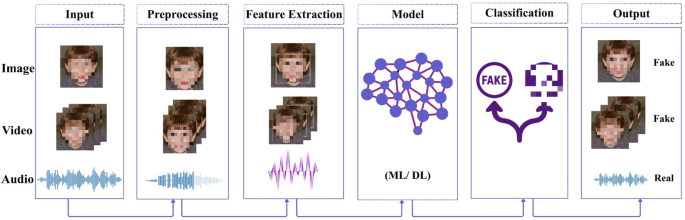
Deepfake detection relies on analyzing features extracted at various stages of the processing pipeline, including preprocessing, feature extraction, modeling, and classification. Figure 7 illustrates the general pipeline of a typical deepfake detection system across different modalities, including image, video, and audio.
The first step in a deepfake detection pipeline is input, which can be an image. video, or audio. During preprocessing, operations such as normalization, face alignment, and noise removal can be applied. Features are extracted that represent important artifacts that could signal whether media is fake or real, such as facial textures, edge artifacts, abnormal frequencies, etc.
Classification ML models for media forensics tasks use two methodologies, including ML and DL. The former uses handcrafted feature extractors and classifiers to identify artifacts or abnormalities in manipulated media. In contrast, DL methods like Convolutional Neural Networks (CNNs), vision transformers (ViTs), and Transformer-based variants automatically learn hierarchical representations from data. CNNs learn to capture local spatial inconsistencies via convolutional filters. ViTs split the image into patches and use self-attention mechanisms to capture long-range dependencies across the entire image. Transformer-based methods leverage both CNNs and ViTs, enabling better generalization to novel manipulations and greater versatility in the forensic model.
At the classification stage, learned representations classify inputs as real or fake. In the output stage, the model usually outputs either a binary label (i.e., FAKE or REAL) or a confidence score. This design lets the pipeline integrate flexibly across modalities and detection techniques.
Appendix B Abbreviations used in the analytical tables
The abbreviations used in Tables 3, 4, and 5 are summarized in Table 7 .
Appendix C Emerging trends in deepfake research
Croitoru et al. (2026) and Dehghani and Saberi (2025) emphasize that creating hyper-real content across various modalities, such as facial expression, voice intonation, and emotional context, has become possible because of recent models such as diffusion models, 3D-aware GANs, and style-based generators such as StyleGAN3 and DreamFusion, where attention-based networks improve the latent space representations, achieving high realism and controllability, in turn, posing new challenges for deepfake detection techniques.
Wang et al. (2024b), Redhaei et al. (2025), and Lin et al. (2024) further note that, in detection, the spotlight has gradually shifted from manual forensic analysis to AI-based and multimodal methods. ViT and BEiT models have shown considerable potential for detecting subtle spatiotemporal artifacts while maintaining fairness and generalizability across diverse datasets. In this vein, Pontorno et al. (2025) and other recent works have proposed models that incorporate contrastive and self-supervised learning to better capture cross-modal correlations. Further, Oorloff et al. (2024); Raza and Malik (2023) have proposed hybrid models that incorporate joint audio-visual perspectives and temporal consistency validation methods, such as AVFF and Multimodal Trace, which performed well on the FF++ and DFDC benchmark sets.
work has established the need for Explainable AI (XAI), showing that interpretable models can also visualize decision boundaries, thereby enforcing interpretability and transparency in their systems. Some works on large multimodal systems, such as SIDA Huang et al. (2025), have identified a similar need for interpretability, along with explainable localization and social context awareness, in detection methods.
Montibeller et al. (2025), Chandra et al. (2024), and Oza et al. (2024) show that researchers now focus on understanding models’ behavior on social media and in the wild rather than on benchmark datasets. For this example, we added compression artifacts and noise during testing to assess detection reliability on distributed multimedia. In this context, it shows that research has gone from high accuracy on lab datasets to understanding field-level model robustness and applicability.
In summary, recent literature Khan et al. (2025) shows improvements in DL-enabled detection systems. Future directions of research include making detection methods more robust to distributional shifts, applying Blockchain Distributed Ledger Technology (BDLT) to record content origin and other metadata to establish content provenance, and applying XAI to detection systems to improve human understanding of generated results.
1.1 C.1 Real-world applications of deepfake detection systems
Application domains include, but are not limited to, the following areas that have implemented deepfake detection systems. We list some of these areas below to highlight the importance of researching deepfakes beyond surface-level or academic environments. As generative models have advanced exponentially over the past few years, concern has grown the malicious use of media manipulation technology. Researching deepfake detection is critical to creating a safe, trustworthy, and legitimate media environment. Examples of application domains include:
Social Media and Content Moderation : Many content moderation pipelines used by social media companies include deepfake detection systems to flag manipulated media (Westerlund 2019; Tolosana et al. 2020). Social media platforms such as and Twitter have implemented AI pipelines that analyze uploaded videos and images. This detection can occur in real time before the media goes viral. Social media platforms also use automated labeling systems to denote media flagged by deep learning models. This can take the form of a “this media has been manipulated” label or even sending the media to moderation teams for further analysis. Systems like these are critical to preventing videos that target elections or times of crisis.
Social Media and Content Moderation : Many content moderation pipelines used by social media companies include deepfake detection systems to flag manipulated media (Westerlund 2019; Tolosana et al. 2020). Social media platforms such as and Twitter have implemented AI pipelines that analyze uploaded videos and images. This detection can occur in real time before the media goes viral. Social media platforms also use automated labeling systems to denote media flagged by deep learning models. This can take the form of a “this media has been manipulated” label or even sending the media to moderation teams for further analysis. Systems like these are critical to preventing videos that target elections or times of crisis.
Digital Forensics : Deepfakes have significant implications for forensics, where media authenticity can determine the outcome of legal cases (Verdoliva 2020). For example, deepfake detection solutions can verify videos used as evidence in a criminal trial. Law enforcement and security teams can also use deepfakes as part of their arsenal to validate media. For example, many high-profile cases use forensic tools to detect deepfakes by finding artifacts such as misaligned faces or head movements, inconsistent lighting, and even compression artifacts in AI-generated media.
Digital Forensics : Deepfakes have significant implications for forensics, where media authenticity can determine the outcome of legal cases (Verdoliva 2020). For example, deepfake detection solutions can verify videos used as evidence in a criminal trial. Law enforcement and security teams can also use deepfakes as part of their arsenal to validate media. For example, many high-profile cases use forensic tools to detect deepfakes by finding artifacts such as misaligned faces or head movements, inconsistent lighting, and even compression artifacts in AI-generated media.
Cybersecurity and Fraud Prevention : Deepfakes are often used in phishing and identity attacks. With the rise of voice deepfakes and visual impersonation attacks, criminals have leveraged AI-generated media to bypass security (Mirsky and Lee 2021). For example, CEOs of financial institutions have been impersonated over the phone via voice deepfakes to authorize transfers of millions of dollars. Deepfake detection models can be used in conjunction with security pipelines to analyze voices, images, and other behavioral biometrics in realtime. For instance, many enterprises can implement detection solutions that block transactions or raise alerts when deepfake activity is detected.
Cybersecurity and Fraud Prevention : Deepfakes are often used in phishing and identity attacks. With the rise of voice deepfakes and visual impersonation attacks, criminals have leveraged AI-generated media to bypass security (Mirsky and Lee 2021). For example, CEOs of financial institutions have been impersonated over the phone via voice deepfakes to authorize transfers of millions of dollars. Deepfake detection models can be used in conjunction with security pipelines to analyze voices, images, and other behavioral biometrics in realtime. For instance, many enterprises can implement detection solutions that block transactions or raise alerts when deepfake activity is detected.
Biometric Authentication : Face recognition and identity verification systems often embed deepfake detection into their pipelines (e.g., anti-spoofing and liveness checks). Mobile authentication providers, for example, and border control agencies use similar technologies to prevent face reenactment attacks and the cloning of another person’s identity (Raghavendra et al. 2020). Deepfake detection combats a variety of spoofing attacks, such as replay attacks and face reenactment, where the facial movements of a source video are transferred to a target identity.
Biometric Authentication : Face recognition and identity verification systems often embed deepfake detection into their pipelines (e.g., anti-spoofing and liveness checks). Mobile authentication providers, for example, and border control agencies use similar technologies to prevent face reenactment attacks and the cloning of another person’s identity (Raghavendra et al. 2020). Deepfake detection combats a variety of spoofing attacks, such as replay attacks and face reenactment, where the facial movements of a source video are transferred to a target identity.
Media Integrity and Journalism : Deepfake detection can empower fact-checkers and journalists to verify media. Media organizations have begun implementing media analysis systems to automatically vet user-submitted content (Vaccari and Chadwick 2020). Breaking news is one example where detection tools can help first responders verify media authenticity. Fact-checking organizations have also begun using deepfake detection to analyze disinformation campaigns targeting political figures and global events.
Media Integrity and Journalism : Deepfake detection can empower fact-checkers and journalists to verify media. Media organizations have begun implementing media analysis systems to automatically vet user-submitted content (Vaccari and Chadwick 2020). Breaking news is one example where detection tools can help first responders verify media authenticity. Fact-checking organizations have also begun using deepfake detection to analyze disinformation campaigns targeting political figures and global events.
The applications discussed above also highlight that detection models must be coupled with decision-making and response processes (i.e., as shown in the Decision and Response layer in our analytical framework). Specifically, automated alerting, content moderation operations, and human-in-the-loop flag verification require tight coupling between the Detection layer and Response layer. With this integration in place, deepfake detection models can be used at scale for real-world, large-stakes, and high-risk operations.
Rights and permissions
Open Access This article is licensed under a Creative Commons Attribution-NonCommercial-NoDerivatives 4.0 International License, which permits any non-commercial use, sharing, distribution and reproduction in any medium or format, as long as you give appropriate credit to the original author(s) and the source, provide a link to the Creative Commons licence, and indicate if you modified the licensed material. You do not have permission under this licence to adapted material derived from this article or parts of it. The images or other third party material in this article are included in the article’s Creative Commons licence, unless indicated otherwise in a credit line to the material. If material is not included in the article’s Creative Commons licence and your intended use is not permitted by statutory regulation or exceeds the permitted use, you will need to obtain permission directly from the copyright holder. To view a copy of this licence, visit .
Reprints and permissions
Alharbi, H.S., Noor, A., Alharbi, G. et al. Deepfake detection in the era of generative AI: a systematic review, research challenges, and future direction. Artif Intell Rev (2026).
Received : 03 January 2026
Received : 03 January 2026
Accepted : 05 November 2026
Accepted : 05 November 2026
Published : 24 November 2026
Published : 24 November 2026
DOI :
DOI :
Generative Artificial Intelligence
Audio-visual analysis
Explainable Artificial Intelligence (XAI)
Ayman Noor View author profile
Ghada Alharbi View author profile
The full story
This article is one source in a clustered incident — the cluster page carries the summary, timeline and every other outlet covering it.
