 Back Gbhackers
Hackers Use Malicious DLL and Fake PDF Files to Deliver PureLogs and PureRAT Payloads
A shipment-themed ZIP archive is delivering a multistage malware chain that combines DLL side-loading, disguised utilities, and encrypted Python code to deploy payloads associated with PureLogs and PureRAT infrastructure.
Unit 42 observed the activity on October 21, 2026, according to research notes dated November 16 and credited to Shazan Khaja and Muhammet Algan.
Originally named wpspdf.exe , the application is renamed Shipment_Condition_And_Check_mp4.exe to match the shipment lure.
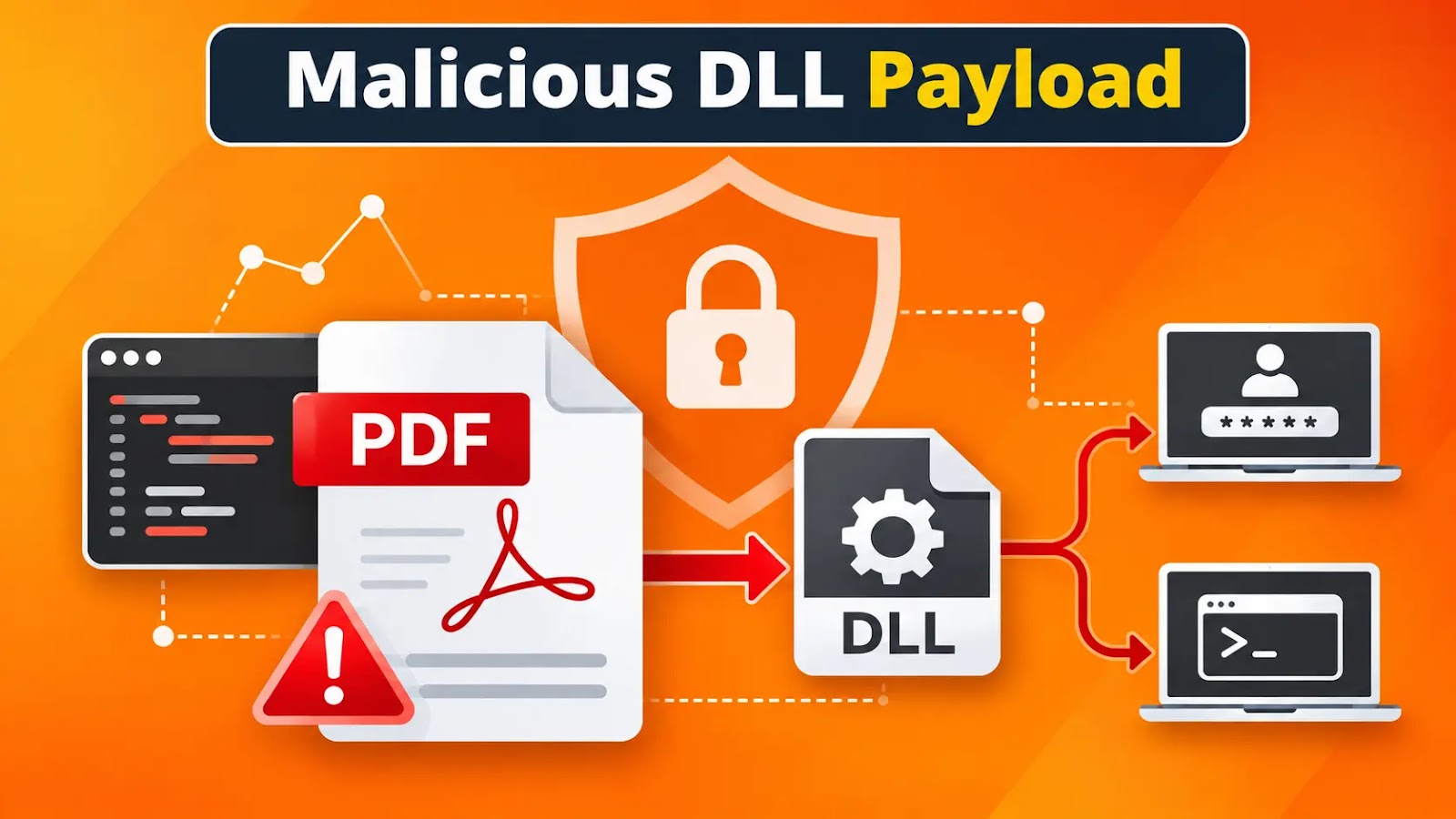
Launching the renamed executable causes it to load krpt.dll from its own directory. This is DLL side-loading : attackers abuse a legitimate application’s library-loading behavior to execute malicious code.
Unit 42 has previously documented comparable abuse of trusted applications, including PDF readers, in its research on malicious DLL loading.
The executable remains a legitimate 32-bit application. Its valid signature and file hash therefore do not independently establish malicious activity; the adjacent DLL and subsequent execution chain provide the context.
Telemetry shows Windows Explorer writing krpt.dll at 03:02:53 UTC, consistent with archive extraction. The executable started at 03:03:06, loaded the DLL approximately one second later, and initiated archive extraction by 03:03:09.
The malicious DLL continues execution through a 32-bit cmd.exe . The command changes into an x subdirectory and opens document.pdf , giving the victim a normal-looking document while background activity proceeds.
Another file, QK_참외_냉장고재고현황_2019.png , is not an image. It is a signed WinRAR command-line executable disguised with a PNG extension.
The utility extracts the password-protected archive OP_2023년_치킨뼈분석표_그냥요.dat into C:\Users\Public .
The extracted package contains a Python runtime inside a MicrosoftEdgeUpdate subfolder. Its interpreter, renamed MicrosoftEdgeUpdate.exe , impersonates Microsoft’s browser updater rather than representing a genuine Microsoft component.
Unit42 observed that , the attack begins when a user downloads and extracts Shipment_Condition_And_Check_mp4.zip . Inside nested folders, attackers place a legitimate, digitally signed Kingsoft PDF executable beside a malicious krpt.dll .
The interpreter executes a Python -c command that reads QK_2021년_치킨배달대기시간_됩니까.pdf as raw bytes.
Despite its extension, this file contains encoded Python code, not a readable PDF.
Malicious DLL Payload
The command XOR-decodes those bytes using the repeating 20-byte key d9301f099d9dd27cc9a1c190e40719cfaff77f65 , then passes the decoded result to exec() .
This second-stage script uses randomized identifiers and arithmetic expressions involving XOR, shifts, and additions to obscure constants.
It imports modules including base64 , winreg , ctypes , and subprocess , although imports alone do not establish which capabilities ultimately execute.
The script contains a large Base64 blob and the Base64-encoded key mq8/qZ7D/RkPOCbLyUUBs+wCuA== . Decoding the blob and applying repeating-key XOR produces a Windows PE payload beginning with the MZ header bytes 4D 5A 90 .
The decoded payload contacts tea.vexexo[.]com , resolving to 185.139.214[.]102 , with observed TLSv1 traffic over port 443.
Unit42 associates this infrastructure , with PureLogs and PureRAT campaigns; that association does not independently prove both malware families executed.
Defenders should prioritize the combined behavioral sequence: a signed executable running from Downloads, loading adjacent krpt.dll , spawning command execution, and unpacking Python into a public directory.
Particularly distinctive signals include MicrosoftEdgeUpdate.exe executing from C:\Users\Public , a .png utility accepting archive-password arguments, and Python decoding a supposed PDF before invoking exec() .
The unrelated Korean filenames provide additional hunting context but do not establish attacker nationality or targeting.
Correlating these events offers stronger detection than treating any single filename, signature, or extension as conclusive evidence of compromise alone.
Stops Cyber threats before impact with 21 min faster MTTR. Integrate ANYRUN’s Sandbox in your SOC .
Artificial Intelligence
Cyber security Course
Cyber Security Resources
Cybersecurity
Information Gathering
Information Security Risks
GitLab Patches 37 Security Vulnerabilities Affecting CI/CD Pipelines, GitLab Pages, and MCP Server
Hacker Behind Massive GTA 6 Leak Pleads Guilty to Breaching Rockstar Games
Mozilla Releases Firefox 160 Security Update Fixing 99 Vulnerabilities, Including Sandbox Escape Flaws
Apple Tightens macOS 27.3 Security to Stop Apps From Accessing Sensitive Files Without Explicit Permission
Old Bitly Links Hijacked to Redirect Users From McDonald’s, Burger King, and Government X Posts
Hackers Use SEO Poisoning to Infect 1,000 WordPress Sites With Gootloader Malware
The full story
This article is one source in a clustered incident — the cluster page carries the summary, timeline and every other outlet covering it.
