 Back News.Ycombinator
The oldest ice disappears and the Stone Age emerges from it
'We have been at the edge of the ice. We have seen it happening. And we are witnesses to a rapidly changing archaeological landscape,' write the glacial archaeologists. Finds from the Viking Age are becoming scarce, while 6,000-year-old arrowheads are now emerging from the melting ice.
For exactly 20 years, archaeologists working with Secrets of the Ice have been recovering and preserving artefacts emerging from the ice in the mountains of Innlandet, eastern Norway.
Until now, most of the objects have been up to 2,000 years old. Many date from the Viking Age.
But the ancient ice is now beginning to melt.
And within this oldest ice lie the oldest finds: large quantities of arrow shafts and arrowheads from the Bronze Age and the Stone Age.
Here comes the Stone Age
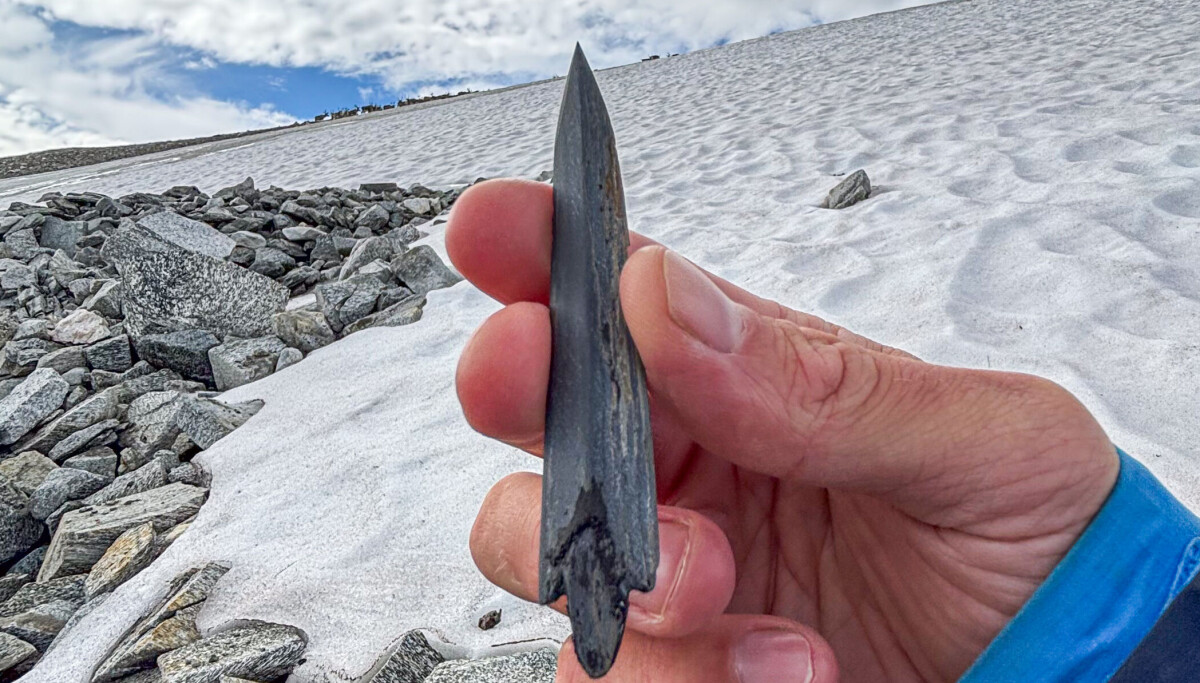
One of the oldest finds from this year's first field expedition is an arrow with an arrowhead and shaft made of slate.
The fact that arrows are emerging from the melting ice is not surprising. Over the 20 years they have been working here, the archaeologists have found extensive evidence of reindeer and reindeer hunting . They have also found clothing, shoes , dead packhorses, and a pair of skis .
The preservation conditions in the ice have meant that organic material, such as wood, leather, and textiles, have also survived.
“This year, we found 48 prehistoric arrows. That's a lot,” Espen Finstad, who leads Secrets of the Ice, tells Science Norway.
He explains that, with these latest discoveries, more than 100 arrowheads and arrow shafts have now been recovered from a single ice patch over the years.
The oldest arrowheads are made from slate, freshwater mussel shells, and bone. More recent arrowheads are made from iron and are 'only' between 1,000 and 1,500 years old.
But this year’s fieldwork carries an added sense of gravity.
Finstad explains that the work of recovering archaeological artefacts from the ice has always carried a certain duality.
“It’s fun going around looking for things. It’s exciting, and finding something is just really cool," he says.
Yet behind the excitement lies the reality of climate change. Finstad points to the recent landslide in Nepal and the glacier collapse in Jotunheimen.
“We have always acknowledged this contradiction and the reality behind our work. But this is the first time it has truly affected us on an emotional level,” Finstad says, adding:
“This year, there was a much deeper sense of seriousness and sadness. Only patches of ice remain where we once had large ice patches. It's brutal. And this year, that reality struck us more forcefully than ever before."
Finstad and his colleagues estimate that most of the ice patches containing archaeological artefacts will have disappeared within the 20 years.
“There has been ice here for 6,000–7,000 years. Nature has been warning us and sending signals for many years. But now it's giving up. Now it is simply going to melt,” says the glacial archaeologist.
'For thousands of years, ancient ice has safely preserved unique objects from the past. Now that ice is disappearing,' the archaeologists write in a press release the finds. 'We have been at the edge of the ice. We have seen it happening. And we are witnesses to a rapidly changing archaeological landscape.'
Se dette innlegget på Instagram Et innlegg delt av forskning.no (@forskning.no)
Et innlegg delt av forskning.no (@forskning.no)
Finstad and his colleagues are planning more fieldwork in the coming weeks, weather permitting.
So far, they have secured finds in the Kvittingskjølen mountain area of Jotunheimen, specifically at Langfonne, Storefonne, and Hanklefonne.
Several of the finds are already on display at the Norwegian Mountain Centre in Lom, just a few days after they were discovered.
Translated by Alette Bjordal Gjellesvik
Read the Norwegian version of this article on forskning.no
A 1,300-year-old arrow and horse dung have emerged from a melting Norwegian glacier
Melting ice near Norway's highest mountain reveals horse bridle that could stem from the Viking Age
The latest news from Science Norway, sent twice a week and completely free.
This is how whales nurse underwater
This is how whales nurse underwater
The oldest ice is disappearing: The Stone Age is emerging from the melting ice
The oldest ice is disappearing: The Stone Age is emerging from the melting ice
The Vikings’ ancestors may have raided the North Sea coasts as early as the 3rd century
The Vikings’ ancestors may have raided the North Sea coasts as early as the 3rd century
What would happen if the Earth stops rotating?
What would happen if the Earth stops rotating?
Why was there such a huge amount of down in the Oseberg Viking ship?
Why was there such a huge amount of down in the Oseberg Viking ship?
The full story
This article is one source in a clustered incident — the cluster page carries the summary, timeline and every other outlet covering it.
