 Globaltimes.Cn
China Achieves Record-Low Temperature in Space Experiment
Article Content

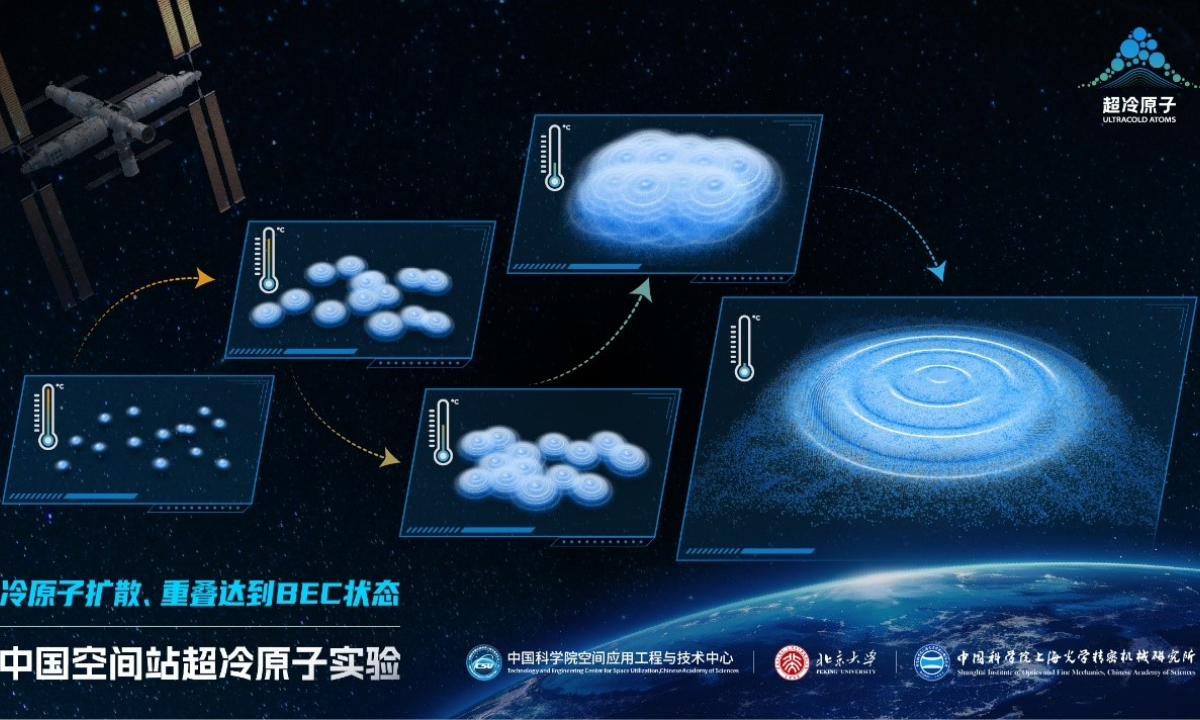
- •Chinese scientists cooled rubidium atoms to 9.7 picokelvins aboard the Tiangong space station.
- •The experiment utilized laser traps and microgravity to enhance cooling efficiency.
- •Findings will be published in Science, expanding quantum research possibilities.
Chinese scientists aboard the Tiangong space station have cooled rubidium atoms to 9.7 picokelvins, setting a new world record for the coldest man-made matter. This achievement, announced on November 6, 2026, allows researchers to explore quantum states of matter, specifically Bose-Einstein condensates. The experiment utilized laser-based traps to contain approximately 20,000 rubidium atoms in a microgravity environment, which enhances cooling effectiveness compared to Earth. Previous records included 38 picokelvins achieved in Germany and 52 picokelvins by NASA. The findings will be published in the journal Science, providing insights into fundamental physical laws and exotic states of matter. This breakthrough opens new avenues for quantum research and understanding the universe.
Ask AI about this cluster
Answers cite the sources they use
Timeline
More articles in this cluster (3)
Common questions
What temperature was achieved?
What is the significance of this experiment?
Where were the findings published?
Continue Reading
 Critical RCE Vulnerability in Prefab UI Disclosed A critical remote code execution vulnerability, CVE-2026-120338, was disclosed on November 1, 2026, affecting Prefab UI's Generative UI sandbox. The flaw allows attackers to execute arbitrary Python code by exploiting Deno's permissions, enabling file read/write access on the host server. This vulnerability affects…
 China-Linked Hackers Exploit PHP2Shell Vulnerabilities to Breach U.S. Government Systems On October 21, 2026, the PHP development team released patches for two critical vulnerabilities in PHP, known as PHP2Shell (CVE-2026-109618 and CVE-2026-109619), which allow unauthenticated remote code execution. These vulnerabilities were actively exploited by a suspected China-linked threat actor who compromised 25…