 thedfirreport.com
 BengalSEO Campaign Delivers Malware via SEO Poisoning
Article Content

- •BengalSEO has been active since 2015, using SEO poisoning to deliver malware.
- •The custom malware, MayaBot, facilitates command-and-control and system monitoring.
- •The operation is linked to two IT service providers in Rajasthan, India.
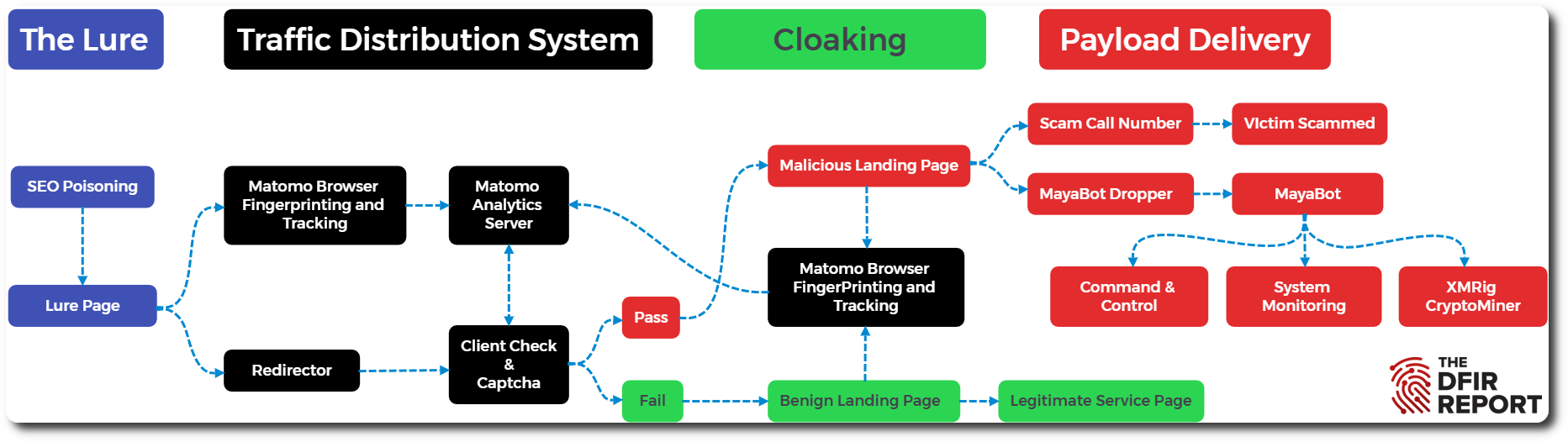
In March 2026, a significant SEO poisoning campaign named BengalSEO was identified, attributed to two IT service providers in Rajasthan, India. This operation has been active since at least 2015, utilizing Black Hat SEO techniques to create lure pages that redirect users to tech support scams and malware deployment. The malware, named MayaBot, enables command-and-control functions and has been used since 2022. The campaign affects users searching for legitimate tech support and software downloads, leading them to malicious sites. Evidence suggests that the operation is financially motivated and employs sophisticated traffic distribution systems to optimize its reach. The DFIR Report has linked the operation to WeConnect Solutions LLC and Garage2Global, both of which have been implicated in developing malicious web infrastructure. The campaign's impact is widespread, targeting unsuspecting victims through manipulated search results on Microsoft Bing.
Ask AI about this cluster
Answers cite the sources they use
Timeline
More articles in this cluster (3)
Following this threat?
Track AlphaAgent and Garage2Global in your own feed — you're alerted when they show up in new reporting, leak sites or exploitation.
Free account · no card needed
Continue Reading
 Critical BeyondTrust 9.3 Vulnerability Actively Exploited by Threat Actor A critical vulnerability (CVE-2026-102764) in BeyondTrust Remote Support has been discovered and is actively being exploited by the threat group ARMORY CASTLE, reportedly linked to China. The vulnerability, which has a CVSS score of 9.3, allows unauthenticated attackers to upload files and potentially compromise host…
  Lazarus APT Launches Operation FlashHole Using AI and Post-Quantum Cryptography Kaspersky has identified a cyberespionage campaign, dubbed Operation FlashHole, attributed to the Lazarus APT group, active since July 2025. The campaign has targeted at least three organizations in South Korea's construction, software, and wire-communication sectors. Attack methods include spear-phishing emails…