 Back Balkanweb
 BIRN: Censorship, AI and deepfake! The online war over the 'Flamingo Revolution'
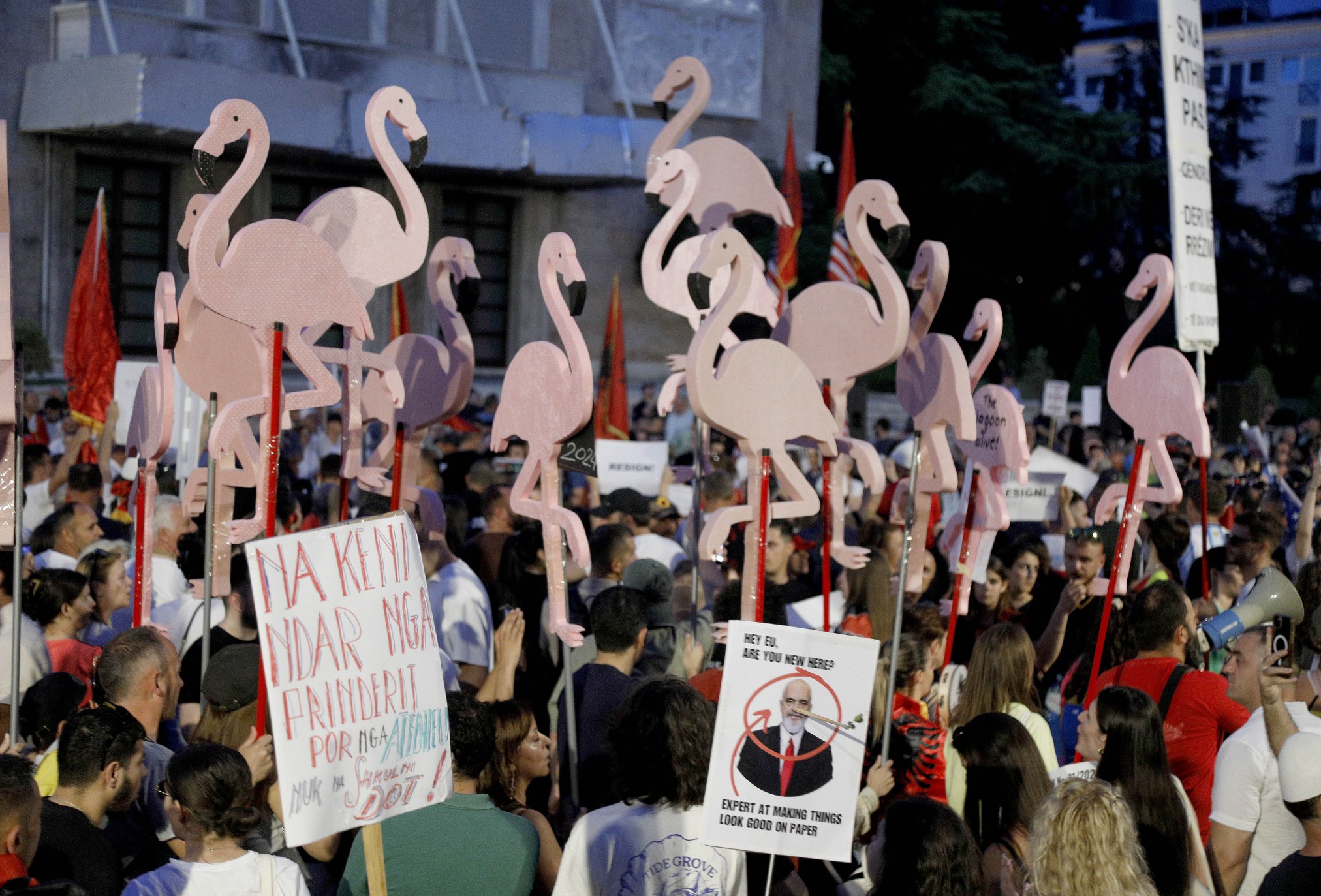
The protests known as the “Flamingo Revolution” shifted the battle from the streets to social media, where the voices of activists, journalists, and opposition representatives were attempted to be silenced through coordinated targeting methods.
The protests known as the “Flamingo Revolution” shifted the battle from the streets to social media, where the voices of activists, journalists, and opposition representatives were attempted to be silenced through coordinated targeting methods.
Since the beginning of June, activist and communications expert Alesia Burnazi has turned her Instagram account into a reporting window from "Dëshmorët e Kombit" boulevard in Tirana.
With a cell phone in hand and a small "fly" microphone, Burnazi began reporting on the protests known as the "Flamingo Revolution" to fill the information gap created by the boycott of traditional media.
But she found a new audience on Instagram and continued her live reporting, often perched on a concrete block or flower pot along the boulevard to provide a more comprehensive view of the protest.
But the attacks were not long in appearing.
Burnazi was initially targeted by government representatives and anonymous profiles, who accused her of manipulating videos in order to increase the number of protesters, an accusation she considers ridiculous.
Then at the end of August, ten videos of the protest were deleted from her Instagram profile on the pretext of copyright infringement – while on September 3, the account was completely deactivated without any explanation.
“This was a direct attack on freedom of expression and independent journalism,” Burnazi says.
Started as a spontaneous protest against government plans to build a massive tourist resort in the Zvërnec protected area, the “Flamingo Revolution” quickly turned into the largest anti-government protest to take place in Albania since the fall of the communist regime in the early 90s.
However, the battle is not only taking place on the streets, but has also moved into the virtual space of social networks.
Data obtained by BIRN shows that during the marathon protests, a multitude of tools were used as weapons to silence critical voices; including hundreds of anonymous profiles, Artificial Intelligence, deepfake technology and sophisticated attacks to online censor dozens of activists, journalists, opposition representatives, civic platforms and the Instagram accounts of major media outlets.
The global organization "Repro Uncensored" that documents digital censorship to the detriment of freedom of expression classifies the "Flamingo Revolution" as the most visible example of efforts to stifle critical voices in a society, although the malicious actors are still unidentified.
“Albania may be the clearest example we have documented, but the questions extend beyond a single country,” says Martha Dimitratou, executive director of Repro Uncensored.
“If coordinated actors can exploit platform systems to erase activists, journalists, major media outlets, and elected representatives from public debate, this creates a pattern that can be replicated anywhere,” she added, considering this bad news for democracy in Albania and beyond.
IA, a knife with two blades
The "Flamingo Revolution" in Albania is happening in parallel with the Artificial Intelligence revolution - a new tool widely used by activists to produce creative and ironic content addressing the old political class that has dominated the country for three decades.
But Artificial Intelligence is a double-edged sword; it was also used to spread disinformation and false information protesters and the protest.
Through an online , BIRN identified dozens of cases where Artificial Intelligence was used to spread false information, which was then amplified through anonymous pages or profiles.
This is also confirmed by cybersecurity expert Besmir Semanaj, who emphasizes that AI systems have identified the 'Flamingo Revolution' as one of the key developments in Albania.
“AI has been part of the online communication ecosystem around the protest, especially for content creation and processing,” Semanaj, a protest supporter, told BIRN.
"But a distinction must be made, using AI for communication or content creation is one thing, using AI as a weapon for censorship or attacking protesters is another. Protesters are using it for creativity, and the government for disinformation," he added.
Alba Brojka, an expert on Digital Policies, shares the same opinion. Brojka says that in both camps there has been a use of Artificial Intelligence, but the goals have been different.
"The use of Artificial Intelligence in the protests has been massive, and this is not only because the protesters and every actor has chosen to use it, but it also follows a global trend," said Brojka.
Brojka recalls cases when fake images, known as deepfakes, were distributed through communication media to feed the narrative of foreign actor intervention during the protest.
"The photo of people allegedly arriving by bus from Greece was a deepfake posted online specifically to manipulate public opinion and serve a kind of narrative and argument circulated by both the government and supporters of the other, non-protesting camp," Brojka stressed.
Behind the use of deepfakes, disinformation campaigns, and digital attacks lies a deeper problem, related to the lack of legal regulation. According to Brojka, Albania lacks a proper regulatory framework to hold these systems accountable or transparent how they are used.
"We currently only have the use of AI regulated in the national digitalization strategy 2022-2026 and we do not yet have a strategy for AI," said Brojka.
There are also two draft laws submitted for consultation on the same issue, but the lack of approved legislation makes transparency on how Artificial Intelligence is being used difficult.
In early September, dozens of Instagram accounts were deactivated without any warning by the Meta company, including activists, journalists, opposition representatives, and the media sites Euronews Albania and Citizens.al.
The organization Repro Uncensored has verified at least 70 cases – all linked to the “Flamingo Revolution.” But it believes the true scale could reach several hundred.
The Albanian government has denied any possible involvement in these efforts, and Dimitratou says that from the investigations so far, there is no concrete evidence implicating the government or any public institution.
However, the facts speak of coordinated targeting, with verified cases related to the same protest, with repeated copyright complaints within short periods, and with replacement accounts targeted after the original accounts were deactivated.
Furthermore, Dimitratou told BIRN that they have secured communications where a reporter admits to being paid $1,800 in cryptocurrency to target several accounts, while using a phone number registered in the United States of America.
While the targeted individuals believe the campaign may be politically motivated, Dimitratou says investigations are ongoing to discover who ordered and financed the campaign to delete protest supporters' Instagram accounts.
The concern, however, goes beyond the discovery of the perpetrators and the case of Albania.
“Meta should treat these cases as a coordinated pattern rather than a collection of isolated implementation errors, preserve all relevant data, and investigate who ordered and financed the reporting activity,” says Dimitratou.
“Without transparency, meaningful safeguards and accountability, platform infrastructure can become a ready tool to suppress political opposition, independent reporting and democratic participation,” she further emphasized.
Along the same lines, Semanaj also speaks of coordinated targeting in the case of deactivating Instagram accounts, with the aim of suppressing critical voices in support of the "Flamingo Revolution".
In addition to the technical side, Semanaj also points out the profound contrast in the way state institutions react when government interests are affected versus cases where critical voices are targeted.
"Another worrying thing is the government's double standard. When businesses near it were affected by on Google, the government stood up every institution and contacted Google. In the case of the protesters' accounts, nothing was done. Rama simply declared that 'we didn't do it,'" he stressed./ BIRN
The full story
This article is one source in a clustered incident — the cluster page carries the summary, timeline and every other outlet covering it.
