 Back Dialogo-Americas
Bolivia, Brazil Close Gaps Exploited by Organized Crime Through Intelligence Sharing
Criminal organizations operating between Bolivia and Brazil exploit the countries’ extensive shared border to move drugs, people, and resources across jurisdictions. In response to this threat, both countries are strengthening intelligence sharing, police presence, and coordinated operations to reduce the operating space of networks such as the First Capital Command (PCC) and Red Command (CV).
This cooperation gained new momentum in August with the launch of the Secure Borders plan in critical sectors along the Bolivia-Brazil border, following a series of homicides in the department of Santa Cruz. The initiative builds on cooperation against transnational organized crime that both governments agreed to deepen during Bolivian President Rodrigo Paz’s official visit with his Brazilian counterpart, Luiz Inácio Lula da Silva, in March 2026.
Wave of violence accelerates deployment
The deployment of Secure Borders accelerated following a violent weekend on the Bolivian side of the border in early August that left five people dead, including a police officer. The violence began when armed men attacked a farm, killing four people and kidnapping two women. The following day, a 21-year-old police lieutenant gathering witness statements in San Matías, Santa Cruz department, was killed in an ambush. The Bolivian government attributed the escalation to a dispute between the two Brazilian criminal organizations over drug trafficking corridors.
“We are in a war between two Brazilian criminal organizations fighting over a corridor to export drugs, organizations classified by the United States as narcoterrorist groups,” Bolivian Government Minister Marco Antonio Oviedo said.
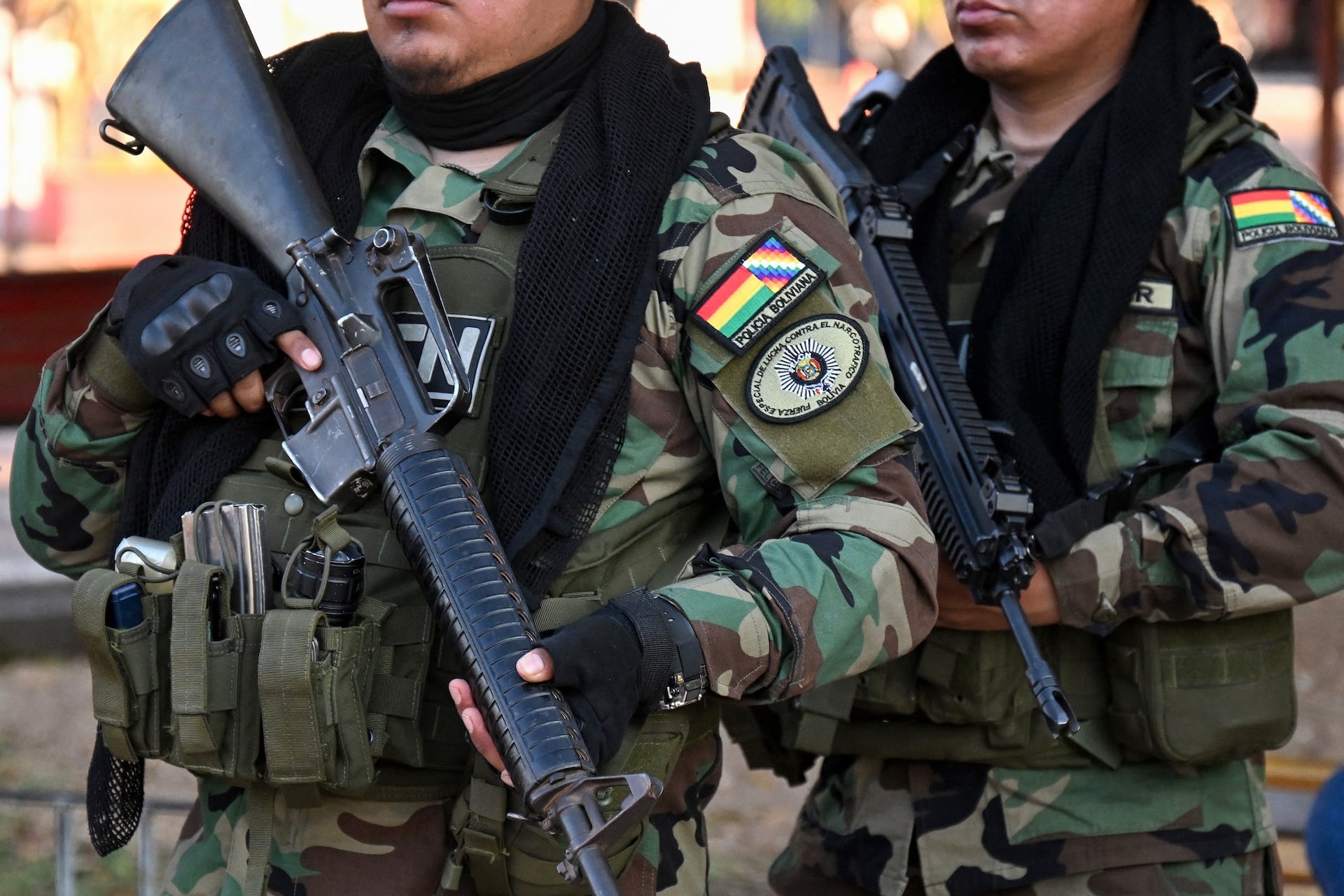
The plan includes coordinated controls and operations in the border region and seeks to strengthen the capabilities of the Bolivian Police through greater coordination with foreign police forces and intelligence services.
Paz linked stronger border security to the protection of legitimate economic activity. “A secure border is a border that produces, exports, and progresses […]; a secure country attracts investment, a country the world trusts and where Bolivians have the confidence to invest in their own territory,” he wrote on X . “Bolivia is reclaiming its territorial sovereignty.”
Shared intelligence architecture between La Paz and Brasília
The Bolivian government also announced plans to establish a permanent Brazilian Federal Police office in La Paz to strengthen efforts against the PCC and CV, Oviedo told reporters August 5. The office would facilitate information sharing and coordination against criminals crossing the border, while Bolivia will have reciprocal police representation in Brazil.
Cooperation had already been intensifying. In May, during the 13th Bolivia-Brazil Joint Commission on Drugs and Related Issues, both countries agreed to advance intelligence sharing, the deployment of liaison officers, coordinated operations, efforts to combat money laundering, and the dismantling of criminal organizations.
On August 2, a coordinated operation involving the Brazilian Federal Police, the Civil Police, and Bolivia’s Special Force for the Fight Against Drug Trafficking (FELCN) resulted in the arrest at the border of a fugitive wanted by Brazil. The operation provided a concrete example of how information sharing can translate into action on both sides of the border.
Bolivian authorities also said intelligence cooperation with Brazil helped identify many of those responsible for the violence in San Matías, underscoring the importance of rapidly sharing information when suspects and criminal networks move across jurisdictions.
“There is a strategy that responds to the particular objectives of Bolivia and Brazil but converges in the fight against organized crime,” Guillermo Holzmann, an international analyst and academic at the University of Valparaíso in Chile, told Diálogo . “The exchange of processed and unprocessed information, intelligence cooperation, and the standardization of protocols that make it possible to bring terrorists such as the PCC and Red Command to justice are essential.”
Legal trade, a new line of defense against drug trafficking
Cocaine trafficking through Bolivia has increased in recent years, while the country has gained prominence as a producer, according to InSight Crime . Security forces discovered 1,501 drug laboratories in 2024, a 74 percent increase from 2023.
Coca cultivation also continued to rise. According to the United Nations Office on Drugs and Crime (UNODC) 2025 Coca Crop Monitoring Report, released in September 2026, Bolivia recorded 36,400 hectares of coca cultivation in 2025, up 7 percent from the 34,000 hectares recorded in 2024. The figure exceeds the 22,000 hectares authorized under Bolivian law by 14,400 hectares.
Throughout 2026, FELCN strengthened foreign trade controls to prevent exports from being used to conceal drug trafficking activities, Oviedo said. As of August 25, the force had conducted 373 analyses and inspections of exports in border areas, compared with 15 procedures in all of 2025 and 10 in 2024, according to the Ministry of Government.
Controls focus on shipments of wood and rubber , which are considered vulnerable to use for concealing controlled substances. The inspections are carried out in coordination with the National Customs Service, the National Agricultural Health and Food Safety Service, and port authorities, using scanning and risk analysis to detect suspicious cargo without hindering legitimate trade.
Cooperation to deny operating space to organized crime
The presence of the PCC and CB beyond Brazil poses a challenge that no security force can confront exclusively within its own borders. Criminal organizations exploit jurisdictional differences , border crossings, and logistics chains to sustain networks operating in more than one country.
Secure Borders seeks to counter that dynamic by combining a security presence on the ground with permanent intelligence sharing, liaison officers, coordinated investigations, and controls over routes and commercial activities that criminal organizations can exploit. The coordinated arrest of the fugitive wanted by Brazil and the identification of suspects linked to the violence in San Matías demonstrate how such cooperation can produce concrete operational results.
For Holzmann, information sharing and the standardization of protocols are essential to ensuring that this coordination can bring members of these organizations to justice. Bolivia-Brazil cooperation therefore seeks to reduce one of the key advantages enjoyed by transnational networks: their ability to cross a border and continue operating from another jurisdiction.
By maintaining permanent intelligence channels and coordinating actions on both sides of the border, Bolivia and Brazil are strengthening their ability to protect their territory and respond to organizations that operate transnationally. Secure Borders turns that cooperation into an operational tool, helping ensure that the border is no longer an advantage for organized crime but a space for coordinated action between both countries.
The full story
This article is one source in a clustered incident — the cluster page carries the summary, timeline and every other outlet covering it.
