 Back Biometricupdate
 CBP tests walk-through facial recognition for long-elusive land
U.S. Customs and Border Protection (CBP) has taken another step toward closing one of the government’s biggest remaining gaps in its biometric entry-exit system by testing facial recognition systems that can capture pedestrians as they walk out of the U.S. at a busy Texas border crossing.
The Department of Homeland Security’s (DHS) Science and Technology Directorate (S&T) said it tested three industry solutions at the Progreso International Bridge after CBP asked the directorate in October 2025 for technology that can securely and efficiently confirm pedestrian departures using biometrics.
More than 1.1 million pedestrians leave the U.S. for Mexico through the crossing annually, according to the bridge director.
The demonstration is particularly significant because pedestrian land exit has remained one of the unfinished portions of a biometric entry-exit system Congress first mandated decades ago.
It also comes as CBP has access to a large new pool of money to move such technology beyond testing.
The Secure America Act , signed into law on June 10, appropriates $3.45 billion to CBP through September 2029 for border security, technology, and screening.
Among the purposes Congress specifically authorized are “necessary expenses, including the deployment of technology,” for the biometric entry and exit system required by the Intelligence Reform and Terrorism Prevention Act of 2004 .
The money is not exclusively earmarked for biometrics and can also support inspection equipment, AI, surveillance technology, air and marine systems, and other border operations.
Biometric Update reported in June that the account sits within nearly $70 billion in new DHS funding through 2029, although Congress did not specify how much of the technology money CBP must spend on facial recognition or other biometric systems.
The Progreso field test took place in May, shortly before Congress enacted the new funding. The work now provides a clearer picture of one capability that could eventually draw on that money, although DHS has not said it will purchase any of the tested systems.
Land exit remains the difficult piece
CBP already uses facial comparison extensively at airports, seaports, and pedestrian land-border entry lanes. Exit has been much harder at land crossings because travelers generally are moving away from U.S. inspection facilities, and stopping large volumes of pedestrians or vehicles to collect biometrics could create significant congestion.
That problem was still unresolved when DHS finalized sweeping biometric entry-exit regulations last year.
The final rule , effective Dec. 26, 2025, removed regulatory limits that had confined biometric exit to pilot programs and provided that all non-U.S. citizen travelers subject to the rule may be photographed upon entry and departure.
But CBP acknowledged that it still lacked a feasible solution for broad biometric exit deployment in the land and sea environments. CBP said it had implemented comprehensive facial biometric processing at air, sea, and pedestrian land entry, but only at air exit.
The agency said it would publish another Federal Register notice before undertaking large-scale biometric exit implementation at land or sea ports.
The Progreso test appears aimed squarely at that gap.
S&T initially invited six companies to the Maryland Test Facility for capability demonstrations early this year. CBP and S&T selected three systems for additional testing, two from NEC National Security Systems and a joint solution from Paravision and AiFi .
The work was conducted through Cooperative Research and Development Agreements, with the companies covering their own participation costs.
Before moving to Texas, S&T constructed a replica of the Progreso pedestrian exit environment in Maryland so the vendors could install and refine their systems under controlled conditions.
They moved to the actual crossing in May.
Faces captured without stopping pedestrians
The operational problem was considerably different from capturing a face at an airport kiosk or boarding gate.
Systems had to obtain usable images of people walking through an outdoor corridor while handling different heights and walking speeds, hats, sunglasses, and umbrellas, as well as changing daylight and nighttime lighting.
NEC demonstrated its SmartID Express and NeoFace Express systems. NEC National Security Systems President Todd Morris said the systems captured what the company characterized as high-quality facial images of thousands of pedestrians per day under outdoor conditions.
The Paravision-AiFi approach combined facial recognition with AiFi’s spatial-analysis technology to analyze pedestrian movement through the capture area and select facial images suitable for biometric matching.
DHS said the vendors used AI and other technologies to construct a three-dimensional model of the capture zone, observe pedestrian movement, and select facial images suitable for matching against CBP’s Traveler Verification Service , the agency’s cloud-based facial matching system.
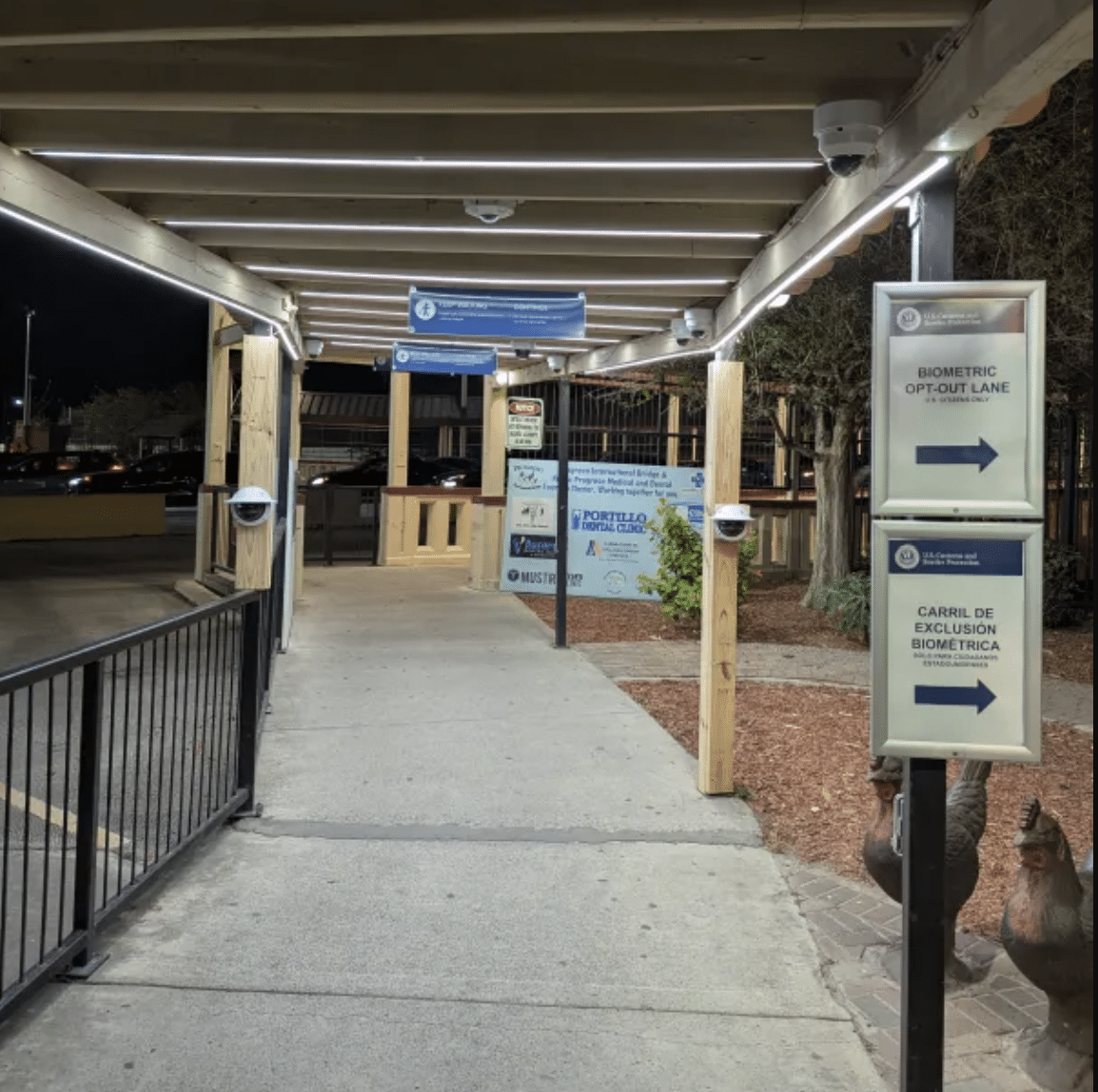
Cameras were positioned at different heights and locations around the pedestrian walkway, and testing continued after dark with different lighting configurations.
U.S. citizens were told through English- and Spanish-language signs that they could decline biometric collection, and a separate opt-out lane was provided. DHS said the biometric entry-exit mandate applies to non-U.S. citizen travelers.
CBP Biometrics Program Office Director Larry Panetta said image capture “exceeded expectations” during both daytime and nighttime testing and said the technology could serve as a “force multiplier,” allowing CBP to deploy its resources more effectively.
In its September 1 account of the test, DHS did not publish quantitative recognition or capture-success rates, false-match figures, demographic performance results, or comparative scores for the three systems.
That leaves the Progreso trial as an operational assessment rather than a procurement decision.
Still, it marks a notable progression from where CBP stood when it issued the biometric rule less than a year ago.
The agency then said it was still searching for a feasible way to perform biometric exit at land borders.
It has now tested multiple walk-through facial capture systems under live border conditions, while Congress has separately provided a multibillion-dollar technology account that expressly allows money to be used to deploy the biometric entry-exit system.
CBP has already said that before it implements large-scale biometric exit at land ports, it will publish the details in the Federal Register and seek public .
AiFi | biometric corridor | biometric exit | border security | CBP | contactless biometrics | facial recognition | NEC NSS | NeoFace | Paravision | Texas | U.S. Government
The full story
This article is one source in a clustered incident — the cluster page carries the summary, timeline and every other outlet covering it.
