 Back Today.Lorientlejour
 EU Council approves 'support mission' in Lebanon for initial 3
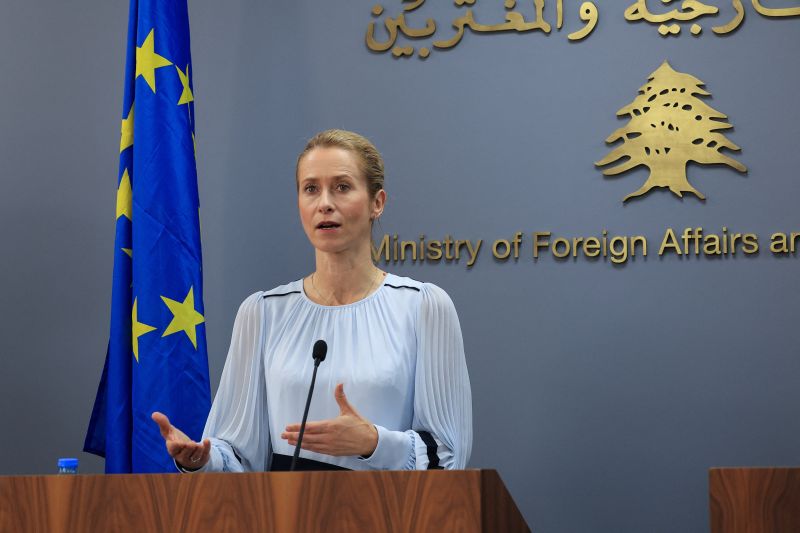
EU European Commission Vice-President Kaja Kallas speaks at a press conference, in Beirut, Lebanon, Oct. 8, 2026. (Credit: Mohamed Azakir/Reuters)
BEIRUT — To fulfill its commitment to the "future of Lebanon," the Council of the European Union on Monday approved the establishment of a "support mission" in the country, where authorities and the international community fear a "security vacuum" after the expiration of the U.N. Interim Force's mandate at the end of December. This mission, which will have an initial mandate of three years, will have two components, military and civilian, and its launch will be the subject of a separate and subsequent decision.
The mission will be tasked with "advising and supporting the Lebanese Army and the Internal Security Forces, in order to strengthen territorial control, border security, and internal security," said European foreign policy chief Kaja Kallas in a statement. Kallas visited Beirut on an official trip last week. "Europe is investing in the future of Lebanon," Kallas added on Monday, describing it as a "major shift" in security relations between Beirut and Brussels.
Aoun and Berri stress need for UNIFIL alternative to EU representative
According to the statement published on the Council's website, the mission will include a military and a civilian component. The first will provide "advice and training" to the army, particularly in the areas of surveillance and land border control, intelligence, surveillance, and reconnaissance, combating smuggling as well as operational coordination. The second will offer training to the ISF, particularly in the areas of cybercrime, combating smuggling, and port security. Both aspects will be overseen under a "unified political mandate." The mission "will coordinate its activities with EU institutions, Member States, and the United Nations."
Civil and military aspects
However, this mission will not be intended to replace UNIFIL, whose mandate is due to expire at the end of the year and which the EU supports extending. On Thursday, Kaja Kallas had in fact called from Beirut for the peacekeepers to remain, expressing fears of a “security vacuum” in the south of the country, where more than 600 km² are occupied by Israel, which is systematically razing dozens of villages to create a so-called “buffer zone."
The U.N. Security Council had in fact decided in August 2025 to end the peacekeepers’ mandate on Dec. 31, 2026, under pressure from the United States. The United Nations peacekeeping force in southern Lebanon (UNIFIL) comprises of around 7,500 personnel from nearly 50 countries. It has been deployed since 1978, but its presence has not prevented Israel from attacking Lebanon.
Rajji urges EU to include Iranian 'proxies' issue in negotiations with Tehran
Operational planning for these different aspects must still continue and will be the subject of a separate decision before it is launched on the ground. In remarks to the press upon her arrival at the Council meeting in Luxembourg, the EU’s top diplomat expressed hope that the mission "will be ready to work on the ground within two months."
Speaking from Beirut, Kallas on Thursday called for an extension of UNIFIL's mandate, expressing fears of a "security vacuum" in the South, where more than 600 square kilometers are occupied by Israel, which has systematically razed dozens of villages to create a so-called "buffer zone." Under U.S. pressure, the Security Council decided in August 2025 to end the peacekeepers' mandate on Dec. 31, 2026. The European official already clarified that the EU mission would not replace the U.N. force, nor would it be "limited to the South."
L'UE approuve une « mission de soutien » au Liban, pour un mandat initial de trois ans
Already have an account? Login here
You have reached your article limit
Stay informed a Middle East in crisis.
Already have an account? Login here
The full story
This article is one source in a clustered incident — the cluster page carries the summary, timeline and every other outlet covering it.
