 Back Satellitetoday
Former DoD Official Warns that Golden Dome May Not Outlive Trump Presidency
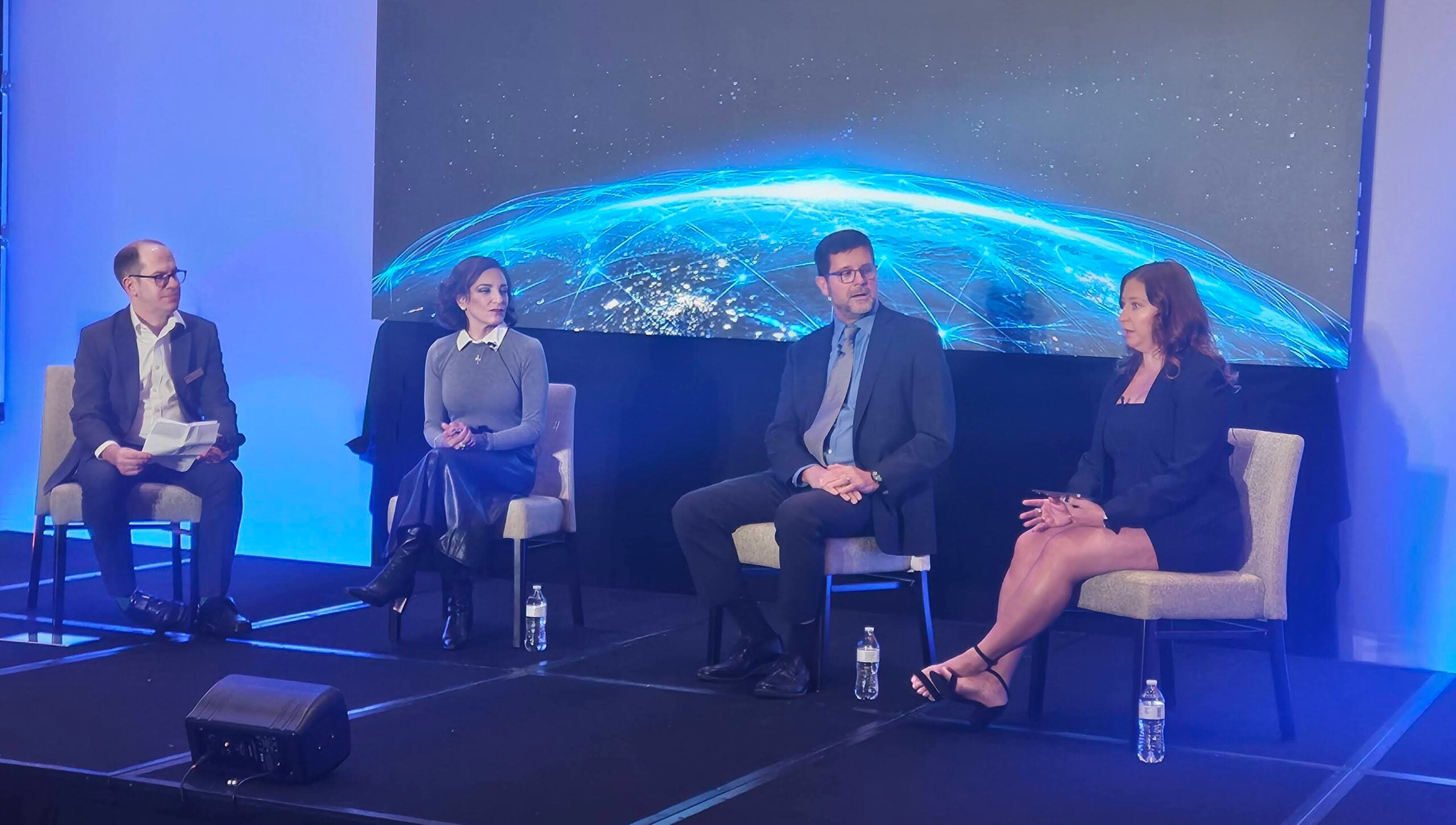
Branding that associates the Golden Dome missile shield personally with President Trump, alongside its expected $1 trillion price tag, partisan disputes, and Democratic election victories on Capitol Hill may well combine to doom the program, although missile defense will continue to be a bipartisan national security priority, one former Department of Defense (DoD) official said Tuesday at CyberSat.
“There’s no $1.5 trillion dollar [defense] budget coming. Ever. There’s not even partisan support for it, so there can’t be bipartisan support,” said John Plumb, vice president for strategy at K2 Space , referring to the topline Pentagon funding in President Trump’s budget proposal for the fiscal year that started Oct 1.
“When you use the words Golden Dome, now it’s political, and when you politicize national security, you get a political response. So it’s damaging,” continued Plumb, who was the first-ever assistant secretary of defense for Space Policy during the Biden administration.
Missile defense, including its space-based elements, has long been a relatively uncontroversial program enjoying bipartisan support in Congress, Plumb said. But President Trump’s technology-stretching, overly ambitious, and hugely expensive plans poisoned the well of Democrats’ support.
“Missile defense is needed, and missile defense will continue,” said Plumb, adding later, “I think any administration, Republican or Democrat, is going to continue to improve missile defenses for the U.S., 100 percent.”
But Golden Dome, which envisages a high-speed global network of sensors and space-based interceptors , is planned to be much more than just missile defense, argued Plumb. Yet it isn’t clear exactly how much more, because it isn’t clear which of the technologies being discussed would actually prove usable in practice, he said.
“What is Golden Dome? If Golden Dome is just space-based interceptors, then we could argue space-based interceptors. Are they going to stick around? I think [it’s] probably unlikely,” Plumb said.
The current missile defense system could succeed in mitigating or even stopping an attack by a rogue nation with a handful of nuclear missiles like North Korea or Iran. But there is no evidence, said Plumb, that it would deter the use of conventional missiles and it would be overwhelmed by the kind of barrage that could be fired by a peer nuclear power like Russia or, increasingly, China.
“Fundamentally, there is no level of missile defense that deters an adversary,” said Plumb, “It just puts pressure on them and they get a vote.”
Given these factors, proper congressional stewardship of taxpayer dollars makes it hard to justify the huge costs of such a system, Plumb pointed out. “This is a $1 trillion system. That is not a good thing to do. The opportunity cost is too great, and it also will never get done.”
Lacey Wean, geospatial and space vertical executive for Carahsoft , agreed that “Clearly the biggest issue is how it’s going to be funded.”
Golden Dome is a massive undertaking involving thousands of tech contractors companies, bleeding edge new technologies and “all the moving parts and the policy pieces surrounding that,” said Wean.
The questions that has to be answered, she said, is, “How do you do that effectively, and how do you do that at scale, and how do you do it at a reasonable cost that can actually be funded?”
Picking up on the policy issue, IonQ executive and former Defense Department CISO and acting CIO Katie Arrington said that Golden Dome already has at least one achievement to its name: Fixing the policy logjam that forbade capabilities funded by the military under Title 10 to be used by the civilian government under Title 40 or the intelligence community under title 50, and vice versa.
“It took Golden Dome for the president to give an exception, so that satellite images funded under one title could be used for another,” Arrington said. “We have a lot of data to use to help defend this country. The problem is we have a lot of our own laws in place that don’t allow us to do that.”
Arrington hammered the idea that cybersecurity needs to be built-in to Golden Dome assets from the design phase, not bolted on once the elements are being manufactured.
“If it’s not built in from the start, don’t bother,” Arrington said, noting that as acting DoD CIO last year she had signed a memo requiring Golden Dome suppliers to meet a much higher level of cybersecurity than the standard for the defense industrial base as a whole. Golden Dome suppliers need to implement National Institute of Standards and Technology (NIST) Special Publication (SP) 800-172, much more stringent than SP 800-171, which DoD contractors in general had to meet.
The need for cybersecurity is underlined by the fact that once a satellite is in orbit, it is basically impossible to update hardware, and could be challenging to even upgrade software.
“Once it’s in space. It’s gone,” she said. “I believe that companies like K2, Carahsoft, they are breeding a culture of security. You cannot launch into space [and] pray and hope that it works. It’s got to be maintained.”
The full story
This article is one source in a clustered incident — the cluster page carries the summary, timeline and every other outlet covering it.
