 Back Globaltimes.Cn
French supermarket cyberattacks highlights physical risks of hacking, China's state security ...
French supermarket cyberattacks highlights physical risks of hacking, China's state security authority warns
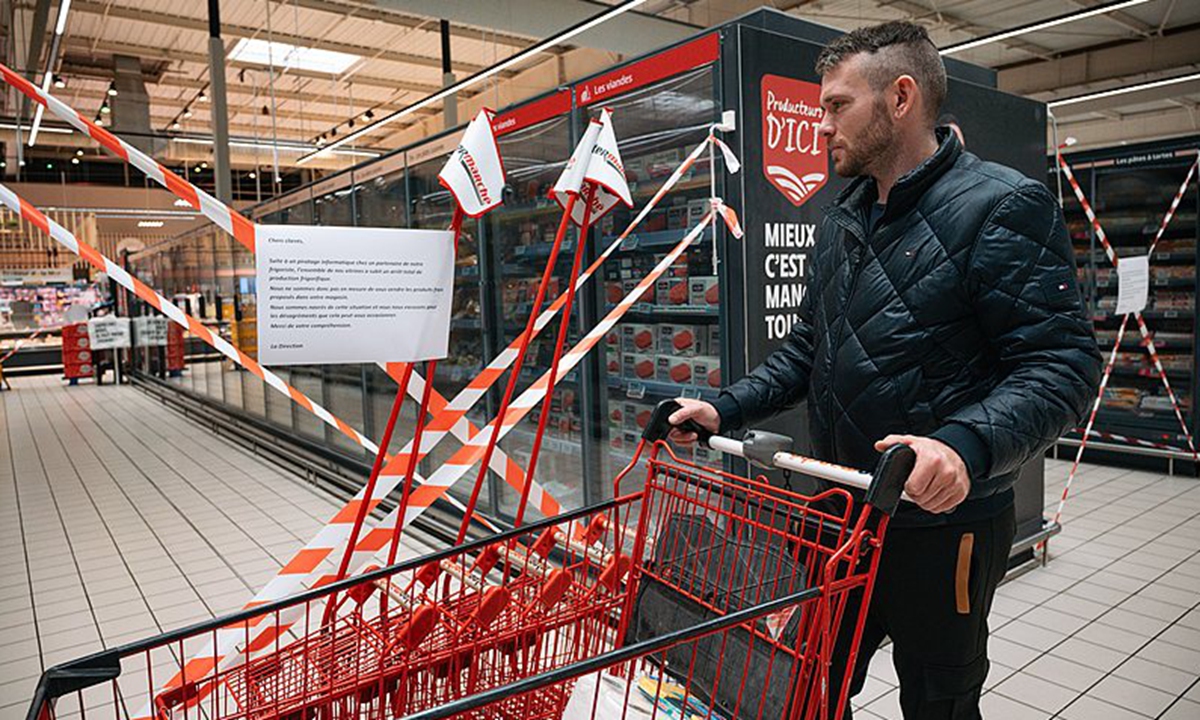
Several large and medium-sized retailers in France suffered a cyberattack affecting their refrigeration equipment on the night of Monday, October 12, 2026. Photo: VCG
China's Ministry of State Security (MSS) on Wednesday warned that cyberattacks are no longer confined to stealing data in the virtual world, but can directly target physical systems and cause tangible damage, citing the recent cyberattack on French supermarkets.
Hackers reportedly exploited remote management interfaces to launch cyberattacks against the refrigeration systems of hundreds of large supermarkets across France. They remotely activated the forced-defrost function on refrigeration equipment and set the temperature to 50 C, destroying large quantities of fresh and frozen food products and causing losses that could reach millions of euros.
The MSS said in a statement on Wednesday that the cyberattack on hundreds of French supermarkets did not involve any particularly sophisticated technology. The attackers managed to remotely manipulate the temperature controls in just three steps.
First, the attackers used network-scanning tools to identify refrigeration control devices left exposed to the public internet without adequate protection. They then exploited security flaws in temperature control systems to bypass authentication and gain control privileges.
Finally, the attackers sent commands that appeared legitimate to force the refrigeration equipment to enter defrost mode and change the temperature setting to 50 C, causing the equipment to continue heating.
The incident has exposed security risks in industrial control systems and serves as a cautionary lesson, the ministry said. When industrial control systems are connected to the internet for remote operation and maintenance, security vulnerabilities can allow hackers to launch cyberattacks and directly manipulate physical equipment. Such damage can then spread from individual devices to broader systems, amplifying the damage.
Once attackers gain access to industrial control equipment, they can alter operating parameters and issue malicious commands, causing production, storage and transportation equipment to shut down abnormally or operate under excessive loads.
Industrial control systems play a vital role in supporting operations across sectors such as electricity, water supply, oil and gas, transportation, healthcare and food production. An intrusion into industrial control systems in critical sectors could also cripple infrastructure, disrupt the basic functioning of cities and affect normal production and daily life.
Once a single device is compromised, risks can spread to upstream and downstream systems, triggering cascading effects and further increasing losses, the MSS stated.
However, securing industrial control systems does not necessarily require large-scale, costly engineering overhauls. Careful selection of secure firmware, stronger network perimeter controls and regular vulnerability inspections can effectively address security gaps and reduce risks to industrial control systems.
For example, the ministry advised using strong passwords for all accounts, minimizing the exposure of industrial control devices to external networks and promptly disabling unnecessary remote access functions.
Where remote access has to be enabled, access permissions should be limited to what is necessary, identity verification properly implemented, and device login logs reviewed regularly. Any suspicious login activity should be addressed promptly, the MSS noted.
The full story
This article is one source in a clustered incident — the cluster page carries the summary, timeline and every other outlet covering it.
