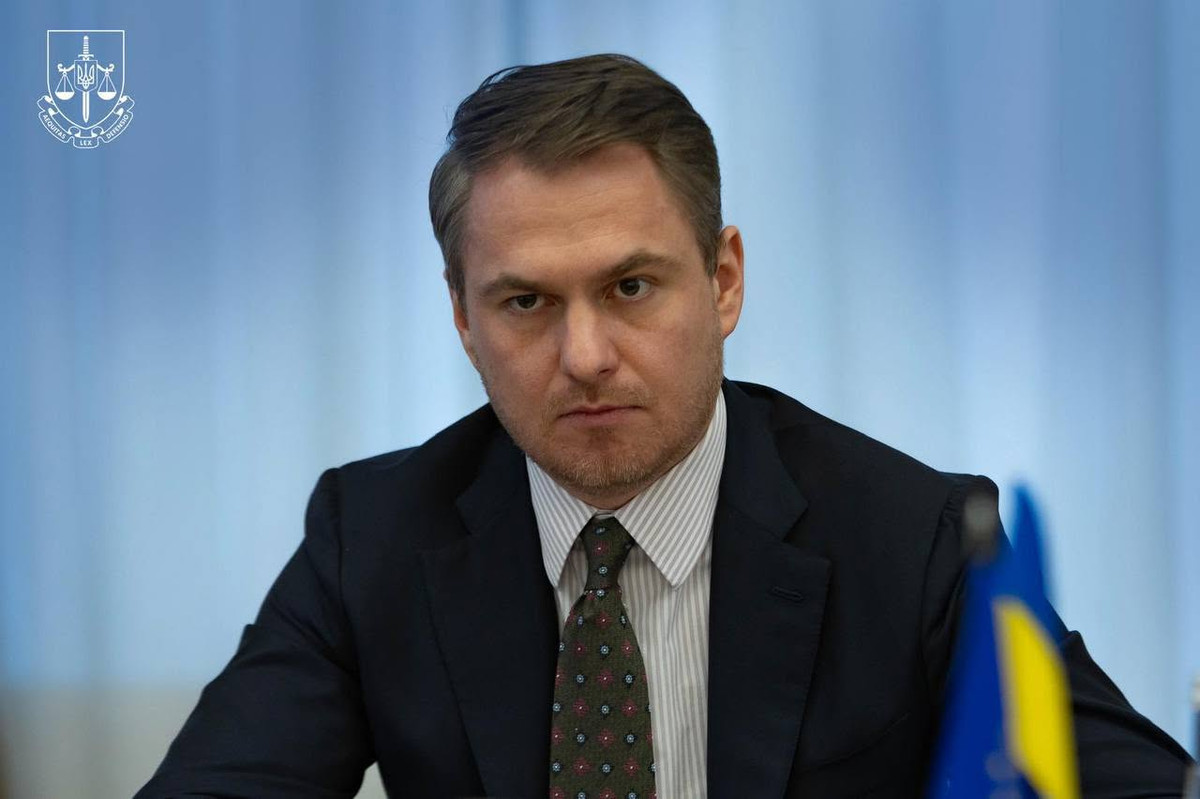
Former Prosecutor General Ruslan Kravchenko has resigned from Ukraine’s prosecution service on Monday, closing the gap that had previously allowed him to remain a Prosecutor General’s Office (PGO) employee despite his dismissal as the country’s top prosecutor.
Spokeswoman Mariana Haiovska told Ukrainska Pravda and other journalists that the acting prosecutor general had aready signed an order dismissing him, formally ending his status as a PGO prosecutor.
Follow our coverage of the war on the @Kyivpost_official .
Why and how did Kravchenko remain a prosecutor until now?
Although Kravchenko was ousted from his post as prosecutor general on Sept. 15, after a total of 317 lawmakers approved President Volodymyr Zelensky’s motion , he remained a prosecutor in the PGO until his resignation was accepted on Monday.
The Prosecutor General’s Office earlier confirmed to Ukrainska Pravda that Kravchenko’s foreign business trip ended on Friday, Sept. 18. As of 2 p.m. local time on Monday, he still hadn’t reported to the office. His whereabouts remained unknown.
His failure to resume duties, combined with his resignation request, created conditions for a rapid dismissal from the prosecution service rather than a prolonged disciplinary procedure.
“If he does not report for work, the personnel department will submit a memorandum to the prosecutor general or the deputy responsible for personnel matters,” a source in the prosecutor’s office told Ukrinform ahead of Kravchenko’s resignation.
Ukraine, Germany Sign €8.5B in Defense Deals, Merz Pledges More Air Defense Support
“The absence will be documented, and officials will establish whether he is on sick leave. Ultimately, absenteeism is grounds for dismissal.”
Under Part 3 of Article 42 of Ukraine’s law “On the Prosecutor’s Office,” dismissal as prosecutor general does not automatically terminate the person’s underlying powers as a prosecutor.
Because of this, his absence created a separate disciplinary issue.
The PGO would have to first document the missed work and determine whether there is a legitimate explanation, such as medical leave.
If the absence was considered unjustified, the office could submit a disciplinary complaint to the Qualification and Disciplinary Commission of Prosecutors , which decides whether misconduct actually occurred and what disciplinary action – if any – should follow.
Only after reviewing the complaint and the circumstances may the commission impose a proper sanction. That process, however, has now been overtaken by Kravchenko’s resignation which provided a legal basis for a swift dimissal.
The process remains separate from Operation Carthage. Kravchenko could have faced professional dismissal for absence without becoming a criminal suspect or vice versa.
A dispute that began in early September
The dispute began on Sept. 4 when the National Anti-Corruption Bureau of Ukraine (NABU) and the Specialized Anti-Corruption Prosecutor’s Office (SAPO) announced “Operation Carthage.”
The investigators allegedly uncovered a criminal organization led by a head of the Prosecutor General’s Office department that systematically collected bribes from fraudulent call centers and laundered criminal proceeds.
Shortly after the probe’s announcement, Ukrainska Pravda reported that the agencies had already detained Serhii Kropyva, the head of the Cyber Department at the Prosecutor General’s office.
His appointment to the post had already drawn scrutiny before , because he was appointed without undergoing a competitive selection process.
NABU and SAPO said five people in total were suspected of participating in the alleged organization.
Though the anti-graft agencies did not publicly release their names, Radio Liberty identified them through information disclosed in court proceedings as:
Serhii Kropyva (allegedly created and managed the organization and legalized the money received),
Yelyzaveta Ivakhnenko (Kropyva’s partner, who also helped legalize the money)
Serhii Kutsyi (Kropyva’s driver who was allegedly carrying the cash and issuing property for his relatives and himself)
Danylo Slipchuk (an employee of the Department of Information Technologies of the Prosecutor General’s Office, who reportedly checked the addresses of call centers and helped his accomplices figure out which of them belong to “their own”)
Oleksandr Dydych (Kropyva’s relative and a lawyer who kept records of his assets while helping the team hide ownership of property by re-registering it to other people).
According to the High Anti-Corruption Court, Kropyva and Ivakhnenko were taken into custody until Nov. 2 with a bail of Hr. 120 million (roughly $2.7 million) and Hr. 20 million (approximately $450,000).
Serhii Kutsyi was taken into custody until Nov. 3 with a bail of Hr. 3 million (roughly $67,000), while Oleksandr Dydych will be held until Nov. 2 with a pledge of Hr. 15 million ( $335,000).
No publicly known decision on a pretrial restriction for Slipchuk was available at the time of the report.
Kravchenko had not been publicly identified as the organization’s leader or formally named as a suspect by NABU and SAPO.
Around the same time, PGO confirmed that searches were conducted at premises used by Kravchenko and other senior officials, while subsequent reporting said intercepted materials may have referred to a higher-ranking figure as the “Chief.”
Kravchenko denied involvement in the alleged scheme and said on Sept. 6 that the employee implicated in the case had been suspended and that the relevant department would be reviewed.
Zelensky met with Kravchenko and the heads of NABU and SAPO on Sept. 7. Following the meeting, Kravchenko submitted his resignation. After the announced resignation, Kravchenko remained in office pending parliament’s decision.
On Sept. 14, he escalated the confrontation by accusing NABU chief Semen Kryvonos of forging official documents to obtain an especially large improper benefit and of fictitious adoption allegedly intended to create grounds to avoid legal responsibility.
He announced a separate suspicion against a person close to SAPO chief Oleksandr Klymenko, alleging an attempt to offer an improper benefit to High Anti-Corruption Court judges and facilitate draft evasion.
He also ordered polygraph examinations for staff involved in supervising and investigating fraudulent call-center cases.
The agencies rejected the allegations , saying no suspicion had officially been served on Kryvonos and denying Kravchenko’s claims that NABU had seized criminal cases referenced in his statement.
Hours after accusing the heads of the agencies of the crimes, Kravchenko left the country in an official vehicle overnight, for an official five-day trip beginning Sept. 13.
The Anti-Corruption Action Center (ANTAC) also reported his departure.
As of Sept. 21, Kravchenko had not been formally notified of suspicion, Ukrainska Pravda reported.
The full story
This article is one source in a clustered incident — the cluster page carries the summary, timeline and every other outlet covering it.
