 Back cryptoslate.com
 How a quiet flaw in Bitcoin’s top scaling network left user funds open to total wipeouts – and the fix arrived later than disclosed
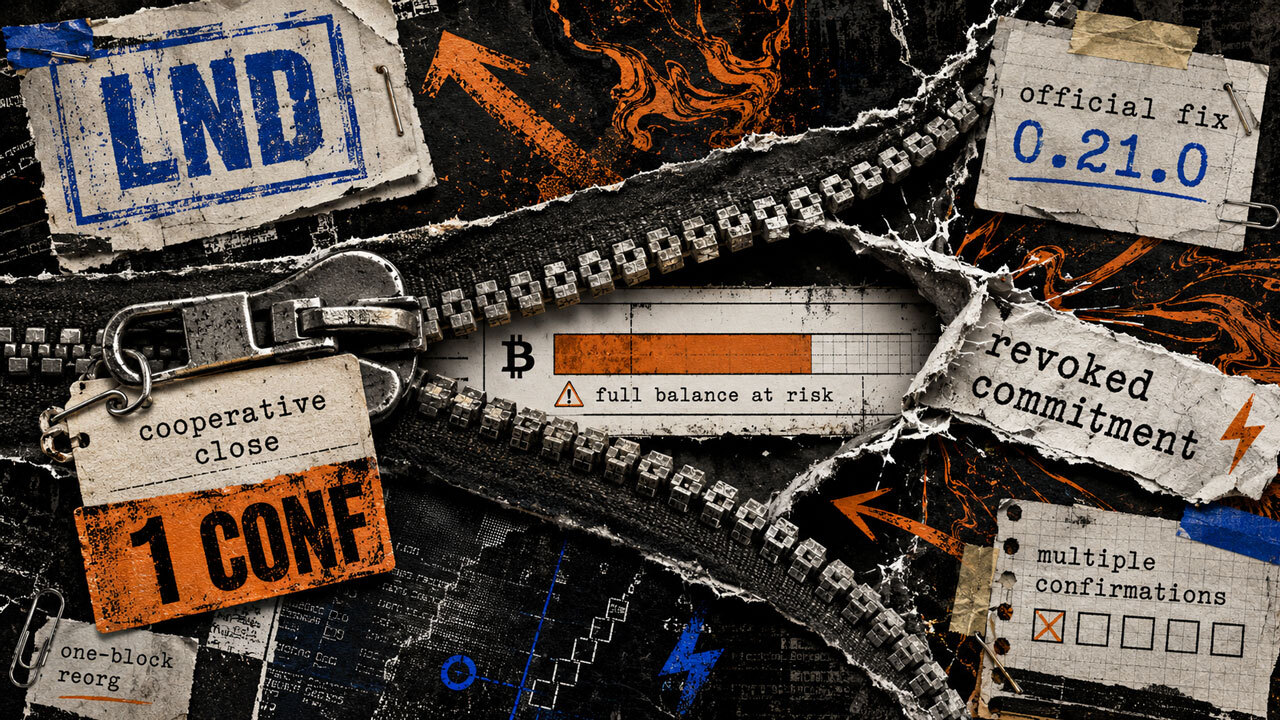
01 LND’s cooperative-close flaw can expose a channel’s full balance in a reproduced worst-case attack.
02 The attack needs a malicious peer, a one-block reorganization and an old revoked commitment transaction.
03 Repository history puts LND’s official fix in 0.21.0; earlier standard releases need separate patching.
LND , a Lightning Network node implementation, has disclosed a channel-close flaw that can put an entire channel balance at risk in the reproduced maximum-loss scenario. Operators using standard releases below 0.21.0 should treat their nodes as lacking the official fix unless they were independently patched.
The Aug. 13 disclosure describes how a malicious channel peer could combine a one-block Bitcoin reorganization with an old, revoked commitment transaction after a cooperative close. Bastien Teinturier, who published the disclosure, said no affected users were known.
Researchers discover vulnerabilities in Bitcoin layer-2 Lightning Network
Before the fix, LND could forget a cooperatively closed channel after the closing transaction received its first on-chain confirmation. That removed the channel state the node needed to respond safely if Bitcoin later reorganized that block out of the chain.
The attack requires more than an ordinary one-block reorganization. A malicious peer must first participate in the cooperative close, wait for one confirmation, and then take advantage of a reorganization that removes the closing transaction. The peer must also possess and publish an earlier revoked commitment, an outdated channel balance state that should trigger punishment.
Inside Bitcoin’s 24 hour race to survive a global internet blackout
An affected LND node can then fail to broadcast the penalty transactions designed to punish publication of that revoked state. Under the reproduced scenario, the loss can reach the channel's full balance. That figure is a maximum loss condition, not evidence that the vulnerability was exploited in the wild.
The disclosure and fix are specific to LND. They do not suggest that other Lightning implementations the same channel-close flaw.
Exchange BTC Lightning channels break our favorite Bitcoin metric
The official fix starts with LND 0.21.0
Upstream repository history places the official fix in 0.21.0, not the 0.20.0 version cited by the public disclosure.
Pull request #10331 merged into the project's master branch on Jan. 16, 2026. A backport to the 0.20.x branch was later reverted, and a subsequent documentation change said the improved cooperative-close confirmation logic had actually landed in 0.21.0. The project's 0.21.0 release notes also associate the reorganization-safe close logic with that release line.
Operators therefore should not rely on the disclosure's 0.20.0 cutoff. Standard releases below 0.21.0 should be treated as lacking the official fix unless independently patched.
LND's security policy recommends the latest minor release of the newest major line an operator can support. As of Aug. 25, the project's latest official package was lnd v0.21.2-beta , released Aug. 13.
The fix makes LND retain close state while waiting for multiple confirmations and react to reorganization notifications instead of considering the channel resolved after one block.
Mentioned in this article
Also known as "Akiba," Liam Wright is a reporter, podcast producer, and Editor-in-Chief at CryptoSlate. He believes that decentralized technology has the potential to make…
CryptoSlate may use AI tools to support research, editing, and production workflows. Our journalism remains human-led, with our editorial team responsible for every published article. Read our full AI usage disclaimer .
Our writers' opinions are solely their own and do not reflect the opinion of CryptoSlate. None of the information you read on CryptoSlate should be taken as investment advice, nor does CryptoSlate endorse any project that may be mentioned or linked to in this article.
Buying and trading cryptocurrencies should be considered a high-risk activity. Please do your own due diligence before taking any action related to content within this article. Finally, CryptoSlate takes no responsibility should you lose money trading cryptocurrencies. For more information, see our company disclaimers .
The full story
This article is one source in a clustered incident — the cluster page carries the summary, timeline and every other outlet covering it.
