 Back Lrt.Lt
 I worry about Russian miscalculation in Baltics – interview with Britain's top general
Vilnius dismisses new Russian threat over Kaliningrad as ‘psychological pressure’
Lithuania preparing for Russia's efforts to spread fear, divide society, PM says
Estonia attributes attack on defence firm to Russia
NBA legend Shaquille O'Neal arrives in Lithuania
Lithuania's budget deficit likely to exceed 3% year, PM says
I worry Russian miscalculation in Baltics – interview with Britain’s top general
Lithuania to test air raid sirens on Tuesday
Lithuania to showcase culture, arts in 52 countries during EU presidency
Lithuania imposes national sanctions on Russian billionaires Usmanov, Fridman
Russian language study falls, German rises in Lithuanian schools
Canadian, Norwegian, Ukrainian ambassadors in Lithuania sign plea to bring back detainees
Lithuania sticks to 2030 Rail Baltica deadline despite Baltic agreement to extend it
Amid warnings over possible attack, Europe mulls contingency plans
Between three countries, a young Lithuanian finds her way
Lithuania’s interior minister wants to restore warning shots for police and border guards
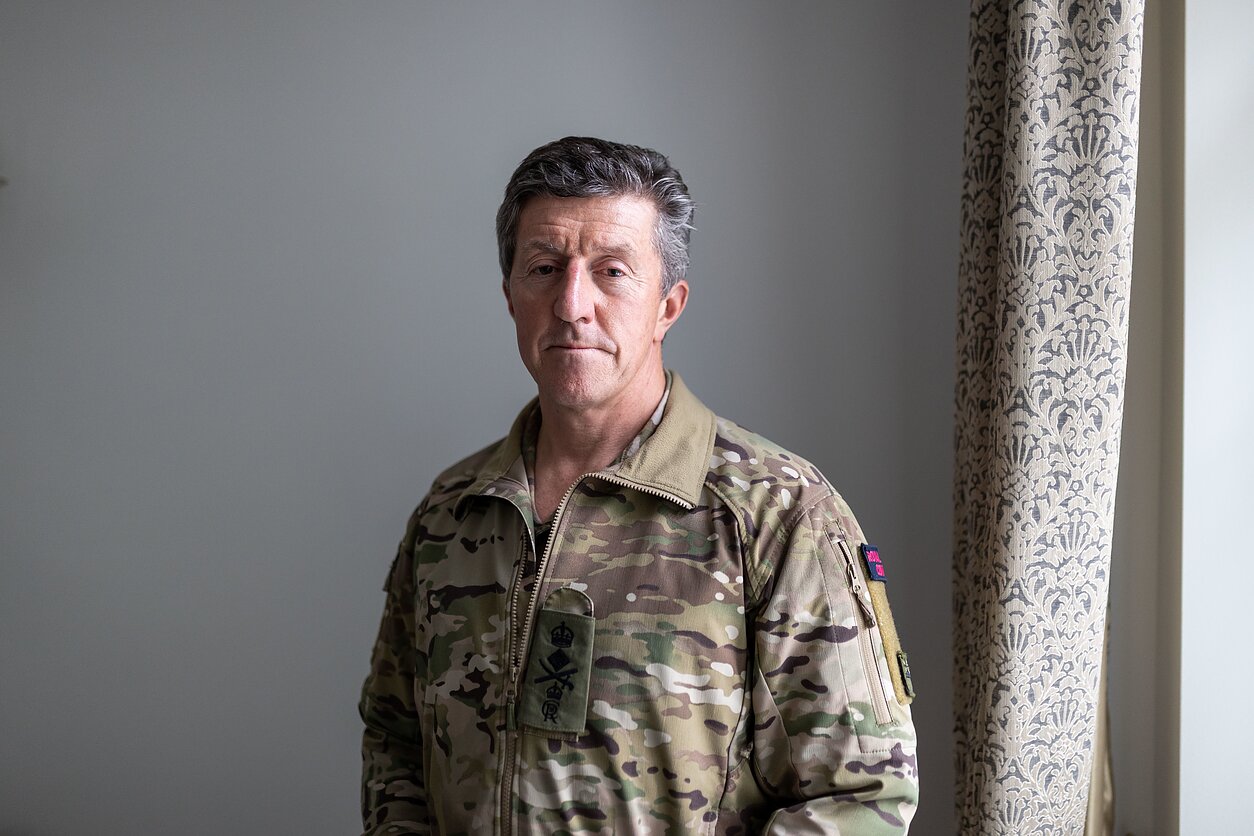
Britain’s top navy general Gwyn Jenkins visited Lithuania and the Baltic states last week as the UK continues to build the 10-nation Joint Expeditionary Force (JEF) as a coalition of the willing that would speed up decision-making in case of a Russian attack.
“I'm not being alarmist. Nobody is catastrophising what could happen in the Baltics”, he said, adding that Russia will continue “to probe for weaknesses” unless NATO countries show strength. In an exclusive interview with LRT.lt, General Jenkins spoke the importance of the Klaipėda seaport, the British-led JEF as a coalition of the willing, and the growing risk of Russia “doing something stupid” in the Baltics.
You mentioned the word alarmism. I'm seeing a lot of that now, especially in international media. From your perspective, are there any signs we're seeing that would require more vigilance than before? I'm a military strategist by profession. Our job is to be prepared, and that means we take all our threats, all the threats that we see in front of us, very seriously, but that isn't an excuse for making the Russians out, out to be more than they are. [...] Russia is bleeding in Ukraine. It has made a massive strategic mistake in picking an egregious illegal war with a sovereign state on European soil that we are all supporting. While the war goes on, I don't believe Russia has the capacity to take the more alarmist courses of action that some people talk . It recognises that we are a phenomenal force if it was stupid enough to pick an Article 5-type scenario. But the concerns are of something happening below that threshold?
If I have a concern Russia, it is that I don't think they're very professional. I think their ability to miscalculate is huge. When I see it in the Baltic, and I see it in the North Sea, and I see it around the British Isles and elsewhere, unprofessional behaviour has the potential to escalate certain scenarios. Our management of that and our ability to contain something– if they do something silly, stupid, illegal, egregious – that is where the concerns lie. And that's not the same as a pre-planned massive invasion of Europe. This threat is very serious. I am worried and concerned Russian behaviour and what they might do either during the war or once the war in Ukraine is finished [and] what happens to the Russian state after that point.
[...] If I wind back 15 years, I was in the military staff college education, right round the G8 in Northern Ireland when Vladimir Putin was there. I actually met him because I was the military assistant to the prime minister.
At the time, in all of our war games and exercises at that point, the precursor to war was what we’re living through at the moment [in Europe]. If you'd asked the 15-years-ago me what the condition-setting would look like for confrontation with NATO, we're in all of that. That is not to predict a war, but it is to say that we can't be complacent. What do you remember of Putin? He's very short in a way that his images don't necessarily portray. He’s very intense, not very engaging as an individual with anyone. But I didn't spend a lot of time with him.
The Suwalki Gap question receives a lot of attention. What can you from the naval, or from the British, perspective?
Land resupply is obviously crucial to both your nation and all the Baltic states and all our forward land forces – the UK forward land forces in Estonia, the Germans here. If military strategy and history teach me anything, it's don't depend on just one line.
The sea lines of communication and our ability to resupply across the Baltic Sea is really important. I think you have some of the best port facilities in the Baltic states; they are really important infrastructure that we should make sure that we can protect.
Is that what you talked during your meetings here? Yeah, I have., because we have learnt a lot from Ukraine in terms of their ability to protect their port infrastructure and the challenges they've had. I think we've seen a lot from the conflict in the Gulf recently in terms of how you protect port infrastructure from a range of possible attack options. I'm really keen that we continue to talk how that can be done here, how we support each other in that, because it's important to all of us. It's been a key part of my, some of my discussions here. For people who don’t know the British-led Joint Expeditionary Force (JEF), which also includes Lithuania, is this a fail-safe for below-Article 5 crises?
So the most important thing I think JEF is it is a complement to NATO. We are working hand in glove through the JEF with the NATO planners on how the JEF can support NATO plans. The advantage of the JEF is there's 10 of us, and we don't need consensus to act.
Is it a coalition of the willing, essentially? Basically. As the scenario evolves, the flexibility of the JEF means any of us can contribute [in a way] that is really supportive of the NATO plans. When you look at the way the NATO plans are set up now, as NATO is developing consensus and trying to understand what has happened and is deciding what its response is, we have the ability as JEF nations to act quite quickly in support of each other. I know that politically you're quite keen to stress that JEF is not competing with NATO. But I think for many people in the Baltics, saying that we have some form of a regional alliance where nations can act quickly in case there's a danger would be a reassurance factor. It should be reassuring, because JEF has been a really useful construct for all of us. It will span the Baltic to the high north [and] all the navies that we're talking with and all the nations are really enthusiastic it.
So what’s Lithuania's role? Protect Klaipėda at all costs? I think there is definitely a view of, as we work through the JEF plans, where the critical bits of infrastructure are on which we both nationally depend and on which NATO depends, and how we would focus resources in different scenarios. When I was in Norfolk [NATO and US naval base] recently, talking with them, [...] they would really welcome that.
Lithuanian defence minister apologises over 48,000-euro staff party
Vilnius dismisses new Russian threat over Kaliningrad as ‘psychological pressure’
Lithuania preparing for Russia's efforts to spread fear, divide society, PM says
Estonia attributes attack on defence firm to Russia
NBA legend Shaquille O'Neal arrives in Lithuania
Lithuania's budget deficit likely to exceed 3% year, PM says
Lithuania to test air raid sirens on Tuesday
Lithuania to showcase culture, arts in 52 countries during EU presidency
Lithuania imposes national sanctions on Russian billionaires Usmanov, Fridman
Russian language study falls, German rises in Lithuanian schools
The full story
This article is one source in a clustered incident — the cluster page carries the summary, timeline and every other outlet covering it.
