Advances in the accessibility of small, unmanned drones have given nonstate actors an asymmetric advantage, creating an imperative for African governments to adapt layered defensive systems.
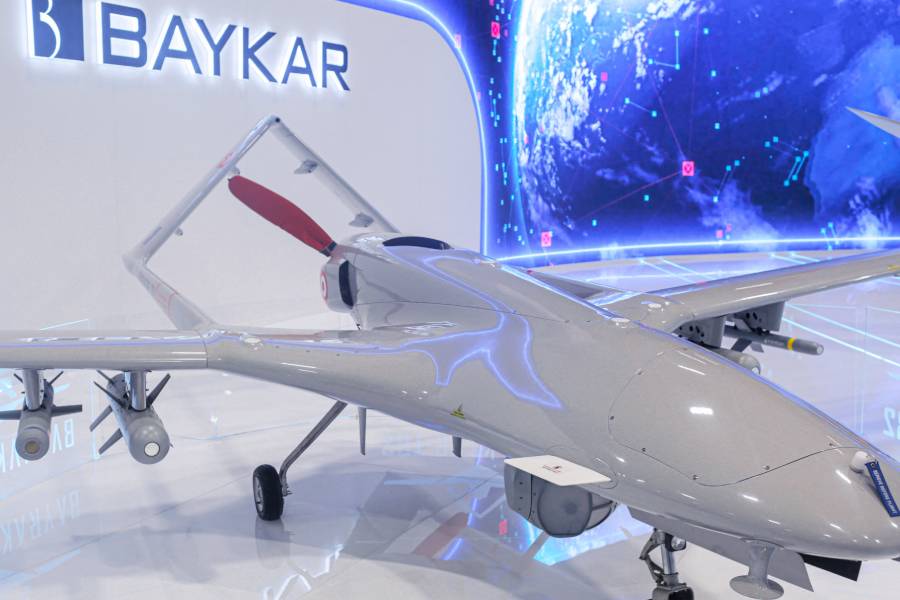
An unmanned combat aircraft made by Turkish company Baykar on display at an exhibition. (Photo: AFP/Ahmed Deeb)
The rapid diffusion and growing use of inexpensive, attritable unmanned systems by Africa’s armed nonstate actors is reducing governments’ longstanding advantage in airpower.
Armed nonstate actors across Africa are rapidly expanding their employment of commercially modified small unmanned systems, giving them an advantage over government forces.
African military drone capabilities remain concentrated on imported long-endurance platforms and possess limited counter-unmanned aerial systems (C-UAS) capabilities.
African governments should adopt a risk-based doctrine for countering the armed nonstate actor drone threat that combines layered C-UAS defenses, efforts to restrict illicit drone supply chains, and the integration of small unmanned systems into force structures optimized for irregular warfare.
I n every major armed conflict in Africa today—Sudan, the Sahel, Somalia, the Lake Chad Basin, and the eastern Democratic Republic of the Congo (DRC)—drones are used by combatants on both sides that are actively shaping battlefield outcomes.
Paralleling patterns globally, this is reflective of a profound shift in the manner in which warfare is conducted across the continent. Armed forces in at least 40 African countries have acquired drones as part of their arsenals. Moreover, armed nonstate actors are employing drones in at least 17 African countries. Eleven African countries now produce military drones, and several others have production efforts underway.
Sources: Military Africa , Center for New American Security , Author, UNIDIR
Drones are not just proliferating. Their sophistication is also advancing rapidly, with capabilities such as fiber-optic controls and AI-enabled targeting available at costs that put such small unmanned systems well within the reach of most armed actors in Africa. Globally, these advances are putting defenders at a disadvantage, and imbuing smaller states, criminal organizations, and armed nonstate actors with novel capabilities to impose costs, stretch the battlefield, and strike hardened assets.
Insurgents are showing that they can survive, and even thrive, in an era of autonomous warfare.
Insurgents are showing that they can survive, and even thrive, in an era of autonomous warfare.
The Front de libération de l’Azawad’s (FLA) use of first-person-view (FPV) drones in April 2026, illustratively, forced Russian paramilitary forces to evacuate their bases in Kidal, Mali. The impotence of Mali’s fleet of Bayraktar TB2 drones in countering the assault should set off alarm bells in capitals across Africa. The TB2 is Africa’s most sought-after military drone and has been acquired by dozens of countries. 1 While long-endurance drones such as the TB2 still play an important role, future wars are likely to be dominated by lower-cost and more numerous attritable unmanned systems. So far, it is Africa’s nonstate armed actors, rather than militaries, that are most effectively taking advantage of this shift. Insurgents are showing that they can survive, and even thrive, in an era of autonomous warfare.
Unmanned Systems and Their Growing Capabilities
A “drone” is typically defined as a remotely operated or autonomous robotic system. In practice, the term covers an enormously heterogeneous set of equipment, vehicles, platforms, and munitions. Nearly every capability on the modern battlefield, from a grenade to a fighter jet, now has a drone analogue or can be integrated onto a drone platform. Treating all of this under a single label obscures each drone platform’s distinct role and function.
What most fundamentally distinguishes one drone from another is domain:
Unmanned aerial systems (UAS)
Unmanned surface or underwater vessels (USV/UUV)
Unmanned ground vehicles (UGV)
Drones range enormously in size and sophistication. Some drones are the size of a hummingbird. Others possess the wingspan of a passenger jet. Frames, modes of propulsion, sensors, communications links, and payloads determine a drone’s cost, range, survivability, and destructive power.
Four categories account for nearly all documented drone use on Africa’s battlefields to date:
Long-Endurance UAS. Weighing more than 590 kilograms (kg), capable of loitering above a target for 24 hours or more, and typically flying above 4,500 meters, these are the workhorses of the continent’s air forces, used interchangeably for surveillance, targeting, and strike. Long-endurance drones are, by a wide margin, the most acquired military drone on the continent, accounting for nearly three-quarters of all units procured. 2 No platform has defined the category more than Turkey’s TB2, which typically sells for between $5 million and $10 million per drone.
A Mauritanian National Guardsman demonstrates the thermal imaging camera of an unmanned aerial vehicle. (Photo: AFP/Patrick Meinhardt) Intelligence, Surveillance, Target Acquisition, and Reconnaissance (ISTAR) UAS. These drones are used exclusively for intelligence gathering, surveillance, reconnaissance, and targeting and do not carry weaponized payloads. Typically weighing less than 590 kg, they account for roughly a quarter of all drones acquired by African militaries. While many of these acquisitions date to the 2000s and 2010s, before drones were more routinely weaponized, they also include smaller, newer, and at times locally produced drones that are being used for tactical ISTAR. Examples include the Aerius Pro, a vertical take-off and landing (VTOL) drone with approximately 3 hours of flight time, a maximum altitude of 3,700 meters, and a range of 65 km that was developed locally and is used by the Ghanaian military for aerial surveillance. 3
A Mauritanian National Guardsman demonstrates the thermal imaging camera of an unmanned aerial vehicle. (Photo: AFP/Patrick Meinhardt)
Intelligence, Surveillance, Target Acquisition, and Reconnaissance (ISTAR) UAS. These drones are used exclusively for intelligence gathering, surveillance, reconnaissance, and targeting and do not carry weaponized payloads. Typically weighing less than 590 kg, they account for roughly a quarter of all drones acquired by African militaries. While many of these acquisitions date to the 2000s and 2010s, before drones were more routinely weaponized, they also include smaller, newer, and at times locally produced drones that are being used for tactical ISTAR. Examples include the Aerius Pro, a vertical take-off and landing (VTOL) drone with approximately 3 hours of flight time, a maximum altitude of 3,700 meters, and a range of 65 km that was developed locally and is used by the Ghanaian military for aerial surveillance. 3
Small Unmanned Aerial Systems (sUAS). Cheaper still are small first-person-view systems, the drones that have come to define the war in Ukraine and are now spreading rapidly across Africa’s battlefields. These drones typically weigh less than 9 kg, possess ranges of less than 50 km, payloads of no more than several kilograms, and fly below 300 meters. They consist overwhelmingly of quadcopters, such as the DJI Mavic 3, modified to carry explosive charges, conduct short-range reconnaissance, or loiter as improvised kamikaze munitions.
One-Way Attack (OWA) UAS. One-way attack drones are typically medium-sized fixed-wing drones that sacrifice maneuverability for reach. Weighing between 10 and 450 kg with ranges exceeding 100 km, these are built to strike supply lines, command posts, and logistics nodes far behind the front. They remain less common in Africa than the other three categories, but where they have appeared, the effect has been significant. Sudan’s Rapid Support Forces (RSF) have used the Sunflower 200, a Chinese-made derivative of Iran’s Shahed with a range of more than 2,000 km and a 40-to-50-kg warhead, to strike targets across the country.
While not yet widely diffused, Nigeria has acquired and put into service unmanned surface vessels, and is also developing interceptor drones. 4 Tunisia’s Anti-terrorism Battalion uses the Throwbot, a kilogram-scale UGV that can be tossed into buildings and transmit video and audio for close-quarters reconnaissance. 5 In North Africa, criminal groups have used underwater and aerial drones to smuggle psychotropics, cannabis, hashish and cash across the Mediterranean Sea, with the most common smuggling corridor between Morocco and Spain. 6
Assessing African Government Drone Capabilities
African governments vary enormously in what kinds of drones they can field. The top 10 countries account for nearly four-fifths of all procured units, with Nigeria, Algeria, Ethiopia, Morocco, Egypt, and Libya each possessing more than 100 drones. 7 Nigeria stands out for its diversity, having acquired 34 distinct types of drones from a range of suppliers, a sign that the continent’s most capable militaries are building varied portfolios.
These portfolios, however, remain heavily weighted toward one category. For nearly a decade, long-endurance drones have formed the backbone of African UAS arsenals. Overall, 25 different African governments have acquired long-endurance systems. They remain almost entirely dependent on external actors to acquire them, with China and Turkey emerging as the predominant suppliers. The most popular models include Turkey’s TB2 (acquired by 15 countries) and AKINCI (7 countries) drones, followed by China’s CH (9 total countries) and Wing Loong (9 total countries) series.
Sources: Military Africa, Center for New American Security Drone Proliferation Data, Author.
Long-endurance drones have earned their dominant position in three distinct roles. The first is persistent surveillance. Able to loiter unseen and undetected for hours, long-endurance drones are used to collect real-time intelligence on enemy movements and cue indirect fire. For example, after being pushed out of much of Khartoum early in Sudan’s internal war, the Sudanese Armed Forces turned to Iranian Mohajer-6 drones to track the RSF’s movements and dislodge them with pinpoint artillery strikes. 8
The second is long-range strike. Through their extended ranges and flight times, long-endurance drones enable African militaries to attack hundreds or even thousands of kilometers from where the drones are launched. The armed forces of the DRC have used Turkish TB2 and Chinese CH-4 long-endurance drones to target rebel-held positions in M23-held areas of North Kivu, even though they were stationed several hundred kilometers away. 9 This includes a strike that killed M23 spokesman Will Ngoma near the mining town of Rubaya in 2026. Burkina Faso’s armed forces have used long-endurance drones to target militants planting improvised explosive devices (IEDs). Somalia has used long-endurance drones to strike al Shabaab training camps and weapons depots in the country’s south. The Ethiopian National Defense Forces decisively used long-endurance drones to sever a single tarmacked supply road running from rebel-held Tigray toward Addis Ababa in 2022—a development that proved crucial in stopping the offensive and ending the war. 10
The third is close air support. The ability to loiter and target precise munitions from high altitudes enables long-endurance drones to provide critical support to infantry and armored units. When Ansaru and Jama’at Nusrat al Islam wal Muslimeen (JNIM) fighters attempted to overrun the Burkinabé military base in Djibo in December 2023, TB2s broke the assault by targeting the insurgents’ own massed formations. 11
Another appealing attribute of long-endurance drones is that they typically operate at altitudes above the reach of small arms and most portable air defense systems that nonstate armed groups can currently field.
African Nonstate Drone Capabilities
Africa’s armed nonstate actors have adopted a different approach to drone integration and weaponization, focusing on acquiring or modifying small unmanned systems that can be easily assembled or smuggled. In a span of 3 years, many of Africa’s major armed nonstate groups have acquired armed drone capabilities. They have received varying amounts of support, from state- technical assistance to clandestine training through international jihadist networks.
Virtually all of Africa’s militant groups now use drones for intelligence, surveillance, and reconnaissance (ISR). JNIM, the Islamic State in West Africa (ISWA), and al Shabaab have possessed drone-enabled ISR capabilities dating back to 2018. Even Ahl al Sunna wal Jama’a (ASWJ)—considered the least well-resourced of Africa’s militant Islamist groups—has used drones to identify targets in complex attacks against port towns and hydrocarbon infrastructure in Cabo Delgado, Mozambique. 12
Some militant groups use drones to direct, command, and control forces during an attack. During a June 2025 assault in Mopti, for example, JNIM used a quadcopter to hover over positions by Malian forces, feeding their locations to attackers. 13 This is significantly more technically challenging, requiring the integration of real-time drone imagery with communications systems and software to coordinate the efficient movement of allied units.
Most of Africa’s militant groups use drones for propaganda, filming videos of achievements, attacks, or training to bolster recruitment and gain support. Among the most successful in this regard is al Shabaab, which has used drones for both surveillance and propaganda purposes since at least 2018, and also uses varying UAS platforms to plan and coordinate attacks. 14 Though it has yet to successfully weaponize drones, al Shabaab has demonstrated an interest in acquiring advanced UAS systems and an even greater interest in drone jamming technology to evade surveillance and strikes. The group recently sent as many as 400 fighters to train with Yemen’s Houthis, from whom it has already attempted to acquire drones. 15
It is only after the onset of Russia’s war against Ukraine in 2022 that Africa’s militant groups began turning in earnest to the weaponization of drones. The first confirmed uses appeared in 2023, when JNIM and the RSF both deployed quadcopters to drop grenades, munitions, and other improvised explosive devices. The delivery of munitions by DJI Matrice 30T drones, which can carry two explosives, is the preferred method of JNIM, among the most prolific drone users among Africa’s insurgent groups. 16 A majority of Africa’s largest militant groups now use similar tactics.
Source: Desk research by author
The most common drone-warfare tactic of militant groups across Africa is the use of drones in kamikaze attacks, striking targets with fixed-wing or commercial quadcopter drones with attached explosives that detonate on impact. In a short period of time, these attacks have become quite sophisticated. The highly coordinated January 2026 attack on Niamey Airport by the Islamic State in Greater Sahara (ISGS) involved as many as 10 kamikaze drones, resulting in the loss of multiple aircraft.
The most common drone-warfare tactic of militant groups across Africa is the use of drones in kamikaze attacks.
The most common drone-warfare tactic of militant groups across Africa is the use of drones in kamikaze attacks.
Of particular concern, a handful of Africa’s most capable nonstate armed groups have begun fielding fiber-optic FPV and OWA drones whose capabilities exceed what African state militaries can currently field. Tellingly, these capabilities appear dependent on a state sponsor. This highlights that, even if the cost to acquire drones may be falling, access to training and technical expertise remains crucial.
The FLA, with likely assistance from Ukraine, 17 is Africa’s first armed group to have reportedly deployed fiber-optic FPV drones, using them to strike a military base near Aguelhok, Mali. 18 Unlike conventional FPV drones, fiber-optic FPV drones have longer ranges, can strike more precisely due to high-bandwidth data feeds, and are resistant to radio-frequency jamming because they do not rely on radio transmissions. Even the most technologically advanced militaries cannot easily defend against them.
Sudan’s RSF have made particularly effective use of the deep strike capabilities of their Chinese-made OWA Sunflowers and CH-92As, using them to strike at airbases, military installations, and infrastructure in Port Sudan—over 1,000 km from RSF-controlled territory. The RSF’s UAS arsenal is the most diverse and sophisticated of any of Africa’s armed nonstate actors, mainly because it receives most of its military equipment (including long-endurance drones) from the United Arab Emirates. 19 The Rwanda-backed M23 appears to be following a similar trajectory. In January 2026, the group struck an airport over 500 km from the front line using eight Turkish-made YIHA-III OWA drones carrying 10-kg payloads. This level of range and payload would have been unthinkable for a nonstate actor in Africa even 2 years earlier.
Shifting Balances of Airpower
Whereas governments have historically enjoyed air superiority against armed nonstate actors, the growing use of small unmanned systems is eroding this advantage. Five factors explain these shifting balances of airpower.
The major trend in drone warfare has been an evolution away from expensive, exquisite platforms and toward cheaper, attritable ones.
The major trend in drone warfare has been an evolution away from expensive, exquisite platforms and toward cheaper, attritable ones.
The first is a global shift in the types of drones that matter. Over time, the major trend in drone warfare has been an evolution away from expensive, exquisite platforms and toward cheaper, attritable ones. Today, battlefields across the world are being flooded with attritable drones—including sUAS, FPV, and longer-range OWA drones—that achieve similar effects at a fraction of the cost. Long-endurance drones still matter, particularly where opponents lack air defenses, but they are increasingly playing a supporting, ISR-focused role.
The second is that the doctrine and tactics used by insurgents are better positioned to exploit this shift. Long-endurance UAS fit neatly into a culture of importation that African governments already rely on to build military capability: identify a foreign supplier, negotiate a package, and wait, sometimes years, for delivery. Small, attritable drones reward the opposite: dual-use commercial parts, modification, do-it-yourself assembly, rapid iteration, and adaptation. This approach is a familiar one to insurgents used to experimenting with homemade IEDs. Groups including JNIM, the FLA, and ISWA have gone from experimenting with weaponized UAVs to conducting complex, coordinated attacks with them in a matter of months. The impact amplifies insurgent efforts to impose asymmetric costs on government forces, enabling them to use several hundred- or several thousand-dollar capabilities to target and destroy much costlier, equipment, personnel, and infrastructure.
Third, African governments possess limited C-UAS capabilities. In the Sahel, only 4 percent of more than 240 drone attacks were met with any kind of dedicated counter-drone response. 20 As a result, African militaries remain vulnerable even to unsophisticated sUAS capabilities.
Fourth, where governments have little experience in defending against assault from the air, insurgents often have plenty. 21 Their central method is best understood as a form of denial, or taking away the target a drone is trying to see, reach, or exploit. 22 This includes embedding themselves in rural or mountainous terrain out of a drone’s range or reach, operating in small, dispersed units to limit casualties, wearing disguises that make them difficult to see from above, and making rapid, unpredictable movements on motorbikes or tactical vehicles to make them harder to find and target.
Smoke billows after a drone strike on the port of Port Sudan, May 2025. (Photo: AFP)
Fifth is external patronage. With state backing, armed groups including the Houthis, the M23, and the RSF have managed to quickly deploy modified commercial systems, employing large, integrated arsenals of FPV, OWA, and, in the RSF’s case, long-endurance drones. These capabilities enable them to wield the threat of airpower far beyond their territory. Their trajectory is a warning: if additional armed groups, such as JNIM or al Shabaab, able to secure such capabilities, the threat would extend beyond national capitals to infrastructure, assets, and government installations across entire regions.
In short, government airpower in Africa remains concentrated on expensive, imported platforms. Insurgent airpower is cheap, dispersed, homegrown, and built for asymmetric warfare. For now, African governments retain the edge in resources, mass, and access to varied types of drone capabilities. But every factor driving the shift in drone use favors their adversaries. African governments are not moving fast enough to close the gap.
Countering the Armed Nonstate Actor Drone Threat
To meet the growing threat from small unmanned systems now deployed by most of Africa’s major armed nonstate actors will require three actions. First, African security forces must make strategic investments in C-UAS detection and mitigation capabilities. Second, they should undertake security, policy, legal, and law enforcement-driven efforts to reduce the amount of drone expertise, parts, and systems available to armed nonstate actors. Finally, they must incorporate unmanned systems into force structures that excel at irregular warfare, integrating them with highly mobile land forces, command and control (C2), and intelligence networks.
African governments should ensure that their efforts are tailored to address the relatively small number of sUAS platforms that armed nonstate actors currently field.
African governments should ensure that their efforts are tailored to address the relatively small number of sUAS platforms that armed nonstate actors currently field.
In pursuing each objective, African governments should ensure that their efforts are tailored to address the relatively small number of sUAS platforms that armed nonstate actors currently field. The approaches they adopt should also be risk-based, meaning that they adequately meet today’s threat while anticipating tomorrow’s growth. Moreover, to ensure timely access, African militaries should develop and integrate sUAS of their own, through largely local supply chains. African governments simply cannot afford to lag behind their adversaries.
Improving C-UAS Capabilities
Drone defense methods are nearly as diverse as drones themselves. No single approach covers the full threat, and each method varies in its range, cost, effectiveness, the drone types it is best suited to address, and the operational circumstances for which it is designed. Counter-drone doctrines typically break the process into four organizing principles: 23
Detection: identifying a drone through radio-frequency emissions, radar, electro-optical/infrared cameras, or visually.
Denial: taking away what a drone can see or exploit through camouflage, decoys, false signatures, or dispersal.
Disruption: blocking a drone from achieving its objectives through physical obstacles, such as fencing or netting, or through signal interference.
Defeat: neutralizing the drone threat through kinetic interception.
Building on these principles, a basic C-UAS framework for African militaries relies on a layered approach to drone defense. This prioritizes urgently adopting basic, cost-effective capabilities that can detect and disrupt most drones currently in use by armed nonstate actors.
RF jamming and interception should be the default capability for African security forces facing small numbers of sUAS systems.
RF jamming and interception should be the default capability for African security forces facing small numbers of sUAS systems.
The most urgent threat is from tactics that most armed nonstate actors already employ: the use of weaponized commercial off-the-shelf (COTS) sUAS modified to conduct surveillance, drop mortars, or carry out kamikaze attacks. Most of these systems can be detected from their communications emissions and neutralized through jamming or spoofing. A basic handheld radio-frequency (RF) jammer, which typically costs between $10,000 and $30,000, can detect and jam drones at effective ranges of up to several kilometers. 24 Being battery-powered, these systems can be used even when there is no readily available source of power. RF jamming and interception should be the default capability for African security forces facing small numbers of sUAS systems typically deployed by armed nonstate actors.
RF jamming has limits, however. Detection is harder wherever hostile drones must be distinguished from friendly ones, such as in cities or near airports. And jamming can interfere with friendly communications systems. Moreover, a growing set of countermeasures is making RF detection and interception methods more challenging:
AI-assisted guidance, which continues to operate if the link is cut
Frequency-hopping, which can evade simple jammers
Fiber-optic control, which emits no signal to detect or jam
These capabilities are being fielded by a growing subset of nonstate armed groups across the continent.
To help secure sensitive infrastructure such as military bases, airports, and government buildings, African governments should look to invest in compact radar, which can track multiple objects at range in any weather, supplemented by acoustic sensors and electro-optical or infrared cameras for visual confirmation.
Low-cost interceptor drones ($1,000–$10,000) can down OWA threats directly. Basic kits combining radar, jammers, and interceptors run as little as $100,000. 25 At close range, multi-projectile counter-drone shotgun rounds can be used against FPVs that cannot be jammed. Smoke or other obscurants, likewise, can blind an FPV operator’s video feed even without engaging the drone itself.
Drone defense does not always require investment in cutting-edge technology.
Drone defense does not always require investment in cutting-edge technology.
Drone defense does not always require investment in cutting-edge technology. Cover via physical barriers such as trenches, fortifications, earthworks, netting, and camouflage is a time-tested way to enhance the protection and survivability of personnel, equipment, and infrastructure. Drones cannot hit what they cannot see, and most munitions struggle to penetrate more than several meters of earth. The use of obscurants such as $25 smoke grenades may be particularly effective in preventing casualties. 26
Ultimately , no force can expect to intercept every drone. The more realistic goal is to absorb hits and be capable of continuing the mission. This involves cultivating operational resilience through dispersal and force postures that both limit and adequately protect single, high-value targets. 27 It also involves underlying doctrine that enables security forces to practice, train for, and understand their responsibilities in the face of a drone attack. Forces operating in high-risk environments or guarding sensitive infrastructure need training on what to look and listen for, and should rehearse reporting and engagement procedures. Clear, pre-authorized rules of engagement, especially near sensitive civilian infrastructure, are critical to ensure defenders can act in a timely manner.
A Basic C-UAS Framework for African Militaries
Method Description Typical Range Cost Best Against Best For Limitations Priority Level DETECT RF Detection Passively scans for radio-frequency emissions between a drone and its operator 2–5 km $10,000–$30,000 for basic handheld unit COTS sUAS, FPV drones Both fixed installations and mobile units. Ineffective against drones with no RF link Urgent 🔴 Compact Radar Tracks multiple aerial objects at range, in any weather 300 m–5 km $100,000–$2 million for basic bundled unit All UAS types, day or night High-value sites such as bases, government buildings, sensitive infrastructure. Struggles to distinguish small/slow drones from birds; costlier than RF-only detection High 🟠 Acoustic Sensors Detects drones from motor/rotor sound signature 200 m–1 km Small, slow sUAS at close range Perimeter / point defense. Degraded by ambient noise; ineffective at altitude or range High 🟠 Electro-Optical/ Infrared (EO/IR) Cameras Visually confirms a detected drone's presence and type 1–30 km Positive ID before engagement Perimeter / point defense. Needs prior cueing (radar/RF/acoustic) to slew onto target; limited by weather/visibility High 🟠 DENY Dispersal Operating in small, dispersed units rather than massed formations N/A N/A ISR-cued long-range strike Tactical units and formations operating in the field. Reduces a unit's own concentrated firepower; requires disciplined C2 Moderate 🟡 Camouflage/ Concealment Physically obscuring personnel and equipment from visual and EO/IR detection N/A $50–$20,000 per unit Visual and EO/IR detection Tactical units and formations. Limited effects against multispectral sensors, effectiveness varies with terrain High 🟠 Decoys/ False Signatures Presenting false targets or signatures to draw ISR or strikes away from real assets N/A $1,000 to several million dollars ISR-cued targeting Vehicles and equipment. Sophisticated adversaries may learn to discount known decoy patterns Moderate 🟡 DISRUPT RF Jamming Overwhelms the radio link between a drone and its operator 300 m–3 km $10,000–$30,000 for a basic handheld unit COTS sUAS, FPV drones Tactical units and formations operating in the field. Ineffective against fiber-optic FPV or autonomous drones; may disrupt friendly communications Urgent 🔴 GPS Spoofing Feeds a drone false data to redirect or ground it 300 m–3 km $250,000–$600,000 per unit GPS-dependent Protecting fixed installations near population centers. Ineffective against manually piloted FPVs; may affect friendly GPS-dependent systems Urgent 🔴 Entrenchment and Hardening Netting, earthworks, cover, or other physical barriers to protect from drone observation or effects Localized Costs vary; $20–$30 per square meter for netting OWA/FPV on a predictable approach Fixed installations and positions. Protects only the specific site defended; no help against area threats High 🟠 Smoke/ Obscurants Denies an FPV operator's video feed or visual lock without engaging the drone Localized $25 per grenade FPV drones, close-range kamikaze attacks Tactical units and formations operating in the field. Temporary; wind-dependent; no effect on autonomous/pre-programmed drones High 🟠 DEFEAT Low-Cost Interceptor Drones A drone used to physically intercept another drone 15–40 km $1,000–$15,000 per unit OWA drones, larger sUAS Fixed installations and high-value sites. Less effective against small, fast FPVs Moderate 🟡 Counter-Drone Shotgun Rounds Multi-projectile kinetic rounds fired from standard or specialized shotguns $100,000 per missile) Larger, high-value drone threats Protecting high value targets. Cost-inverted against cheap drones Low 🟤
Restricting Drone Supply to Nonstate Armed Actors
The threat from armed nonstate actors should not only be addressed by countering them at the point of attack. The best time to intercept a drone is not once launched, but beforehand, by targeting skilled operators or by preventing malicious actors from acquiring drones in the first place. Armed nonstate actors do not possess legal pathways to acquiring and weaponizing drones. Therefore, African governments, regional actors, and their international partners should redouble efforts to prevent sensitive drone parts and systems from getting diverted into the hands of armed nonstate actors.
Armed nonstate actors do not possess legal pathways to acquiring and weaponizing drones.
Armed nonstate actors do not possess legal pathways to acquiring and weaponizing drones.
In an environment where advances in drone technology favor offense over defense, an urgent priority for security forces should be to collect intelligence on, identify, and target skilled drone technicians and operators. The training of skilled drone pilots is perhaps the biggest bottleneck facing state and nonstate actors alike in developing and integrating UAS capabilities. By preventing trainers from crossing borders and making drone pilots priority targets in the field, security forces can place hard constraints on the ability of insurgents to expand their UAS capabilities.
Domestic law enforcement should accompany these efforts by tightening oversight of the UAS supply chain. Rather than presuming imported drones and components are intended for legitimate civilian use, regulators should adopt a more risk-based approach to ownership, importation, shipping, and operation. All drones imported into countries facing security threats should be registered and monitored. Countries should likewise keep track of certain key components that must be imported to assemble drones, such as motors and flight controllers, strictly monitoring them to ensure they do not fall into the wrong hands. Illustratively, over a typical 4-month period, Kenyan customs authorities seized 339 drones at Jomo Kenyatta International Airport for lacking permits and certification. This underscores how much unregistered drone hardware is already moving through African points of entry. 28
Internationally, African governments should work with global, regional, and bilateral law enforcement bodies to identify and arrest individuals involved in illicit drone trafficking in their countries and territorial waters. While major drone manufacturers often maintain little awareness of how their products are used downstream, several third-party intermediaries are deeply involved in the illicit distribution of drone systems across much of the world, and that much of the supply chain runs through East Asia. 29 These intermediaries should be investigated further and could serve as a focal point for efforts to mitigate diversion.
This will require investment in whole-of-government C-UAS efforts. Countries that have not already done so should consider developing a C-UAS national action plan, law, or strategy, and naming a lead agency responsible. 30 Prosecutors, investigators, police, customs officials, judges, regulators, aviation services, and border authorities increasingly need familiarity with drone technologies, licensing and regulatory frameworks, evidentiary issues, trafficking indicators, and counter-drone considerations. This knowledge is essential not only for addressing illicit drone use but also for strengthening border security, customs enforcement, critical infrastructure protection, and broader public security responses as drone use expands beyond the military domain.
Adapting Drones into African Force Structures
Finally, African militaries must adapt their own force structures to compete in an era of attritable warfare. Countering insurgent drones will not be enough. Governments must also learn to field, sustain, and integrate inexpensive small unmanned systems at scale if they hope to preserve their battlefield advantage. Success in future drone warfare will depend less on acquiring individual platforms than on cultivating an adaptive unmanned systems ecosystem encompassing doctrine, training, command and control, logistics, maintenance, software, and local production.
As critical as it is to push autonomous systems capabilities further down the chain of command, a centralized C2 infrastructure is essential to effectively employ them.
As critical as it is to push autonomous systems capabilities further down the chain of command, a centralized C2 infrastructure is essential to effectively employ them.
The advantage of sUAS is not that they replace long-endurance drones, but that they may reduce the cost of monitoring and controlling terrain. While long-endurance drones will remain useful tools because of their long range, reusability, surveillance, strike capabilities, and survivability, sUAS platforms may allow African militaries to command more of the battlefield at less cost. If effectively integrated, African militaries may be able to drastically increase their ISR and targeting capabilities, enabling them to put sustained pressure on insurgent networks. Experience from Ukraine suggests that unmanned systems well-integrated into military units can command large sections of the battlefield by combining persistent surveillance with continuous precision strike.
This integration can take place at multiple levels. Tactically, African forces can embed small unmanned systems into mobile, integrated tactical units, deploying them alongside infantry and light vehicles. 31 Operationally, fixed-wing ISTAR and shorter-range OWA drones could provide battalion- or brigade-level formations with broader situational awareness and quick-reaction capabilities. Strategically , long-endurance drones and longer-range OWA drones would provide an umbrella of persistent, long-range surveillance and deep-strike capability. Institutionally, African governments could consider establishing dedicated unmanned systems organizations or forces to accelerate the incorporation of unmanned systems into their doctrine, operations, supply chains, procurement, and training pipelines.
As critical as it is to push autonomous systems capabilities further down the chain of command, a centralized C2 infrastructure is essential to effectively employ them. African governments should therefore prioritize investments in interoperable C2 networks and systems. Effective drone employment depends on rapidly connecting sensors, decision-makers, and shooters. Without interoperable C2 systems, militaries will struggle to translate intelligence into timely action or coordinate the growing number of unmanned systems they field. A cohesive C2 infrastructure will also be critical in limiting collateral damage, identifying friendly units and systems, and limiting civilian casualties by ensuring militaries act on timely, accurate, all-source intelligence.
To keep pace with the ever-evolving UAV technology, African governments should also cultivate indigenous drone capabilities. Even cheap drones supplied by external actors can be difficult to sustain locally and do not guarantee control over data and software. 32 Moreover, they require constant updates to hardware and software, and need to be regularly upgraded. To maximize effectiveness and customization, African governments should build and sustain locally developed UAV systems that are suited to the heat, dust, wind, and varied terrain found in operating conditions across Africa. 33
In an era where inexpensive unmanned systems evolve in months rather than decades, the ability to modify, produce, sustain, and improve drones locally will become as important as acquiring them.
Adapting to a New Era
For much of the past two decades, the trends in autonomous warfare provided African governments with an overwhelming advantage in accessing military airpower. The rise of small unmanned systems powered by access to cheap, dual-use technologies has narrowed the gap. While most armed nonstate actors will not reach parity with governments in their UAS capabilities, the growing drone threat from Africa’s armed nonstate actors represents a genuinely novel challenge.
Africa’s insurgents have repeatedly adapted commercially available technologies, including drones, to asymmetric warfare. Governments now face the same imperative.
⇑ Nate Allen, “ Military Drone Proliferation Marks Destabilizing Shift in Africa’s Armed Conflicts ,” Spotlight , Africa Center for Strategic Studies, April 21, 2025.
⇑ Military Africa, “ Drone Procurement in Africa ,” 2026.
⇑ Ekene Lionel, “ Ghana Deploys Indigenous AeriusPro VTOL Drones for Northern Border Security ,” Military Africa , January 10, 2026.
⇑ Ayodeji Adegboyega, “ Nigeria Turns to Local Startup as Insurgents Escalate Drone and Bomb Attacks ,” Business Insider Africa , April 28, 2026.
⇑ Military Africa, “ Expanding the Role of UGVs on the Modern African Battlefield ,” August 10, 2025.
⇑ Ebunoluwa George Ojo-Ami, “ Drone-Enabled Narco-Trafficking in North Africa’s Maritime Domain ,” Military Africa , January 7, 2026.
⇑ Military Africa, “Drone Procurement.”
⇑ Khalid Abdelaziz, Parisa Hafezi, and Aidan Lewis, “ Are Iranian Drones Helping the Army Gain Ground in Sudan’s Civil War ?” Reuters, April 10, 2024.
⇑ Wycliffe Muia, “ French Aid Worker Among Three Killed in Drone Strikes in Rebel-held DR Congo City ,” BBC, March 11, 2026.
⇑ James Jeffrey, “ Drones Over Ethiopia ,” Quillette , January 15, 2022.
⇑ Tactics Institute for Security and Counter-Terrorism, “ Burkina Faso Boosts Counterterrorism Efforts with Advanced Drones ,” October 7, 2024.
⇑ Rueben Dass, “ African Non-State Actors Put Drones on the Attack ,” Lawfare, October 19, 2025.
⇑ Niccola Milnes, “ Drone Swarm Preparation Time and the Sahel Militant Threat ,” post, June 2026.
⇑ Bárbara Morais Figueiredo, “ The Use of Uncrewed Aerial Systems by Non-State Armed Groups: Exploring Trends in Africa ,” Report , United Nations Institute for Disarmament Research (January 2024).
⇑ United Nations Security Council, Monitoring Team’s Thirty-eighth Report , S/2026/651 (August 10, 2026), para. 77.
⇑ Ladd Serwat, “ Reported Drone Use in the Niamey Airport Attack Is the First-Ever by ISSP in Niger ,” Armed Conflict Location & Event Data (ACLED) Project, February 2, 2026.
⇑ Ivana Kottasová, “ Ukraine is Fighting Russia Anywhere It Can – Even in the Deserts of Africa ,” CNN, September 12, 2026.
⇑ Africa Defense Forum, “ Malian Insurgents Attack with Drones ,” April 28, 2026.
⇑ Jared Malsin, Benoit Faucon, and Robbie Gramer, “ How U.A.E. Arms Bolstered a Sudanese Militia Accused of Genocide ,” Wall Street Journal , October 28, 2025.
⇑ Rida Lyammouri and Niccola Milnes, “ AI-Enabled Purple Teaming for Counter-Drone Security in Sahel ,” Research Paper No. 11/26 , Policy Center for the New South (July 2026).
⇑ Nate Allen and Rida Lyammouri, “ Who Is Winning Africa’s Drone Wars? ” Foreign Affairs , June 26, 2026.
⇑ Joint Interagency Task Force 401, “ Small Drones, Big Problems: A First Principles Approach to Countering-UAS ,” U.S. Department of War (June 2026), 32.
⇑ Joint Interagency Task Force, Small Drones, Big Problems, 27-41.
⇑ Atharva Gosavi, “ 7 Affordable Drone Defense Systems Countering Aerial Threats Today ,” Interesting Engineering , March 12, 2026.
⇑ Lyammouri and Milnes, AI-Enabled Purple Teaming, 29-30.
⇑ Stacie Pettyjohn and Molly Campbell, “ Countering the Swarm: Protecting the Joint Force in the Drone Age ,” Center for New American Security (September 2025), 2.
⇑ Hilary Kimuyu, “ Sex Toys, Guns, Drones Among Items Intercepted in KRA Checks at JKIA ,” NTV Kenya, November 7, 2023.
⇑ Conflict Armament Research and David Hayes, “ Tracking the Components of Missiles and UAVs Used by Russia in Ukraine: What Lessons for Control Regimes? ” International Institute for Strategic Studies (September 2025), 11-13.
⇑ United Nations Office of Counter-Terrorism and Conflict Armament Research, Global Report on the Acquisition, Weaponization and Deployment of Unmanned Aircraft Systems by Non-State Armed Groups for Terrorism-related Purposes (New York: United Nations, 2024), 62.
⇑ Fatai Alli, “ Revitalizing Integrated Tactical Units to Combat West Africa’s Irregular Militant Groups ,” Africa Security Brief No. 47, Africa Center for Strategic Studies (February 2026).
⇑ Maxwell Maduka, “ Designing Drones for Africa ,” Cogs of War (podcast), War on the Rocks, June 24, 2026.
The full story
This article is one source in a clustered incident — the cluster page carries the summary, timeline and every other outlet covering it.
