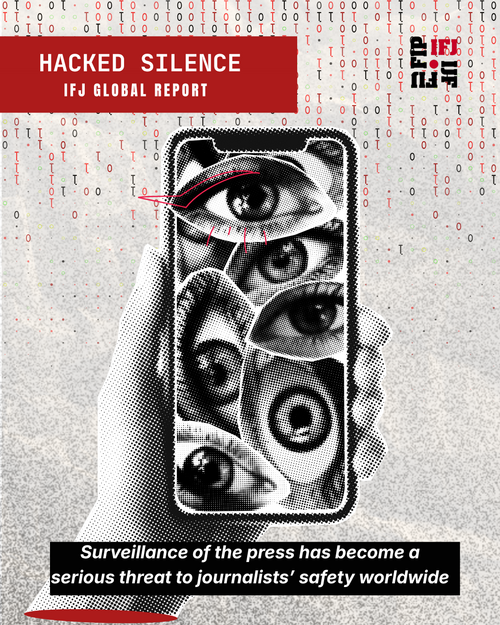
The report demonstrates that when journalists are surveilled, their ability to carry out their work - including securing the confidentiality of sources - is seriously jeopardised. When journalists know they are at risk of surveillance, it has a devastating effect on a free press, and deeply affects journalists’ private life, their safety, their sources, and ultimately, the public’s right to know.
The study was commissioned by the IFJ as the second of two studies. The first one Global Surveillance of Journalists: A Technical Mapping of Tools, Tactics, and Threats , published in April 2026, is an investigative study of the technologies and methodologies used to monitor, target, and intimidate members of the press worldwide.
Hacked silence documents the legal and regulatory environments in which journalists and media operate. It draws on a study of the laws, regulatory rules, resolutions, significant legal cases and rulings, adopted by major inter-governmental organisations – the United Nations, European Union, African Union and Organisation of American States.
The study’s scope is global, with further in-depth research drawing on case studies in 10 countries: India, Pakistan, Kenya, Italy, Serbia, Brazil, Mexico, El Salvador, Lebanon and Jordan.
A wider global context, including a focus on the systemic and widespread surveillance carried out by Israel against Palestinian journalists and the impact of surveillance by Russia/Belarus, was covered in the first report .
The case studies in this new report expose the failings and gaps in current legal and regulatory protections for media freedom and illustrate a spectrum of contexts, from democratic states experimenting with ‘lawful interception’ to authoritarian regimes using imported spyware to suppress dissent and control the press even beyond borders.
The report also highlights how telecommunications providers and major platform companies contribute to surveillance ecosystems.
The analysis reveals emerging patterns, notable contrasts, and persistent regulatory gaps across these diverse jurisdictions, drawing on constitutional norms, statutory laws, and recent case developments.
The study will form the basis of IFJ policy on surveillance, and will support advocacy and lobbying efforts by journalists’ unions, associations, media organisations and civil society organisations committed to media freedom and freedom of expression.
IFJ President Zuliana Lainez said: “When reporters suspect that every call, message, or movement may be watched, they are more likely to avoid sensitive investigations, drop sources, or resort to self-censorship. This study is a wake up call for journalists, media, citizens and governments. It clearly shows how surveillance of the press has become a serious threat to journalists’ safety worldwide. We need a global response to eradicate the surveillance of those who risk their life to inform the public. We urgently need stronger laws defining clearly what tools can be used, when, and by whom.“
The study is authored by human rights lawyer and global policy expert Paula Ligia Martins.
The study was commissioned by IFJ as part of its contribution to the Brave Media project , a global consortium of nine organisations led by BBC Media Action, and including Arab Reporters for Investigative Journalism (ARIJ), Equal Rights and Independent Media (ERIM), International Federation of Journalists (IFJ), Fondation Hirondelle, Media Institute of Southern Africa (MISA), Samir Kassir Foundation, SembraMedia, and the World Association of News Publishers (WAN-IFRA) .
Read the report on the website: here .
Download the full report in pdf: here .
The full story
This article is one source in a clustered incident — the cluster page carries the summary, timeline and every other outlet covering it.
