 Back Market.Us
 Phishing Resistant Authentication Market Size | CAGR of 19.3%
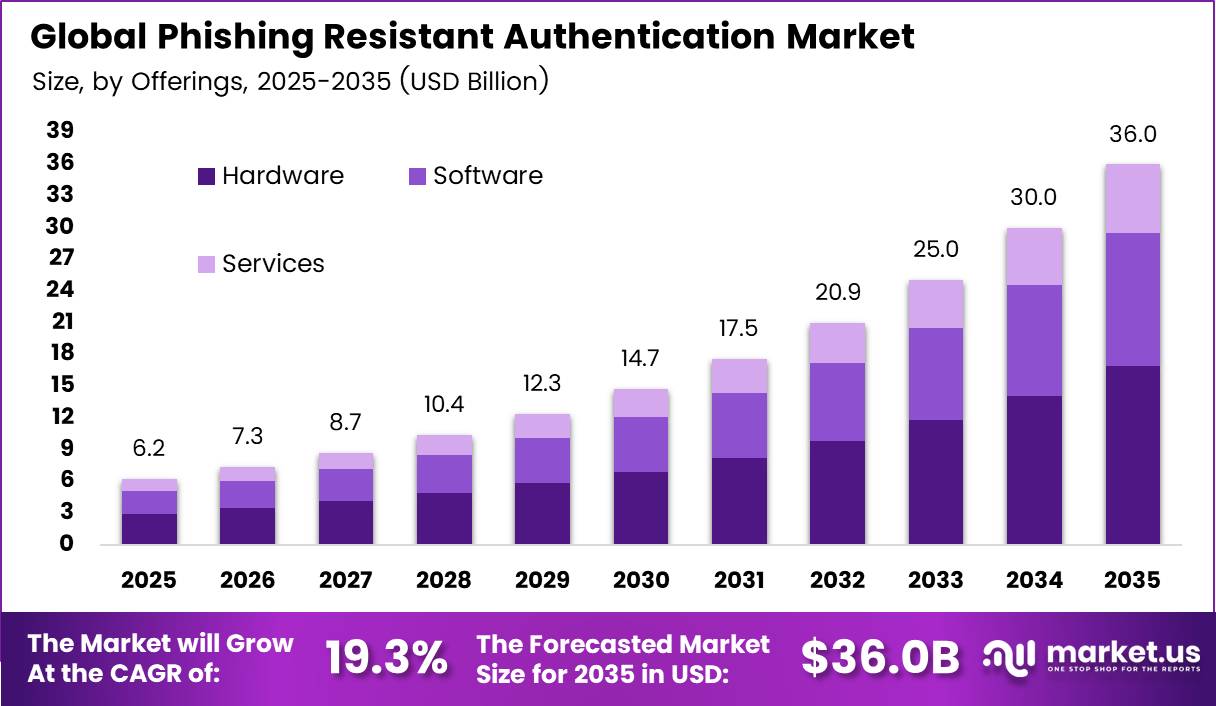
In 2025, the Global Phishing Resistant Authentication Market was valued at USD 6.2 billion . The market is projected to grow at a CAGR of 19.3% during 2026–2035, reaching approximately USD 36.0 billion by 2035. North America dominated the global market in 2025, accounting for more than 36.6% of the total market and generating approximately USD 2.3 billion in revenue.
Rising cyber fraud drives this growth. The FBI Internet Crime Complaint Center logged 859,532 complaints in 2024, with losses of USD 16.6 billion . That is a 33% jump over 2023. Phishing and spoofing ranked as the top complaint type.
Microsoft reported that phishing-resistant MFA blocks over 99% of identity attacks, even when attackers hold valid passwords. It also tracks 600 million identity attacks each day. These numbers push banks, hospitals, and public agencies to replace passwords and SMS codes with FIDO keys, passkeys, and certificate-based login tools.
The North America region faces the highest dollar losses from cybercrime. In 2024, cyber-enabled fraud caused USD 13.7 billion of the losses reported to the FBI. Federal rules also speed up adoption. The US Office of Management and Budget requires federal agencies to use phishing-resistant MFA under its zero trust strategy .
The region also hosts the largest identity vendors. Okta alone earned USD 2.919 billion in fiscal 2026, up 12% year over year. Strong buyer budgets, strict federal mandates, and a deep base of vendors keep North America ahead of every other region through 2035.
The Phishing Resistant Authentication Market stood at USD 6.2 billion in 2025 and will reach USD 36.0 billion by 2035. at a CAGR of 19.3% from 2026 to 2035.
Software leads the By Offerings segment with a 60.1% .
FIDO-Based Authentication leads the By Authenticator Type segment with a 58.1% .
Cloud leads the By Deployment Model segment with a 62.3% .
Government and Public Administration leads the By Industry Vertical segment with a 23.2% .
North America holds a 36.6% and generates USD 2.3 billion in revenue.
Software dominates with 60.1% due to scalable passkey platforms across enterprise apps.
Software leads this market because buyers want one platform that protects logins across every business app. Verizon’s 2025 breach report shows that stolen credentials started 22% of breaches, and phishing started another 16% .
Software also scales with little friction. The FIDO Alliance found that an average of 93% of user accounts at large online services can already use passkeys. This tells buyers the software layer is ready today. Firms often buy platform licenses first and add hardware keys only for high-risk staff.
Services grow fastest because rollout takes real work. CISA tells large firms to roll out phishing-resistant MFA in phases, starting with high-value users like executives. That means mapping systems, moving old apps, and training staff. The reward is clear: FIDO reports up to 81% fewer sign-in help desk tickets after passkey rollout.
FIDO-Based Authentication dominates with 58.1% due to browser-native passkey support across major platforms.
FIDO-based tools lead because they are now built into the phones, laptops, and browsers people already use. The FIDO Alliance estimates that 3 billion passkeys now protect consumer accounts. CISA calls FIDO/WebAuthn the only widely available form of phishing-resistant login, which gives buyers strong backing from a public agency.
Users also prefer it. Passkey sign-ins reach a 93% success rate, compared with 63% for other methods. Login time drops by 73% , from 31.2 seconds to 8.5 seconds. Faster and more reliable logins help firms win support from both staff and customers.
PKI and certificate-based tools grow fastest because certificate rules are getting much tighter. The CA/Browser Forum voted 29 to 0 to cut the maximum life of public TLS certificates from 398 days to 47 days by 2029. The limit already dropped to 200 days in March 2026 and falls to 100 days in 2027.
Cloud dominates with 62.3% due to fast rollout through hosted identity platforms.
Cloud leads because most firms already run their daily work on hosted services. Eurostat reports that 52.7% of EU enterprises paid for cloud services in 2025, up 7.4 percentage points from 2023. Once email and office tools live in the cloud, a cloud login layer is the simplest way to protect them.
Big vendors make this easier. Microsoft’s 2025 annual report shows Microsoft Cloud revenue rising 23% to $168.9 billion . That scale lets cloud providers ship passkey and certificate features to millions of business tenants without on-site installs.
Hybrid grows fastest because larger firms rarely move everything at once. Eurostat finds cloud use at 84.7% of large firms and 66.8% of medium-sized firms, yet these same firms still run older apps on their own servers. Hybrid tools let them protect cloud apps and in-house systems with the same keys. Security teams can then phase out old servers on their own timeline without losing protection along the way.
Government and Public Administration dominates with 23.2% due to federal zero trust phishing-resistant MFA mandates.
Government leads because public rules require it. The White House memo M-22-09 told U.S. agencies to send OMB and CISA a zero trust plan within 60 days. It also required public-facing systems to offer phishing-resistant login within one year. Agencies had to meet full zero trust goals by September 30, 2024.
Healthcare grows fastest because patient data faces heavy attacks. HHS received 663 reports of large health data breaches that happened in 2024. Together, they affected 242.9 million people, even though report numbers fell 9% from 2023.
Geopolitical Impact Analysis
Trade friction directly affects the hardware side of this market. Security keys, smart cards, and readers depend on secure chips and electronic parts made mostly in Asia. In April 2025, the WTO projected world goods trade would fall 0.2% under new US tariffs. It also warned North American exports could drop 12.6% and imports 9.6% .
Shipping risks add more pressure. UNCTAD reported that Suez Canal transits fell 42% from their peak, and weekly container ship transits dropped 67% . By May 2025, Suez tonnage still sat 70% below 2023 levels. Rerouting ships around Africa adds roughly 10 or more days per voyage. This slows token and card deliveries from Asian plants to European buyers and forces vendors to hold more stock.
Chip demand from the AI boom also tightens supply. The WTO found AI-enabling goods, such as semiconductors and servers, made up 47% of world goods trade growth in the first half of 2026. Trade in these goods rose 67% year over year. Secure element makers compete with AI buyers for wafer capacity, which raises chip prices for authenticator hardware.
Tensions also shift buyer choices. Public agencies now favor trusted local suppliers and cloud regions inside their own borders. This trend helps hybrid models grow and pushes vendors to build regional plants and data centers.
North America dominates the Phishing Resistant Authentication Market, holding a 36.6% and generating USD 2.3 billion in revenue. The US drives most of this demand. Victims over age 60 suffered the largest losses in the FBI 2024 data, which pushes banks and insurers to protect customer logins with passkeys.
The FBI logged 256,256 complaints with an actual loss in 2024, and the average loss reached USD 19,372 . These costs make the case for buying hardware keys and certificate tools. Federal policy adds a firm push. CISA Binding Operational Directive 22-01 and OMB zero trust rules require agencies to deploy phishing-resistant MFA.
Asia Pacific is the fastest-growing region in the Phishing-Resistant Authentication Market. India’s CERT-In handled over 1.5 million cyber incidents in 2023, which pushes banks and fintech firms toward stronger logins. Japan and South Korea drive passkey use through large mobile and telecom providers. The WTO projected Asian exports and imports would each grow 1.6% in 2025.
Europe holds a strong second position, led by Germany, France, and the UK. The EU NIS2 Directive covers 18 critical sectors and requires strong authentication controls. Thales, based in France, reported Cyber and Digital sales of EUR 3.852 billion in 2025, including EUR 2.397 billion from Digital activities. eIDAS 2.0 and the EU Digital Identity Wallet will drive PKI and certificate demand across member states.
Key Regions and Countries
Rest of Latin America
Middle East and Africa
Enterprise replacement of phishable authentication
Enterprise demand is shifting from adding another authentication factor toward replacing factors that remain vulnerable to impersonation: according to CISA, FIDO/WebAuthn binds authentication to the legitimate service, while NIST explicitly excludes manually entered one-time codes from phishing-resistant authentication.
The commercial mechanism is therefore broader deployment scope and recurring administration revenue, although native platform capabilities limit standalone credential pricing. The estimated +1.1-percentage-point contribution is an analyst sensitivity, not an institutional forecast.
All table percentages likewise represent percentage-point sensitivities around the supplied 19.3% baseline, using evidence available no later than October 2026; because these forces are already partly embedded in that baseline, they are not mechanically additive.
Even the deliberately conservative arithmetic stress test of simultaneously adding all positive rows produces 25.3% , subtracting all negative rows produces 15.3% , and applying every row produces 21.3% ; these are scenario bounds, not separately validated forecasts.
Incompatible legacy application estates
Applications without a compatible authentication interface impose an immediate purchasing stop for the affected deployment scope, rather than merely increasing administration effort. According to CISA, the widely available FIDO/WebAuthn route depends on supporting authentication infrastructure.
In an illustrative analyst sensitivity, not an observed institutional statistic, if 20% of qualified expansion orders encounter an interface hard stop and 50% of those remain unresolved through the purchasing cycle, 10% of qualified expansion orders slip; this order-level assumption supports testing a modest -0.7-percentage-point CAGR adjustment rather than implying a direct conversion between deferred orders and market growth.
Recovery Assurance Lifecycle Complexity
Phishing-resistant login does not remove the operational vulnerability created when a user loses access to an authenticator: according to NIST, cloud-based recovery can expose synced credentials to unauthorized access; NIST’s recovery guidance recognizes 4 general recovery classes; and Microsoft’s enterprise deployment account describes temporary access passes and identity verification as components of stronger onboarding.
The recurring burden is maintaining comparable assurance across enrollment, replacement, and recovery while continuing to serve existing users. In an illustrative analyst workload sensitivity, if 5% of enrolled users require assisted recovery annually and each case consumes 20 staff minutes, every 10,000 enrolled users generates approximately 167 annual support hours before escalation.
The estimated -0.6-percentage-point friction drag reflects the resulting support burden and rollout caution. Providers need reusable recovery workflows, risk-based escalation, and auditable authenticator replacement to protect service margins without weakening authentication assurance.
Managed authentication for underserved smaller enterprises
The opportunity is a deliberately constructed, channel-delivered service for smaller organizations that have not purchased enterprise-grade authentication operations, not the already active deployment of passkeys by large platforms.
An illustrative analyst unit-economic model assumes standardized onboarding reduces delivery labor per customer by 20% ; if onboarding labor represents 30% of first-year service revenue, unchanged pricing and other costs would improve first-year gross margin by 6 percentage points . These are conditional execution estimates, not source-reported savings.
The modeled +0.8-percentage-point upside requires repeatable channel distribution, sufficient customer density, and controlled service scope; it represents potential capture of currently unserved demand rather than growth automatically generated by existing platform adoption.
Tier 1 leaders include Microsoft, Thales, and Okta. Microsoft runs the largest identity platform through Entra. Its Microsoft Cloud revenue reached USD 168.9 billion in fiscal 2025, up from USD 137.7 billion in fiscal 2024. This scale lets Microsoft build passkeys into Windows and Microsoft 365 for millions of business users.
Thales posted group sales of EUR 22.1 billion in 2025, up 7.6% . Its Cyber and Digital segment earned adjusted EBIT of EUR 526 million , a 13.7% margin. Cyber sales came in at EUR 1.455 billion , down 7.1% . Thales supplies smart cards , PKI, and FIDO tokens to banks and governments. Okta earned USD 2.919 billion in fiscal 2026 and turned a GAAP operating income of USD 149 million . In August 2026, it closed its purchase of Permiso Security, a deal reported at USD 200 million .
Tier 2 challengers hold strong niche positions. Yubico, the leading hardware key maker, posted 2025 net sales of SEK 2,218.0 million . Its Q2 2026 sales rose 9.0% to SEK 543.9 million , with 11.7% organic growth. Intercede expects 2025 revenue of GBP 17.7 million , based on its PIV and credential software for US federal agencies.
Ping Identity, which manages over 3 billion identities, agreed to buy Keyless in October 2025 to add biometric MFA. HID Global, Entrust, Beyond Identity, and HYPR compete through passwordless platforms, physical access cards, and certificate services.
Top Key Players in the Market
HID Global Corporation
Microsoft Corporation
Ping Identity Corporation
Beyond Identity, Inc.
In August 2026 , Okta, Inc. completed its acquisition of Permiso Security, a deal reported at USD 200 million , to add identity threat detection across human, machine, and AI agent identities.
In August 2026 , Yubico AB reported Q2 net sales of SEK 543.9 million , up 9.0% , and perpetual bookings of SEK 437.1 million , driven by strong e-commerce and smaller contracts.
In November 2025 , Intercede Group plc secured new orders and renewals, including a US Department of State G-IDMS support renewal worth USD 1.15 million and an order of USD 0.63 million with 5.25 years of support.
In October 2025 , Ping Identity Corporation signed a definitive agreement to acquire London-based Keyless to add privacy-preserving biometric MFA to a platform that manages over 3 billion identities.
The full story
This article is one source in a clustered incident — the cluster page carries the summary, timeline and every other outlet covering it.
