 Back Discoveryalert.Au
 South Africa Critical Minerals Supply Chain Guide
The transformation of international mineral supply networks represents one of the most significant shifts in global economic geography since the establishment of traditional commodity trading systems. Advanced manufacturing economies increasingly recognise that resource security extends far beyond simple procurement strategies, encompassing comprehensive geopolitical risk assessment and long-term strategic planning. This evolution fundamentally challenges conventional approaches to supply chain management, where cost optimisation previously dominated decision-making processes.
Contemporary supply chain architecture reflects multiple converging forces: technological innovation accelerating demand for specialised materials, geopolitical tensions exposing concentrated supplier vulnerabilities, and environmental considerations reshaping acceptable sourcing practices. Furthermore, these dynamics create unprecedented opportunities for resource-rich nations to establish integrated value chains rather than remaining confined to raw material extraction roles.
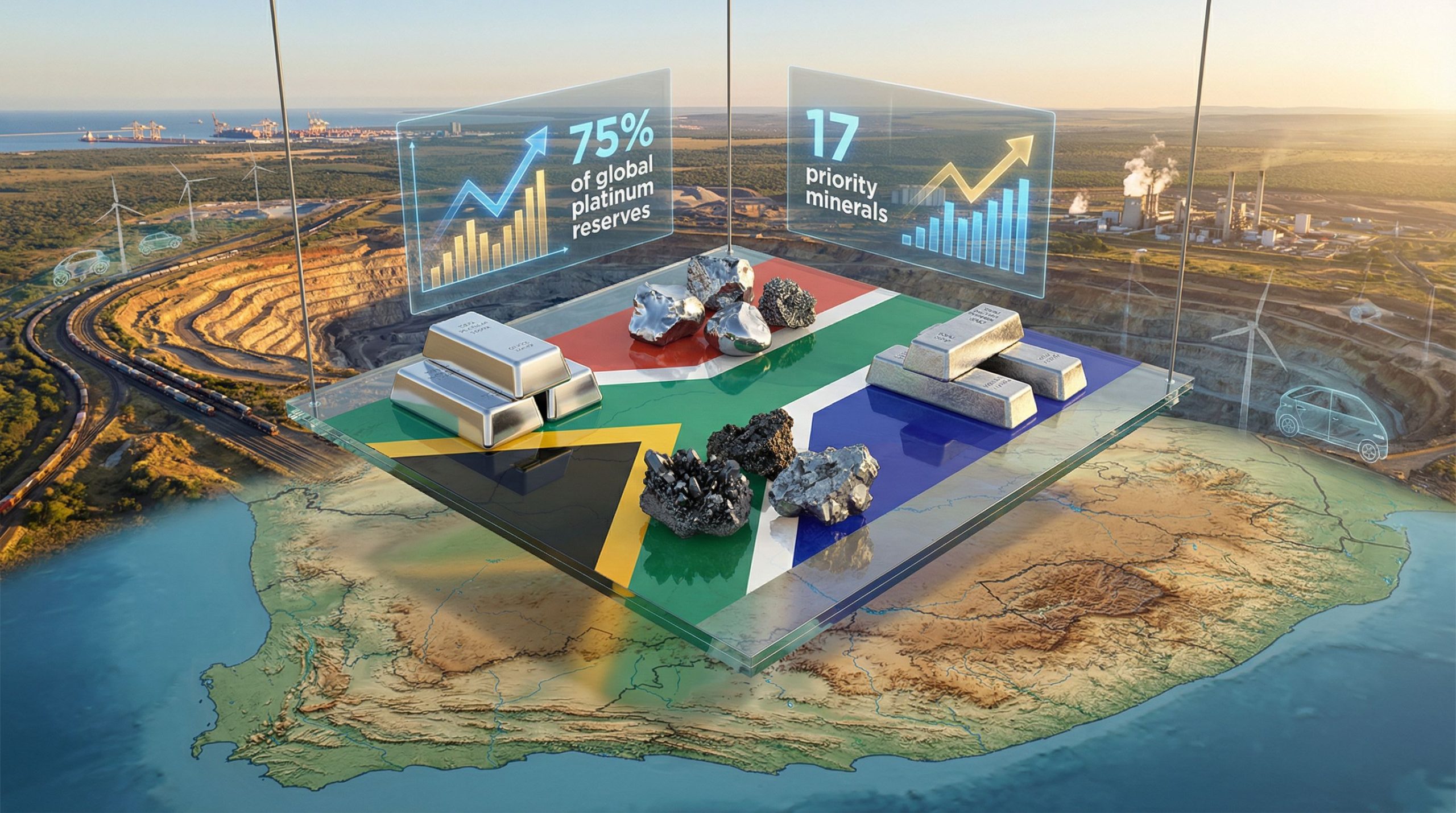
South Africa's emergence as a cornerstone supplier in global critical minerals markets demonstrates how geological advantages, combined with strategic policy development, can reshape international supply relationships. The nation's mineral endowment spans multiple high-value categories essential for technological advancement and energy transition infrastructure, positioning it strategically within the critical minerals energy transition .
Strategic Mineral Portfolio Concentration:
The concentration of multiple critical minerals within a single jurisdiction provides consuming nations with supply chain efficiency while creating strategic dependencies. In addition, South Africa's position as the leading supplier of four major critical minerals to the United States illustrates this dual dynamic, where procurement simplification accompanies increased geopolitical exposure.
The Bushveld Complex represents one of Earth's most significant geological formations for critical minerals concentration. This layered igneous intrusion contains not only the world's largest platinum reserves but also substantial chromium, vanadium, and associated precious metals. Consequently, the geological structure enables integrated mining operations targeting multiple mineral products from shared infrastructure.
Comparative Resource Advantages:
The Northern Cape manganese deposits represent some of the world's highest-grade ore bodies, providing extraction cost advantages compared to lower-grade alternatives. While the United States currently sources 100% of manganese imports from Gabon , South African deposits offer potential diversification opportunities for future supply arrangements.
South Africa's established mining ecosystem provides immediate scaling advantages that new mining jurisdictions cannot quickly replicate. Decades of infrastructure investment have created integrated transportation, processing, and export systems specifically designed for mineral extraction and beneficiation, supporting the broader mining industry innovation .
Existing Infrastructure Assets:
The transition from raw material export to processed mineral production creates substantial economic multiplier effects. However, processing capabilities enable South Africa to capture value-added opportunities while providing international partners with refined materials meeting specific technical specifications.
Southern African Development Community (SADC) coordination creates opportunities for specialised production clusters spanning multiple countries. Regional integration enables countries to focus on their comparative advantages while sharing infrastructure costs and supply chain risks across geographic boundaries.
Cross-border mineral supply arrangements already exist for specific commodities, providing templates for expanded cooperation. Furthermore, regional infrastructure projects, including transportation corridors and power generation facilities, support integrated value chain development beyond individual country capabilities.
International supply chain analysis reveals concentrated dependencies that create systemic vulnerabilities for consuming economies. The United States faces 100% import reliance for 11 critical minerals and significant dependence for an additional 26 materials, creating strategic exposure to supply disruptions, particularly from the US–China trade war impact .
Critical Import Dependencies:
"The United States remains import-reliant for 37 critical minerals, with China dominating processing capacity for rare earth elements, graphite, arsenic, and tantalum."
These concentrated supply relationships expose consuming nations to various disruption scenarios, from natural disasters affecting production regions to geopolitical tensions restricting export access. In contrast, South Africa's political stability and established trade relationships provide alternative supply channels reducing overreliance on single-country dependencies.
Supply chain vulnerability extends beyond simple geographic concentration to include processing capacity bottlenecks and transportation chokepoints. China's control over rare earth element processing exemplifies how downstream capability concentration can create strategic dependencies even when raw materials are geographically dispersed.
Processing Capacity Distribution:
Consequently, the geographic separation between mining operations and processing facilities creates additional vulnerability points within supply chains. Countries controlling both extraction and processing capabilities maintain strategic advantages during supply chain disruptions.
Contemporary investment patterns reflect fundamental shifts in how critical minerals projects are structured, financed, and operated. Traditional commodity-focused models are evolving toward integrated partnerships emphasising long-term supply security and technology transfer, aligning with comprehensive investment strategy 2025 approaches.
Public-Private Partnership Evolution:
Development finance institutions increasingly prioritise projects demonstrating sustainable development outcomes alongside commercial viability. Moreover, Environmental, Social, and Governance (ESG) criteria have become integral to project approval processes, favouring operations in jurisdictions with established regulatory frameworks.
International partnerships increasingly include technology transfer components enabling host countries to develop advanced processing capabilities. These arrangements create mutual benefits: consuming nations secure supply relationships while producing countries capture value-added opportunities.
Specific technology transfer areas include:
Long-term supply agreements provide revenue certainty enabling sustained technology investment and capability development. Furthermore, these contractual arrangements often include volume commitments, price mechanisms, and performance standards ensuring mutual benefits for all parties.
Critical minerals demand growth stems from converging technological and policy trends accelerating adoption across multiple economic sectors. Understanding these demand drivers provides insight into long-term market dynamics and investment opportunities, particularly within the broader critical minerals strategy framework.
The automotive industry's transition to electric powertrains creates unprecedented demand for platinum group metals, lithium, and rare earth elements. South Africa's PGM dominance positions it strategically within this transformation, particularly for fuel cell technologies and catalytic applications.
Automotive Mineral Requirements:
Platinum group metals maintain relevance across multiple automotive technologies, from traditional internal combustion engines to advanced fuel cell systems. This diversified application base provides demand stability despite technological evolution.
Wind turbine and solar panel manufacturing require specific critical minerals for magnetic components, conductive elements, and energy storage systems. However, South Africa's vanadium resources prove particularly relevant for grid-scale energy storage applications supporting renewable energy integration.
Vanadium redox flow batteries offer advantages for large-scale energy storage including long cycle life, scalability, and operational flexibility. Consequently, growing renewable energy deployment creates sustained demand for vanadium-based storage solutions.
Aerospace, defence, and electronics sectors require high-purity critical minerals for specialised applications. South Africa's processing capabilities enable targeting these premium market segments commanding price premiums above commodity-grade materials.
Premium Application Markets:
Successful critical minerals development requires addressing multiple implementation challenges spanning infrastructure constraints, regulatory complexities, and market volatilities. Comprehensive risk assessment and mitigation planning prove essential for project success.
Infrastructure Development Requirements:
Mining licence processing delays and regulatory uncertainty can significantly impact project development timelines and investment decisions. Streamlined approval processes while maintaining environmental and social standards create enabling environments for sustainable development.
Clear policy frameworks provide investor confidence while ensuring community benefits and environmental protection. In addition, transparent regulatory processes reduce project risks and enable long-term planning essential for capital-intensive mining operations.
Critical minerals prices experience significant fluctuations based on technological changes, policy developments, and geopolitical factors. Diversified market exposure and long-term supply agreements help mitigate price volatility impacts.
Risk Management Strategies:
International relations increasingly influence critical minerals supply arrangements as nations recognise resource security implications for economic competitiveness and national security. Strategic partnerships extend beyond commercial transactions to encompass technology cooperation and mutual security arrangements.
Countries are forming bilateral agreements for critical minerals supply including security of supply guarantees, technology sharing provisions, and infrastructure development cooperation. However, South Africa's non-aligned foreign policy enables partnerships across multiple regions without exclusive arrangements.
These agreements often include:
Export restrictions and tariff policies in major producing countries create market opportunities for alternative suppliers. South Africa's established trade relationships provide market access advantages in key consuming regions including the United States, Europe, and emerging Asian markets.
International trade agreements increasingly incorporate critical minerals provisions recognising their strategic importance. Furthermore, these arrangements can provide preferential access, reduced tariffs, and streamlined regulatory processes for participating countries.
Critical minerals markets face multiple potential transformation scenarios driven by technological breakthroughs, policy changes, and geopolitical developments. Scenario planning enables stakeholders to prepare for various future possibilities while maintaining strategic flexibility.
Breakthrough developments in battery chemistry, alternative materials, or processing technologies could dramatically alter demand patterns and competitive dynamics. South Africa's diverse mineral portfolio provides resilience against single-commodity dependency while enabling participation in multiple technology pathways.
Potential Technology Disruptions:
Accelerated decarbonisation policies could increase critical minerals demand beyond current projections while creating pressure for low-carbon mining operations. Consequently, South Africa's renewable energy potential enables development of carbon-neutral mining operations meeting evolving environmental standards.
Carbon pricing and environmental regulations may favour suppliers demonstrating sustainable production practices. South Africa's ability to power mining operations with renewable energy provides competitive advantages in carbon-constrained markets.
Enhanced African continental trade integration could create larger integrated markets for processed critical minerals enabling greater economies of scale. Moreover, South Africa's industrial capabilities position it as a regional processing hub serving continental and international markets.
Continental Integration Benefits:
Successful participation in evolving critical minerals markets requires coordinated action across multiple stakeholder groups including government policymakers, industry participants, and international partners. Clear strategic frameworks enable effective collaboration whilst maximising mutual benefits.
Regulatory Streamlining : Accelerate licensing processes whilst maintaining environmental and social standards through digital systems and coordinated agency review processes.
Infrastructure Investment : Prioritise transportation, energy, and water infrastructure supporting integrated value chain development beyond individual project requirements.
International Engagement : Establish clear frameworks for technology transfer partnerships and supply agreements protecting national interests whilst encouraging foreign investment.
Value Chain Integration : Develop downstream processing capabilities capturing value-added opportunities rather than remaining limited to raw material extraction.
Technology Partnerships : Engage in comprehensive partnerships including technology transfer, skills development, and operational capability enhancement.
Regional Cooperation : Participate in continental integration initiatives achieving scale advantages and risk distribution across multiple countries.
Comprehensive Engagement : Establish partnerships extending beyond simple procurement to include technology transfer, infrastructure development, and mutual capacity building.
Development Finance : Support infrastructure and capability development through multilateral development banks and bilateral development agencies.
Supply Security Arrangements : Create long-term supply agreements providing security for all parties whilst enabling sustained investment in production capacity. According to Africa Business Insider , South Africa emerges as a major player in the US critical minerals supply chain, highlighting the strategic importance of these partnerships.
The South Africa critical minerals supply chain represents a transformative opportunity for global resource security, offering diverse mineral resources, established infrastructure, and strategic positioning that can reshape international supply relationships. The South African government's official critical minerals strategy provides a comprehensive framework for developing these capabilities whilst ensuring sustainable development outcomes.
This analysis is based on publicly available information and market assessments. Investment decisions should consider multiple factors including market conditions, regulatory environments, and project-specific circumstances. Mineral exploration and production involve inherent risks including commodity price volatility, operational challenges, and regulatory changes that may affect project outcomes.
Discovery Alert instantly alerts investors to significant ASX mineral discoveries using its proprietary Discovery IQ model, turning complex mineral data into actionable insights. Understand why major mineral discoveries can lead to significant market returns by exploring Discovery Alert's dedicated discoveries page , showcasing historic examples of exceptional outcomes and begin your 14-day free trial today to position yourself ahead of the market.
The full story
This article is one source in a clustered incident — the cluster page carries the summary, timeline and every other outlet covering it.
