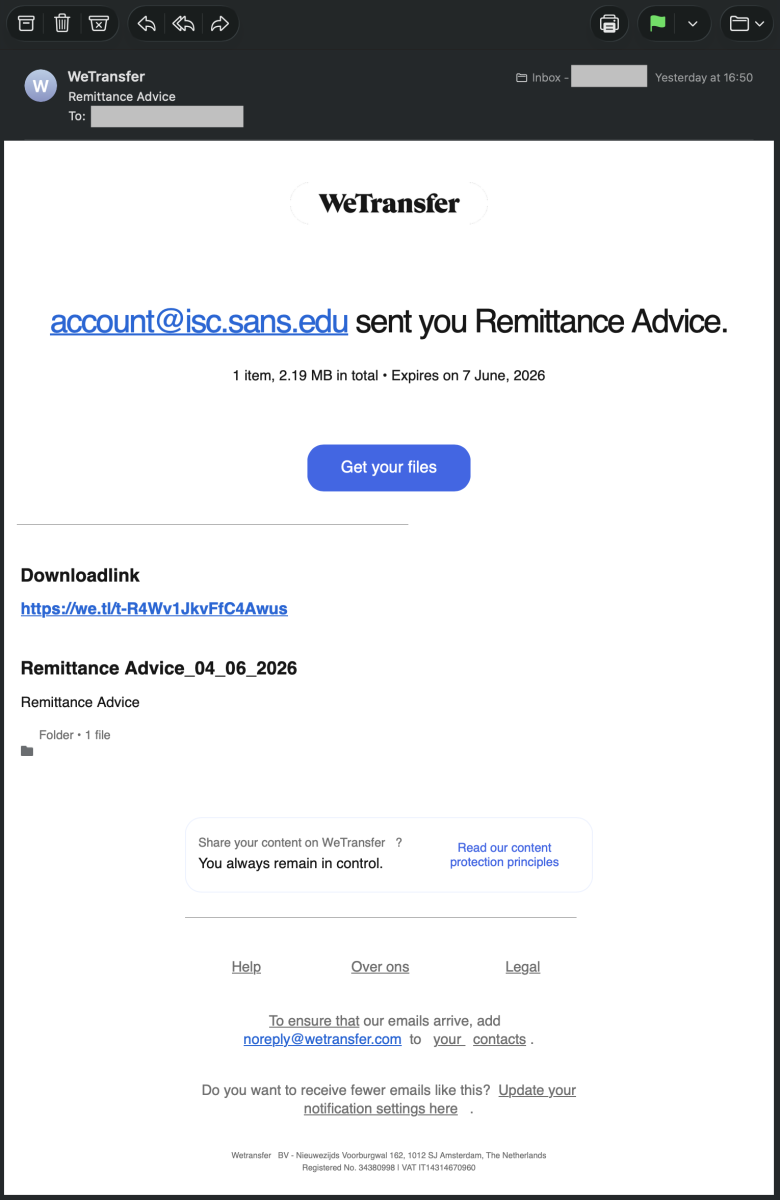
A few months ago, I wrote a diary a payload that was embedded into a JPEG picture. It was a MSI-branded background[ 1 ]. Yesterday, I spotted another one! It seems that the technic is getting more and more popular. This time, it started with a mail containing a WeTransfer link.
Often, the WeTransfer brand is abused in phishing emails. Here, it's was an official link:
The thread-actor shared the initial file via this platform. The file is a piece of Javascript called "Remittance Advice.js" (SHA256:8a83de81fbac4eb0961f3d58982f299664a5fa4c874c7469e69f85f3fc5bd33f).
The contains a lot of junk code that will just do nothing:
Every for-loop will just move to the line. In the middle of the file (>2MB), we have the interesting code that will perform the following tasks:
It will decode the payload in an environment variable:
The obfuscation technique used is ROT13, old but still very efficient:
PowerShell is executed throug WMI:
This code will fetch an MSI background JPEG file from this location:
Note that the threat-actor likes to use well-known services to store his/her payloads. workers.dev is the default, free subdomain provided by Cloudflare for deploying serverless applications[ 2 ].
The technique to hide the payload is the same as my diary. The Base64-encode payload is delimited here with "IN-" and "-in1". To defeat simple Base64 lookups, all "A" characters have been replaced by "#". Once decoded, the payload is a .Net DLL (SHA256:184a3008adff54cb345a599b4f3ca0c7bde29d8ac8379783ff40cd4e7ecc931b). It's a modified version of the Microsoft.Win32.TaskScheduler, an open-source .NET library for managing Windows Task Scheduler[ 3 ].
The PowerShell payload will also fetch another file that will be passed to the loaded malicious DLL:
Here again, a legit online service is used. r2.dev is the default domain used by Cloudflare R2 to serve files and assets stored in public cloud-native buckets. It is a globally distributed, S3-compatible object storage service that allows developers to store large amounts of unstructured data[ 4 ].
The file looks to be another background and contains probably another payload protected by steganograpy (very common with the .Net loaders):
I'm now reversing the .Net loader. Stay tuned for more details soon!
[1] [2] [3] [4]
Xavier Mertens (@xme) Xameco Senior ISC Handler - Freelance Cyber Security Consultant PGP Key