 Back Firstpost
 What is America's 'mother of all bombs'? Can it destroy Iran's buried nuclear sites?
The ‘Mother of All Bombs’, or MOAB, is back in the spotlight amid reports of potential military strikes against Iran. Weighing 21,600 pounds, the massive conventional weapon can devastate surface targets, but its limitations raise questions its effectiveness against deeply buried Iranian nuclear facilities
Contingency planning for United States strikes on Iranian military and energy infrastructure includes the potential deployment of the GBU-43/B Massive Ordnance Air Blast Bomb (MOAB) — colloquially known as the "mother of all bombs," reported CNN on Thursday.
But experts are weighing whether the MOAB is the right tool to achieve Washington’s strategic objectives in Iran.
What is the 'mother of all bombs'?
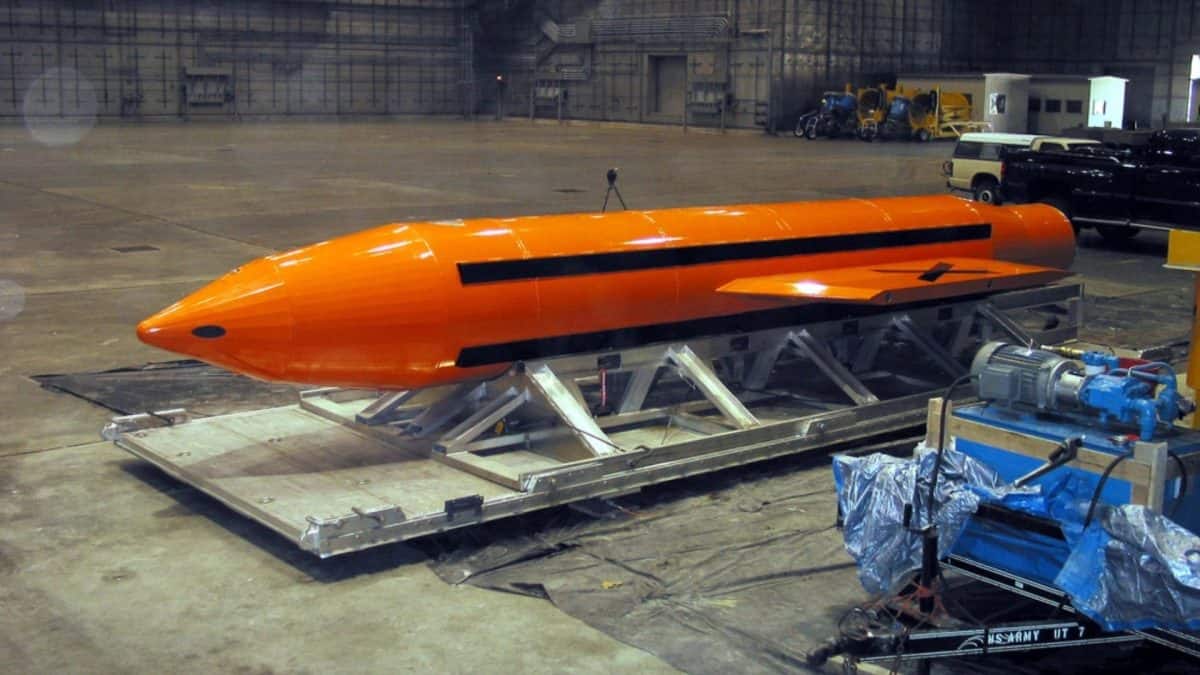
The GBU-43/B Massive Ordnance Air Blast (MOAB) is a 21,600-pound (approximately 9.8 metric tonne) GPS-guided, air-delivered munition.
Developed in the early 2000s by the Air Force Research Laboratory ahead of the 2003 invasion of Iraq, it represents the largest conventional, non-nuclear thermobaric-style weapon in the United States military inventory.
Official designation : GBU-43/B Massive Ordnance Air Blast Bomb
Weight : 21,600 lbs (9,800 kg)
Explosive filler : 18,700 lbs of H-6 (a high-explosive mix of RDX, TNT, and aluminium powder)
Length : 30 feet (9.1 metres)
Diameter : 40.5 inches (1.03 metres)
Guidance system : GPS/Inertial System (INS) with grid fins for flight trajectory stabilisation
Delivery vehicle : MC-130 Combat Talon/Hercules cargo aircraft (dropped via cargo ramp on a sled platform)
Unlike standard aerial bombs carried in the internal bomb bays of fighter jets or stealth bombers, the sheer bulk and length of the MOAB make it impossible to fit inside conventional combat aircraft.
Instead, it is loaded into the cargo hold of an MC-130 transport aircraft, pushed out on a wooden sled via a drag parachute, and guided toward its target using satellite positioning.
How does an MOAB work?
The MOAB is designed primarily as an air-burst weapon. Guided by satellite coordinates, the bomb does not impact the ground to create a deep crater. Instead, it uses a proximity fuze to detonate approximately 6 feet (1.8 metres) above the ground surface.
When ignited, the 18,700 pounds of explosive filler release an astronomical amount of chemical energy in microseconds. The blast wave propagates horizontally outward, producing severe overpressure.
A shock wave or hyper-velocity wall of compressed air radiates outward, destroying buildings, soft vehicles, above-ground bunkers, and radar installations across a blast radius extending approximately 1 mile (1.6 km) in every direction.
The rapid combustion consumes massive volumes of ambient oxygen, creating a localised vacuum as air rushes back into the explosion zone, collapsing subterranean tunnel entrances, rupturing lungs, and suffocating troops hidden within shallow cave structures or soft shelter networks.
The intense flash, shockwave, and massive mushroom cloud were intentionally engineered to create psychological shock, demotivating defending forces.
Has an MOAB been used before?
Despite being designed in 2002 and tested in 2003 at Eglin Air Force Base, Florida, the MOAB sat in the US arsenal unused for nearly 15 years.
The MOAB saw its combat debut on April 13, 2017, when a US Air Force MC-130 dropped a single GBU-43/B on an ISIS-K (Islamic State Khorasan Province) tunnel and cave complex in the Achin District of Nangarhar Province, Afghanistan.
The target was a dense complex of natural caves, improvised tunnels, and anti-personnel minefields used by ISIS fighters to evade air surveillance.
The strike collapsed cave entrances, detonated secondary munitions caches, cleared heavily mined terrain, and eliminated over 90 combatants without causing confirmed civilian casualties, according to official reports.
The 2017 attack demonstrated the exact role the MOAB was created for that is neutralising spread-out surface networks, shallow cave complexes, and clearing heavily defensive terrain where ground forces would otherwise face severe casualties.
Can the 'mother of all bombs' destroy Iran's buried nuclear facilities?
The short answer from military experts is no.
The MOAB is almost entirely ineffective against deeply buried nuclear facilities such as Fordow or Natanz.
The zero penetration design of the MOAB is a thin aluminum casing built to maximise explosive blast energy in open air. If dropped directly onto solid rock or reinforced concrete, the bomb casing would break apart upon impact prior to optimal detonation. It cannot dig through rock.
Iran’s Fordow Fuel Enrichment Plant is carved directly inside a mountain under 200 to 300 feet (60 to 90 metres) of solid granite and reinforced concrete. An air-burst explosion on top of the mountain would leave the centrifuge halls untouched beneath the rock layers.
One major concern is also the fact that the MOAB must be dropped from a slow-moving, non-stealthy cargo plane (MC-130).
Flying a cargo plane into heavily defended Iranian airspace — guarded by air defence systems like the S-300 and domestic Khordad-15 batteries — would expose the delivery crew to extreme risk unless total air supremacy is established first.
What could be used against Iran's underground facililities?
If the MOAB cannot destroy Iran's underground nuclear sites, what weapon can? The true "bunker buster" in the US arsenal is the GBU-57 A/B Massive Ordnance Penetrator (MOP).
The GBU-57 MOP is a 30,000-pound precision-guided weapon engineered out of thick, hardened steel casing.
Unlike the MOAB, the MOP carries a smaller proportion of high explosives relative to its weight, utilising kinetic momentum to drive deep into the earth before detonating.
It can penetrate up to 200 feet (60 metres) of earth or up to 60 feet (18 metres) of high-compressive-strength reinforced concrete.
The MOP is carried exclusively inside the stealthy internal bomb bays of the B-2 Spirit stealth bomber (and future B-21 Raider), allowing it to penetrate contested air defence networks after which, equipped with the Large Penetrator Smart Fuze (LPSF), it counts subterranean voids and structures to trigger detonation precisely inside underground rooms.
To defeat targets buried beneath granite mountain ranges, military doctrine relies on "stacking" — dropping multiple GBU-57 bunker busters sequentially onto the exact same GPS coordinates so that each successive bomb penetrates deeper through the crater left by the one.
So, why is an MOAB being considered by the US?
Defence experts point to several strategic applications of an MOAB across Iranian territory:
Oil and energy infrastructure
Iran’s primary economic hubs — including oil refineries, export terminals on Kharg Island, power grids, and fuel storage facilities — consist of spread-out, above-ground steel tanks and piping.
A single MOAB air-burst explosion over an oil refinery or storage park could destroy vast energy production facilities in one strike, adding more pressure on the regime.
Coastal defence and radar systems
To secure passage through the Strait of Hormuz, US forces would need to destroy Iranian anti-ship missile batteries, radar systems, and coastal command hubs hidden along rocky coastlines.
The MOAB's wide shockwave can clear large surface sectors of mobile launchers, anti-air defence positions, and exposed communications bunkers.
Shallow tunnel entrances
While the MOAB cannot penetrate deep centrifuge halls, its overpressure wave can collapse the entrance portals, ventilation shafts, and access roads leading into underground facilities.
Psychological warfare and deterrence
The MOAB remains a potent psychological symbol. Leaking or confirming that strike plans include the largest non-nuclear weapon signals a willingness to engage in high-intensity, unrestricted conventional bombardment.
With inputs from agencies
what is america mother of all bombs can it destroy iran buried nuclear sites
Mithai on a budget? Why India's sugar prices are soaring ahead of the festive season
Did Kash Patel visit Russia? Why a row has erupted over FBI director's travel plan
Imran Khan issued ‘Leave India’ notice: Can OCI cardholders participate in a political protest?
US ends automatic work permit extensions: How will it affect Indians?
Why foie gras is on the ballot in 2 US cities in November midterm elections
The full story
This article is one source in a clustered incident — the cluster page carries the summary, timeline and every other outlet covering it.
