 Back Finance.Biggo
 Will O'Brien: How a $50000 Underwater Drone Could Turn a $3 Trillion Ocean Economy ...
200 cables carry virtually all global internet traffic between continents, and Will O'Brien says taking out many of them would not be especially hard. The cofounder and president of Ulysses, a company that builds autonomous underwater robots, points out that every cable running from the United States into Europe pretty much crosses Ireland's west coast — a single geographic choke point. "There are far fewer cables than people think," Chris Sacca, his host on the Cheeky Pint podcast and an early Ulysses investor through Lower Carbon Capital, added. The fact that this infrastructure is monitored only when something goes wrong is, in O'Brien's framing, a market failure waiting for a cheaper robot.
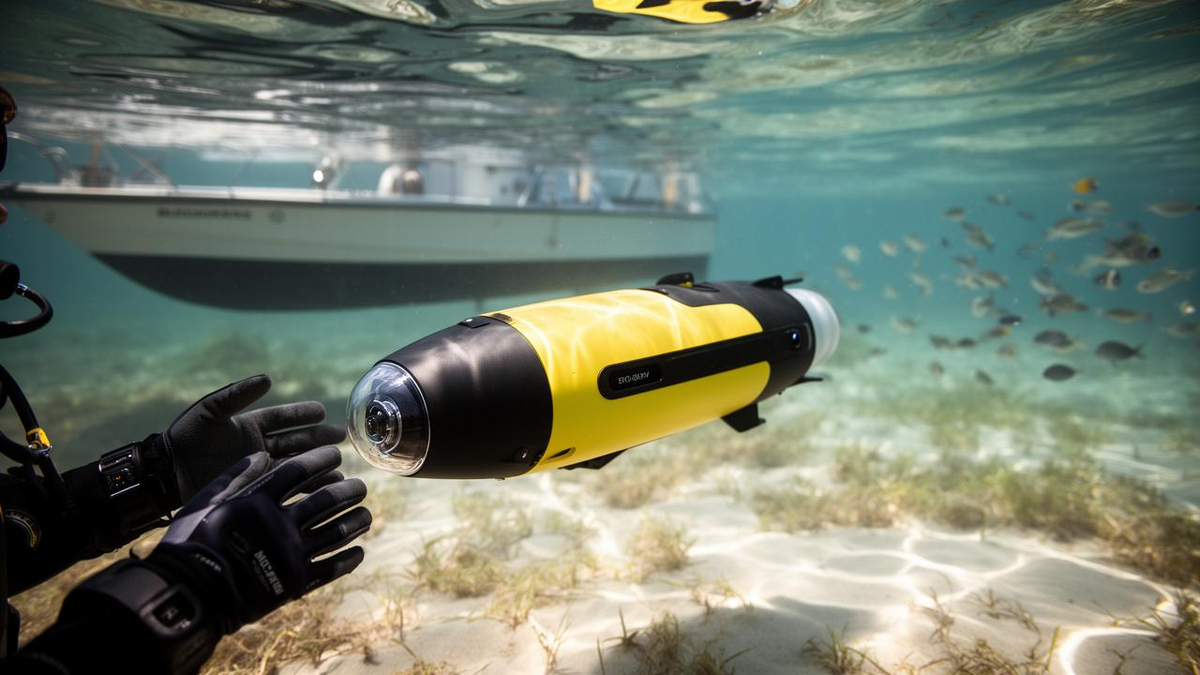
Ulysses' answer is a two-part system designed to make ocean monitoring persistent rather than episodic. At the surface is Leviathan, an autonomous surface craft with a 2,000 nautical mile range. Below is Mako, the submersible that Leviathan launches, recharges wirelessly, and recovers. A Starlink connection links the whole system back to shore, which O'Brien calls "a huge enabling technology for us." The pitch to buyers is not subtle.
A $50,000 Robot Against a $5 Million Incumbent
The commercial thesis begins with a stark number. O'Brien says the US Navy's most common autonomous underwater vehicle costs $5 million. Ulysses' target price for the Mako base vehicle is as low as $50,000 — a two-orders-of-magnitude gap. He concedes the comparison narrows once advanced sensing and are layered on: "then you get to one order" of magnitude. But the low-cost platform is the point, because it makes economics that are otherwise absurd suddenly workable.
The incumbent cost structure, he argues, is driven as much by labor law as by hardware. A chartered ship for ocean work runs a few hundred thousand dollars per day. Because crews can only work roughly eight hours but a ship is expensive to keep idle, operators need three shifts. Each shift needs a manager. Once the crew crosses eight people, the vessel requires a captain, a second mate, a cook, and a doctor. The result is a massive crew and daily costs in the hundreds of thousands of dollars for what is often a single underwater task — finding a mine, inspecting a power cable, planting seagrass.
Mako finds its location, scans or manipulates, and returns when Leviathan calls it . The vehicle carries roughly 100 times more onboard compute than any other autonomous underwater vehicle, running a full NVIDIA 5090 alongside an Intel CPU. O'Brien is deliberately modest the current state of the autonomy software — a polygon to map generates a lawnmower track, and the vehicle can execute rudimentary obstacle avoidance like rising above a rock — but the compute headroom exists because intelligent robotic work underwater requires local sense-making.
Why Modularity Was the Decision That Let Ulysses Say Yes to the Navy
Ulysses started three years ago doing seagrass restoration. In its second year, it landed its first US Navy contract for mine countermeasures and its first offshore wind developer contract. O'Brien attributes the jump across sectors to architecture choices made at the start: Mako is built from what he calls "Lego building blocks." Extra battery packs add roughly 150 nautical miles of endurance. A different rear thrust module makes the vehicle faster. Stereo cameras provide 3D imaging. A sonar front module produces bathymetric maps. Because those interfaces existed early, he says, adopting new missions was easy when the Navy or energy companies came with new problems.
The offshore wind work addresses a specific California objection to floating wind. Power cables in the water attract abandoned fishing lines. Those lines entangle dolphins and whales, and that entanglement is one of the biggest obstructions to permitting. Ulysses is building a sensing system that maps the cables daily, checks structural integrity, detects snagged lines, and carries an implement to cut them free.
On mine countermeasures, O'Brien notes the Navy work was underway before the Strait of Hormuz became a live topic — framing it as a structural need rather than a reactive purchase.
The Real Engineering Constraint Is Not Pressure. It Is Bandwidth.
O'Brien ranks the engineering challenges in a way that inverts common assumptions. Corrosion is manageable through coating and anodizing. Pressure is manageable at the depths Ulysses operates — roughly 1,500 meters, which he says is where most important economic activity happens today, with critical minerals likely to pull work deeper in the future. The real constraint is communications.
Acoustic links deliver something like 10 kilobytes per second over five kilometers. "You can do like 10 kilobytes per second. Over like five kilometers. Acoustically," O'Brien said. That bandwidth ceiling — which host John compares to a dial-up modem — forces most decision-making to run locally on the vehicle. It is also why the surface craft matters so much: it is the recovery, charging, and connectivity point. O'Brien flags distance from repair and recharge as a structural difficulty, and says that in future the autonomous surface craft should be able to repair the underwater vehicle and swap modules "vending machine style."
The Factory Problem: Turning Down Contracts While Suppliers Make 100 Units a Year
The most operationally detailed part of the conversation is not robots but supply chains. O'Brien's framing is blunt: "Right now, our main problem is building things. We are saying no to contracts. We have more demand than we can supply." The daily question at Ulysses is how to build a factory, not how to sell more. The company plans to open a facility year that he says could be one of the largest underwater drone factories in the world by unit count.
The scale argument behind vertical integration is a comparison of two markets. "There's 20 million aerial drones built every year. There's maybe 1,000 to 2,000 underwater drones. For us to really fully manifest our vision, we need to be building millions of underwater drones," O'Brien said. To reach that scale, Ulysses deliberately builds on electronic vehicle, drone, and consumer-electronics supply chains where components are made in the millions, and avoids maritime supply chains. His concrete example: one supplier, when asked, makes only 100 to 200 of a needed component per year — nowhere near enough for a company planning to build a few hundred vehicles year, possibly 1,000.
The build-vs-buy roadmap is staged. The first vehicle was 80% off-the-shelf parts; the company is now on generation five. Software is built from scratch in-house, because Ulysses eschews existing hardware actuation frameworks — its vehicle looks different from other underwater robots. Sonar is currently bought off the shelf, but Ulysses is hiring an acoustics team to build it in-house year. Inertial systems are also bought today, with internal prototypes intended to replace existing suppliers at a fraction of the price and on a scalable supply chain. Manufacturing is one cofounder's entire remit.
John places this pattern in a broader investing thesis: companies start cobbled together from other people's components, then discover bottlenecks as they scale, and each bottleneck becomes an opportunity. He cites a portfolio company, Giga, that taught itself to build transformers from YouTube videos and then went to China to study manufacturing — the same religion, he argues, that came out of SpaceX and Tesla.
Why Slow, Sticky Buyers Suit a Venture-Scale Company
Sacca raises the objection directly: long procurement cycles and government buyers can kill a company before the contract closes. O'Brien pushes back on the premise. He argues venture-scale companies are well suited to these customers because they can fund the R&D and wait, and because the contracts are very sticky once won — a buyer does not want to spend two years replacing an incumbent. His experience selling to government dates to his first startup, which he describes as the first scooter-sharing company in the UK and Ireland. He loved it for two reasons: hard to lose, and the technology reaches people who genuinely need it.
Sacca and John largely endorse this. Sacca says that once these companies reach the contracting phase they are "very reliable and very bankable," and that bridging the gap to that point is the investor's job. John says the Department of Defense has been one of the most sober and consistent customers for their work, and that the Navy and DoD coming inbound to startups is itself a new muscle. The friction is administrative — master services agreements, health and safety requirements on the energy side, contract vehicles and clearances on the government side — not a question of whether the buyer wants the product.
O'Brien also draws a competitive line. He says Saronic does not have an underwater vehicle and is effectively becoming a new shipyard, and that Ulysses differs from firms like Anduril because it is not focused on making things explode. "Any numbnuts can put C4 on a vehicle and make it go boom," he said. "The very difficult, interesting technical question is, how do you build a general-purpose underwater robotic platform?" That platform, in his framing, is what unlocks the ocean at scale.
Seagrass, Fisheries Collapse, and a Three-Stage Theory of Frontier Development
The company never fully left its conservation origins. Seagrass covers 2% of the seafloor but holds 20% of the ocean's carbon, and 20% of commercially important fish stocks rely on it as habitat. O'Brien calls it the most slept-on plant, contrasting it with coral, which gets the attention and the funding. The restoration workflow Ulysses runs is: map where seagrass exists and where it does not, build a habitat suitability model based on depth, water clarity, and other features to identify restoration sites, find flowering plants producing seeds, collect the seeds, and deposit them at the identified sites. Projects are underway in Virginia, Southern Florida, Sausalito in California, the Great Barrier Reef, and elsewhere.
The urgency case is fisheries collapse. Current projections, he says, suggest many critical fish stocks could be wiped out around the 2040s, that billions of people depend on fish as a primary protein or income source, and that overfishing plus habitat loss are the drivers. The restoration rate, he says, is 100 to 1,000 times slower than the loss rate. Regulation is the biggest barrier — he calls it "green tape" — and a project in a very endangered seagrass location in Australia, potentially the largest restoration project in the world, has been stuck.
The broader thesis is that lowering the cost of operating in the ocean unlocks new industries, in the same way reusable launch lowered the cost of orbit. O'Brien's framework for frontier development has three stages: an expedition period justified by a single high-value use case (fur and pelts in the American West, defense satellites in space), then more time and precision in the domain, then persistent settlement enabled by infrastructure (the railroad in the West, reusable launch in space, persistent robotic systems at sea). The ocean version of that third stage, he says, is what turns it "from a $3 trillion economy into a $10 trillion-plus place for commerce." He notes that more of Mars' surface has been mapped than the depths of Earth's ocean, that over 75% of the planet has no eyes on it, and that fewer than roughly 100 people work on the ocean frontier daily. He describes himself as a pro-growth environmentalist and eco-pragmatist.
Undersea Cables Are the Forgotten Critical Infrastructure
The closing stretch turns to cable security, and both O'Brien and the hosts treat it as a live vulnerability. Cables are typically taken out by accidental anchor draggings, though some incidents are not accidental. Targeted demolition of many of them, O'Brien says, would not be especially hard. He also says it is not difficult for China to tap them. He has some undersea cable work at Ulysses that he declines to detail.
John, who says he co-led the team at Google that built its data centers and transoceanic fiber, adds operational detail: fiber is more fragile than data centers. Sacca makes the point vividly: "The way you take a data center offline is you bring a pair of fucking garden shears and you cut the fiber that goes through." John recounts finding cable routes in Oregon by driving the coast looking for "call before you dig" signs, and once finding a street named Five Nines. Sacca notes that until diverse providers like Starlink exist, snipping fiber is sufficient to disconnect entire regions.
O'Brien's prescription is a persistent defense network monitoring critical waterways 24/7 — something he says is far too expensive to do manually, which is the same argument that underpins his entire commercial case. The geography of the Ireland choke point, and comparable points in Asia and the Middle East, makes the vulnerability structural rather than theoretical.
From "Make Something People Want" to "Make Something the World Needs"
Asked what distinguishes the current cohort of hardware founders, O'Brien says the operative motto has shifted from Y Combinator's "make something people want" to "make something the world needs." He borrows a distinction between head-based founders — Jeff Bezos as the canonical example, who saw the internet growing 30% a year and picked books as the obvious first product — and heart-based founders, with Steve Jobs as the canonical example. He places the current cohort closer to the heart-based end, with a more spiritual motivation.
He offers several possible explanations without committing to any single one: many founders in their late 20s were in college during COVID and feel cheated or forced into the digital world, wanting to cause impact in the physical one; more people are returning to organized religion; or the "woke era" shaped them. On faith personally, he says it is very important to him, that he met many of his closest friends in San Francisco through church, and that he lives with three other Christian men who all run tech companies. He jokes that he might need a Student's t-test to check the reliability of his small sample, but says the correlation is noticeable to him.
That statistical reference comes from the episode's opening digression into Guinness as an innovation case study. O'Brien describes Guinness running undirected in-house R&D from the 1890s, hiring smart people and telling them to find a problem. William Sealy Gosset developed small-sample statistics there and had to publish under the pseudonym "Student" so competitors would not learn Guinness was hiring researchers — hence the Student's t-test. The widget, Project ACORN, was voted above the internet in a 1990s ranking of top-20th-century inventions. It is, in O'Brien's telling, the same religion of patient, undirected innovation that he is trying to practice at Ulysses.
The tensions worth tracking are two. O'Brien wants millions of underwater drones and describes the ocean as a $3 trillion economy that persistent robotics could more than triple. But the company is currently supply-constrained, turning down contracts, and building its own sonar, inertial , and factory capacity because its suppliers make 100 to 200 units a year. The bet is that vertical integration converts a demand-rich, supply-poor position into scale before the procurement cycles that fund it run their course. Whether the $50,000 base vehicle holds that price once advanced sensing is added — and whether a factory can be stood up fast enough to matter — will determine whether Ulysses becomes the infrastructure of the ocean frontier or another ambitious hardware company that ran out of runway.
Yang Ming September Revenue Hits NT$21.7 Billion, Up Nearly 70% YoY to a 25-Month High
Dow Rebounds After Two-Day Slide, Gains 51 Points as U.S. Yields Decline
SoftBank Group in talks to raise up to $100 billion from Gulf investors, FT reports
Ellison Family Invests $17 Billion in Warner Bros. Discovery's New Owner
The full story
This article is one source in a clustered incident — the cluster page carries the summary, timeline and every other outlet covering it.
