 www.datadoghq.com
 Advancements in AI SRE Agents Enhance Incident Management Capabilities
Article Content

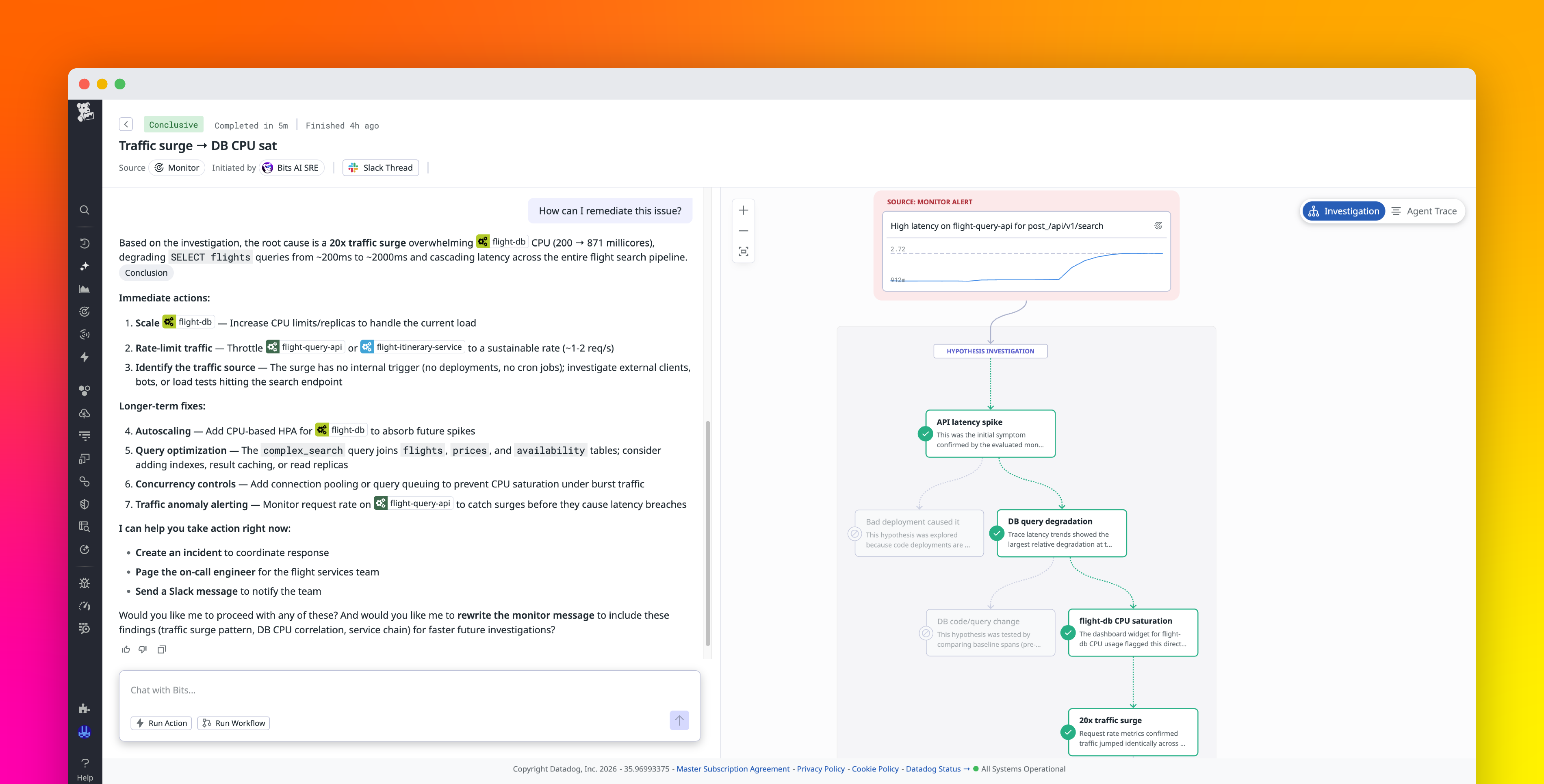
- •Bits AI SRE agent can autonomously investigate alerts, improving response times significantly.
- •The agent now analyzes a wider array of data sources, enhancing its investigative capabilities.
- •AI SRE models emphasize collaboration between AI and human operators for effective incident management.
Recent developments in AI Site Reliability Engineering (SRE) agents have transformed incident management. The Bits AI SRE agent, introduced at DASH 2025, autonomously investigates alerts in real-time, significantly improving response times. It can analyze a broader range of data sources, including logs, metrics, and source code, allowing for more comprehensive investigations. The latest generation of Bits AI SRE is reported to complete investigations approximately twice as fast as its predecessor. These advancements enable the agent to reason across dependencies and integrate seamlessly with existing workflows. The AI SRE approach emphasizes a governed human-agent model, ensuring that AI assists rather than fully replaces human oversight in incident response. This model addresses challenges posed by rapid software delivery and increasing incident rates, as highlighted in a recent SREcon25 EMEA session. The integration of AI in incident management is becoming crucial as organizations face heightened operational complexities.
Ask AI about this cluster
Answers cite the sources they use
Timeline
More articles in this cluster (6)
Continue Reading
 Massive Network of AI Proxy Servers Used for Malicious Activities Uncovered Security researchers from Team Cymru have identified over 10,000 proxy servers in China facilitating malicious AI activities. These servers, termed 'transfer stations,' are primarily used to bypass geographic restrictions and conduct model distillation attacks against frontier AI models. The infrastructure allows…
  Critical RCE Vulnerability in F5 BIG-IP APM Exploited in the Wild A severe heap-based buffer overflow vulnerability, tracked as CVE-2026-94127, has been identified in F5 BIG-IP Access Policy Manager (APM), allowing unauthenticated remote code execution (RCE) on the Traffic Management Microkernel (TMM) data plane. This vulnerability is triggered when both an APM access policy and an…