 Azertag.Az
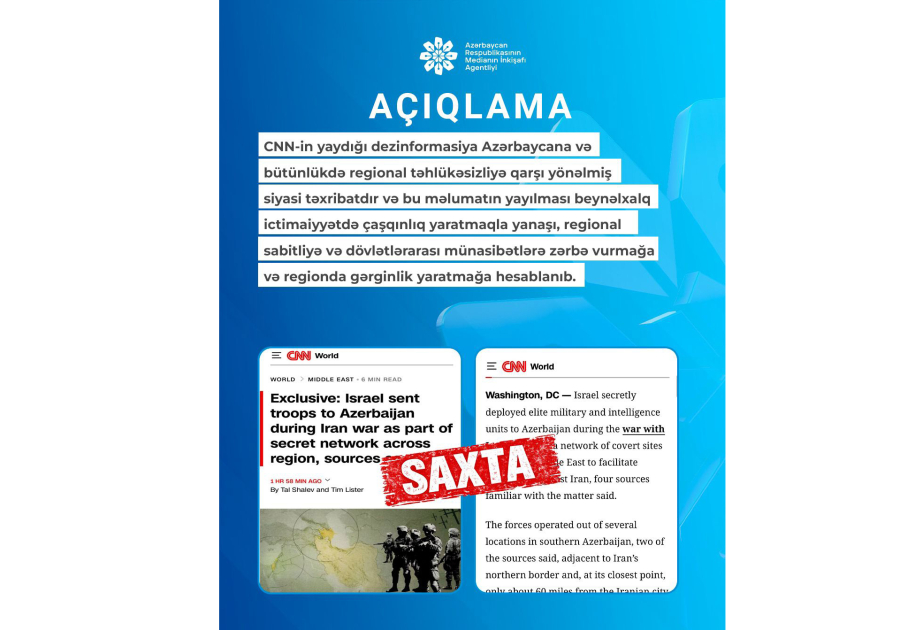
 Azerbaijan Demands CNN Evidence for Allegations of Military Cooperation with Israel
Article Content

- •Azerbaijan's Parliament demands CNN retract claims of Israeli troop presence.
- •The allegations are viewed as part of a coordinated disinformation campaign.
- •Azerbaijani authorities assert no foreign military presence in the country.
On June 5, 2026, CNN published an article claiming that Israel sent troops to Azerbaijan during the Iran war. In response, the Azerbaijani Parliament's Temporary Commission against Foreign Interference demanded CNN provide evidence or retract the claims, labeling them as unfounded and part of a disinformation campaign. The commission stated that the allegations aim to undermine Azerbaijan's national interests and regional stability. The Media Development Agency of Azerbaijan also condemned CNN's report as gross manipulation and a political provocation. They emphasized that no foreign military forces are present in Azerbaijan and called for a retraction and apology from CNN. The situation has escalated into a broader discourse on media ethics and the role of international journalism in geopolitical narratives.
Ask AI about this cluster
Answers cite the sources they use
Timeline
More articles in this cluster (4)
Following this threat?
Track X in your own feed — you're alerted when they show up in new reporting, leak sites or exploitation.
Free account · no card needed
Continue Reading
 PHP2Shell Vulnerabilities Exploited by AI-Driven Attackers Threat actors have exploited PHP2Shell vulnerabilities (CVE-2026-109618 and CVE-2026-109619) to target a government entity in Europe, gaining access to sensitive data within two hours of the initial breach. The attackers utilized AI tools for reconnaissance and post-exploitation activities, including accessing…