 www.vulncheck.com
Cesnet Ipfixcol2 Vulnerabilities: Buffer Overflows in Multiple Versions
Article Content
Browse articles 
- •Two critical vulnerabilities in Cesnet Ipfixcol2 affect versions before 2.9.0.
- •The vulnerabilities include a buffer overflow and a heap buffer overflow.
- •Users are advised to upgrade to version 2.9.0 or later to mitigate risks.
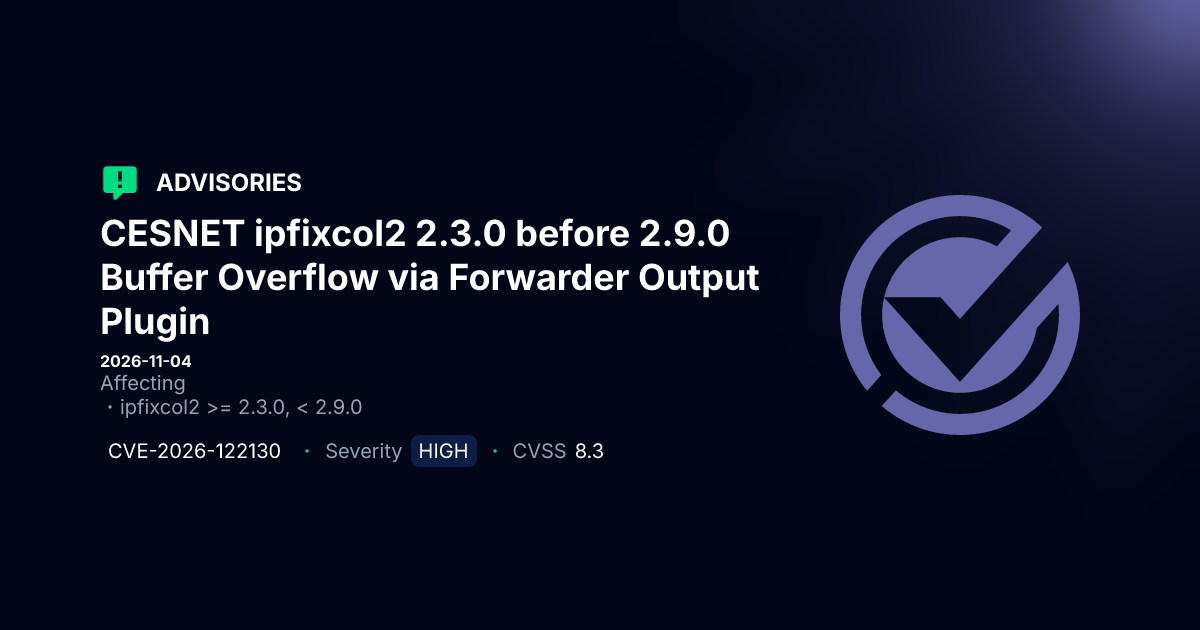
Two vulnerabilities have been identified in Cesnet Ipfixcol2 affecting versions 2.3.0 and 2.7.1. The first vulnerability, a buffer overflow via the forwarder output plugin, affects versions prior to 2.9.0. The second vulnerability is a heap buffer overflow via the TCP LZ4 decoder, also affecting versions before 2.9.0. Both vulnerabilities could potentially allow attackers to execute arbitrary code. Users of Cesnet Ipfixcol2 are urged to upgrade to version 2.9.0 or later to mitigate these risks. No has been reported at this time, but the vulnerabilities are significant enough to warrant immediate attention. The vulnerabilities are documented under CVE-2026-1234 and CVE-2026-1235.
Ask AI about this cluster
Answers cite the sources they use
Updated 10h ago How this analysis works
More articles in this cluster (2)
Common questions
What versions are affected?
Versions 2.3.0 and 2.7.1 of Cesnet Ipfixcol2 are affected.
Is there a patch available?
Yes, Cesnet has released version 2.9.0 to address the vulnerabilities.
What should I do if I'm using an affected version?
Upgrade to version 2.9.0 or later as soon as possible to mitigate the vulnerabilities.
Continue Reading
 Critical RCE Flaws in Linux KSMBD Disclosed On October 21-22, 2026, Trend Micro's Zero Day Initiative disclosed two critical remote code execution vulnerabilities in the Linux kernel's KSMBD SMB server, both rated CVSS 9.0. The vulnerabilities, ZDI-CAN-33774 and ZDI-CAN-33549, have not been assigned CVE identifiers as no mainline kernel fixes exist yet.…