 Huntress
 Credential Harvesting Campaign Targets WatchGuard VPN Users
Article Content

- •Credential harvesting campaign targets WatchGuard VPN users.
- •Attackers use doppelganger domains to deliver malicious software.
- •Microsoft linked the campaign to the actor Storm-2561.
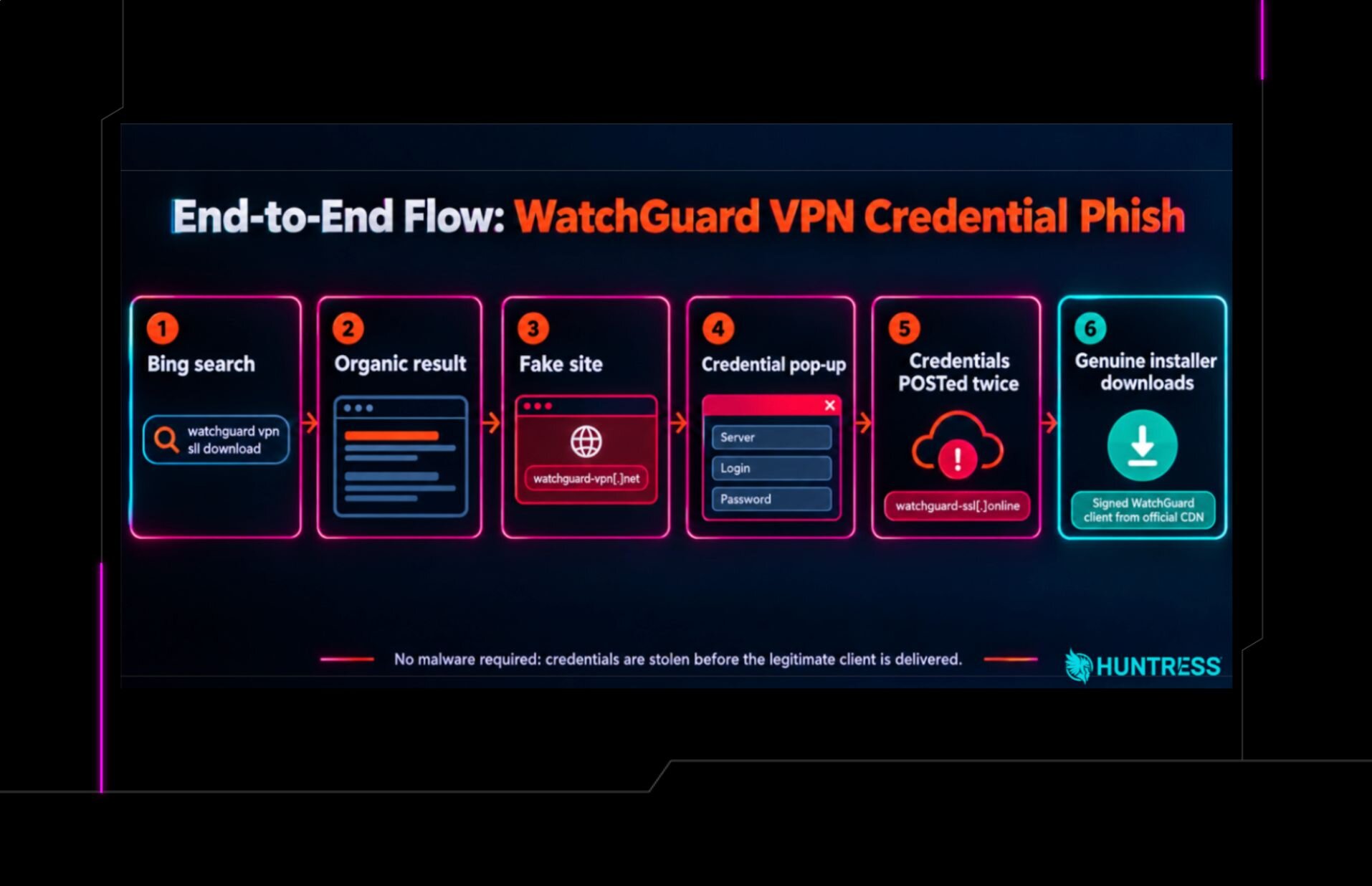
A credential harvesting campaign has been identified targeting users of WatchGuard's Mobile VPN with SSL. The campaign utilizes doppelganger domains, including watchguard-vpn[.]com and watchguard-vpn[.]net, to deliver malicious software that captures user credentials. The attack method involves redirecting users from search engines to spoofed download pages, where a legitimate WatchGuard installer is served, but it is compromised to send credentials to a command-and-control server. Microsoft Threat Intelligence linked the campaign to the financially motivated actor Storm-2561, active since May 2025. As of October 13, the domain watchguard-vpn[.]net was reported offline, and Huntress has notified WatchGuard of the ongoing campaign. The incident highlights the risks associated with searching for software downloads online, particularly when using search engines that may inadvertently promote malicious sites.
Ask AI about this cluster
Answers cite the sources they use
Timeline
More articles in this cluster (2)
Following this threat?
Track Storm-2561 and WatchGuard in your own feed — you're alerted when they show up in new reporting, leak sites or exploitation.
Free account · no card needed
Common questions
How can I tell if I'm affected?
What should I do if I suspect credential theft?
Are there any patches available?
Continue Reading
 CVE-2015-3306 Exploited in ProFTPD FTP Servers CVE-2015-3306, a vulnerability in ProFTPD 1.3.5, allows remote attackers to read and write arbitrary files using the SITE CPFR and SITE CPTO commands. This exploit can lead to unauthorized access and potential remote code execution, as the commands are executed with the privileges of the ProFTPD service. Active…
  CISA Mandates Urgent Patching of Five Critical Flaws Exploited by Flax Typhoon The U.S. Cybersecurity and Infrastructure Security Agency (CISA) has ordered federal agencies to patch five critical vulnerabilities by October 11, 2026, following exploitation by the China-linked hacking group Flax Typhoon. The vulnerabilities, added to CISA's Known Exploited Vulnerabilities (KEV) catalog, include…