 www.vulncheck.com
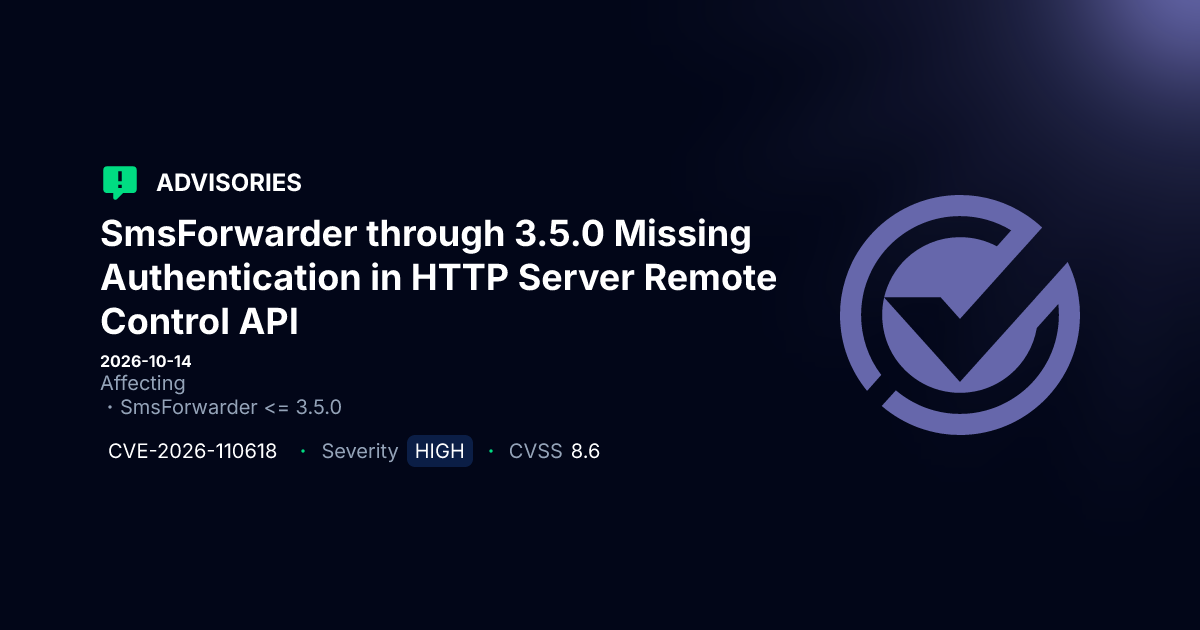
 Critical Authentication Flaw in SmsForwarder Remote Control API
Article Content

- •SmsForwarder versions up to 3.5.0 are vulnerable due to missing authentication.
- •The default security mode allows unauthenticated access to sensitive operations.
- •No patch has been released, posing a significant risk to users.
SmsForwarder versions up to 3.5.0 have a critical vulnerability due to missing authentication in its HTTP server remote control API. The default security mode is set to '0', allowing unauthenticated access to sensitive operations like SMS forwarding and location tracking. This vulnerability affects users who have enabled the HTTP server feature without configuring a signing key. The flaw was confirmed by multiple sources on October 15, 2026, and is categorized under CWE-306 for missing authentication. No patch has been reported yet, and the vulnerability poses a significant risk to user data and privacy. Security professionals are urged to disable the HTTP server feature until a fix is available.
Ask AI about this cluster
Answers cite the sources they use
Timeline
More articles in this cluster (2)
Common questions
Which versions are affected?
Is there a patch available?
What actions should I take?
Continue Reading
 CVE-2015-3306 Exploited in ProFTPD FTP Servers CVE-2015-3306, a vulnerability in ProFTPD 1.3.5, allows remote attackers to read and write arbitrary files using the SITE CPFR and SITE CPTO commands. This exploit can lead to unauthorized access and potential remote code execution, as the commands are executed with the privileges of the ProFTPD service. Active…
  CISA Mandates Urgent Patching of Five Critical Flaws Exploited by Flax Typhoon The U.S. Cybersecurity and Infrastructure Security Agency (CISA) has ordered federal agencies to patch five critical vulnerabilities by October 11, 2026, following exploitation by the China-linked hacking group Flax Typhoon. The vulnerabilities, added to CISA's Known Exploited Vulnerabilities (KEV) catalog, include…