 www.vulncheck.com
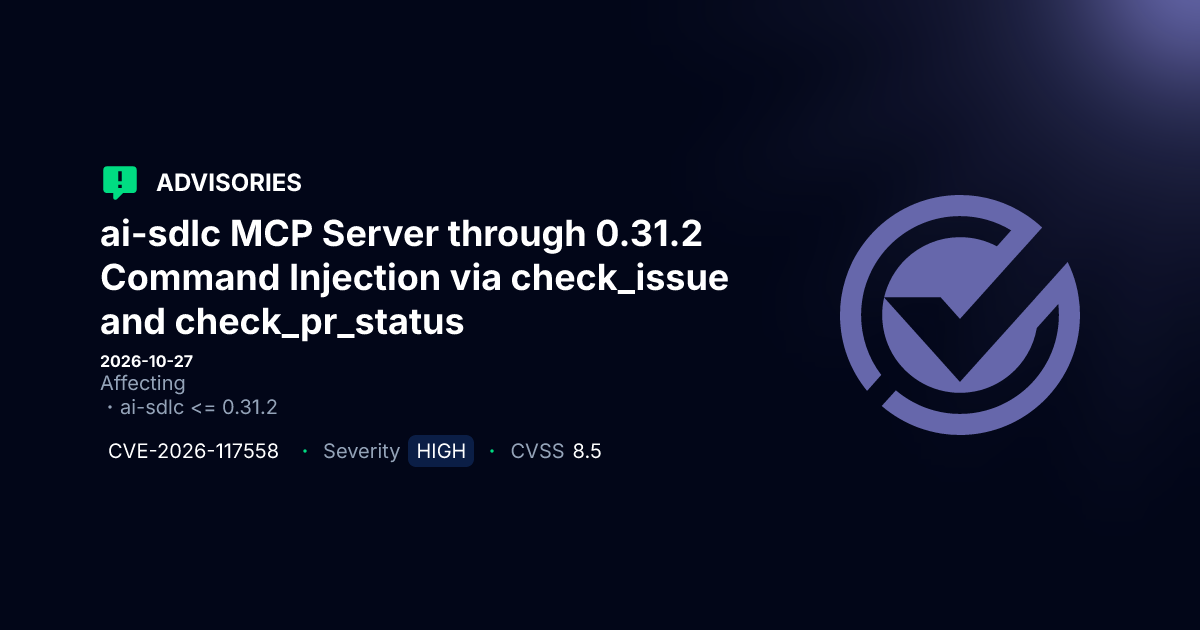
Critical OS Command Injection Vulnerability in Ai Sdlc MCP Server Tools
Article Content

- •Critical OS command injection vulnerability in ai-sdlc MCP server tools.
- •CVSS score of 9.8 indicates high severity and potential for exploitation.
- •Attackers can execute arbitrary commands due to lack of input validation.
The ai-sdlc MCP server tools, specifically check_issue and check_pr_status, are vulnerable to OS command injection (CWE-78) due to improper input handling. The vulnerability allows attackers to execute arbitrary commands on the host system by exploiting the repo parameter, which is directly interpolated into execSync() calls without sanitization. This critical vulnerability has a CVSS score of 9.8 and affects all versions up to 0.31.2. Attack vectors include shell command separators, subshell expansion, and pipes, enabling attackers to exfiltrate sensitive data or establish reverse shells. The vulnerability was disclosed on October 28, 2026, and is currently. Security professionals are urged to review their use of these tools and implement mitigations as soon as possible.
Ask AI about this cluster
Answers cite the sources they use
Timeline
More articles in this cluster (2)
Common questions
Which versions are affected?
Is there a patch available?
What should organizations do to protect themselves?
Continue Reading
 Critical RCE Vulnerability in Langflow Exposed CVE-2026-105740 is a critical remote code execution (RCE) vulnerability affecting Langflow versions prior to 1.9.0. Authenticated users can exploit this flaw by adding an MCP server with the 'Stdio' transport, allowing arbitrary OS commands to be executed without validation. The vulnerability was published on October…