 www.vulncheck.com
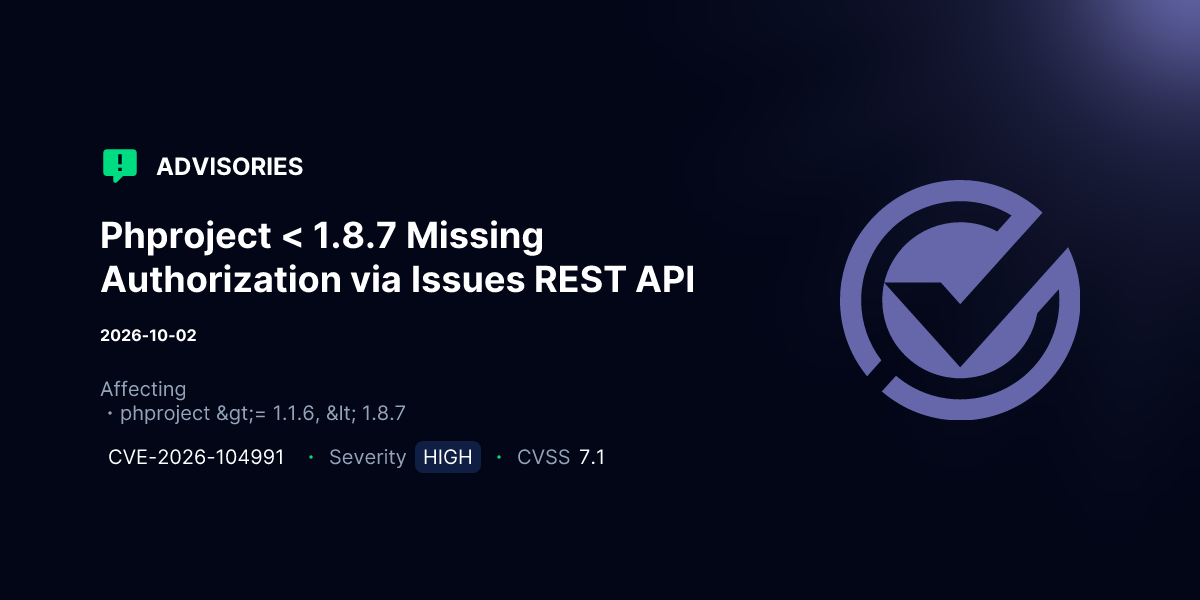
 CVE-2026-104991: High-Risk API Vulnerability in Phproject
Article Content

- •CVE-2026-104991 allows unauthorized access via API keys.
- •Affected systems are Phproject versions before 1.8.7.
- •No active exploitation or PoC code reported as of now.
CVE-2026-104991, published on October 2, 2026, identifies a missing object-level authorization vulnerability in Phproject versions prior to 1.8.7. This flaw allows authenticated API key holders to bypass security controls, enabling unauthorized access to restricted issue contents and the ability to post unauthorized comments. Organizations with internet-accessible instances are particularly at risk, especially those with broadly distributed or long-lived API keys. The vulnerability has a CVSS score of 7.1, indicating a high risk, but there is currently no confirmed active exploitation or proof-of-concept code available. Administrators are advised to review API logs and restrict access until a patch is applied. The vendor has not yet confirmed the urgency of this issue, and no exploitation status has been reported.
Ask AI about this cluster
Answers cite the sources they use
Timeline
More articles in this cluster (3)
Following this threat?
Track CVE-2026-104991 in your own feed — you're alerted when they show up in new reporting, leak sites or exploitation.
Free account · no card needed
Common questions
Which versions are affected?
Is there a patch available?
What immediate actions should I take?
Continue Reading
 Citrix NetScaler Critical Vulnerabilities Exploited: Urgent Patching Required Citrix NetScaler ADC and Gateway products are affected by critical vulnerabilities CVE-2026-88771 and CVE-2026-88772, both assigned a CVSS score of 9.5. The Cybersecurity and Infrastructure Security Agency (CISA) added these CVEs to its Known Exploited Vulnerabilities catalog on September 27, 2026, and mandated…
  Critical Citrix NetScaler Zero-Day Vulnerabilities Exploited Citrix disclosed two critical zero-day vulnerabilities, CVE-2026-88771 and CVE-2026-88772, affecting NetScaler ADC and Gateway systems, which are being actively exploited. Both vulnerabilities have a CVSS score of 9.5 and allow unauthenticated attackers to execute arbitrary commands remotely. CVE-2026-88771 arises…