 Haveibeenpwned
 CyrusOne and Double Counter Breaches Expose Over 648,000 Accounts
Article Content

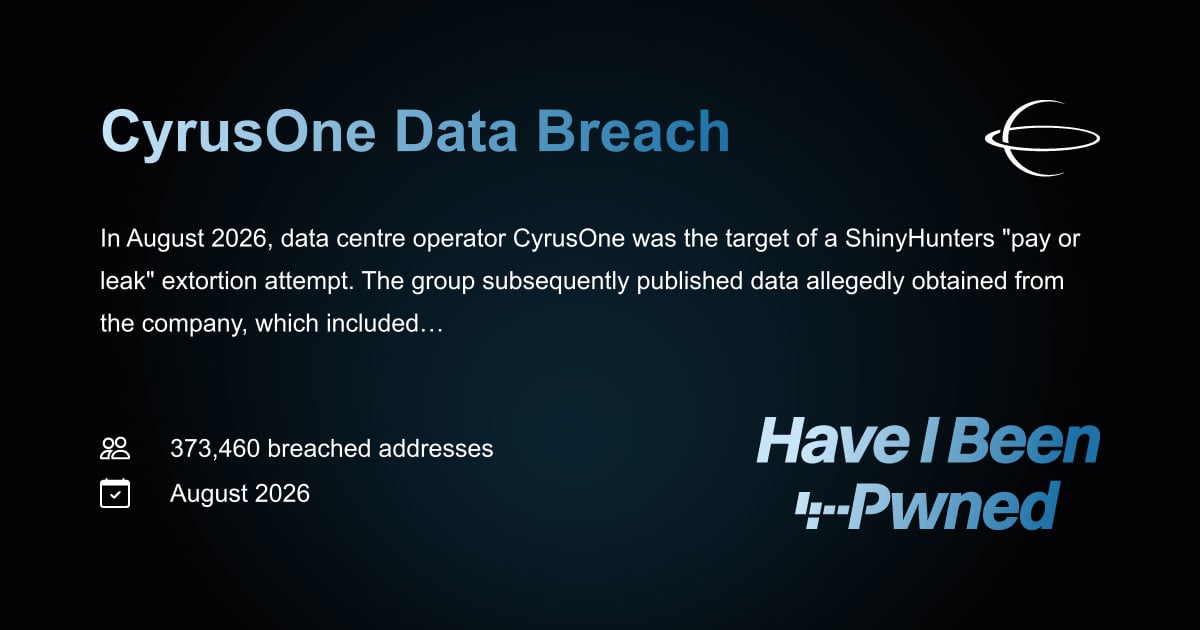
- •CyrusOne breach involved 373,460 accounts, primarily corporate data.
- •Double Counter reported a breach affecting 274,922 accounts in October 2026.
- •Both breaches were disclosed on October 7, 2026, with strong recommendations for password changes.
In August 2026, CyrusOne, a data center operator, suffered a breach involving 373,460 accounts due to a ShinyHunters extortion attempt, which resulted in the publication of sensitive corporate data. The leaked data included email addresses, names, physical addresses, phone numbers, job titles, and operational information. Additionally, Double Counter reported a breach in October 2026, affecting 274,922 accounts, with details still emerging. Both breaches were added to Have I Been Pwned on October 7, 2026. Users are advised to change passwords and enable two-factor authentication where possible. The breaches highlight the ongoing threat of extortion tactics in the cybersecurity landscape.
Ask AI about this cluster
Answers cite the sources they use
Timeline
More articles in this cluster (3)
Following this threat?
Track ShinyHunters and CyrusOne in your own feed — you're alerted when they show up in new reporting, leak sites or exploitation.
Free account · no card needed
Common questions
How many accounts were affected in each breach?
What types of data were leaked?
What actions should users take?
Continue Reading
 ShinyHunters Hack Exposes Sensitive FBI Employee Data On September 23, 2026, the FBI disclosed an investigation into a data breach by the hacking group ShinyHunters, which claims to have stolen sensitive personal information of approximately 38,000 FBI employees and job applicants. The stolen data reportedly includes names, addresses, phone numbers, Social Security…
  ShinyHunters Escalate Oracle PeopleSoft Exploitation Amid Microsoft Mega-Patch ShinyHunters, a hacking group, has escalated attacks exploiting Oracle PeopleSoft vulnerability CVE-2026-35273 following the arrest of a member in the Netherlands. This vulnerability, with a CVSS score of 9.8, is being exploited using URL-encoding techniques to bypass web application firewalls. Microsoft recently…