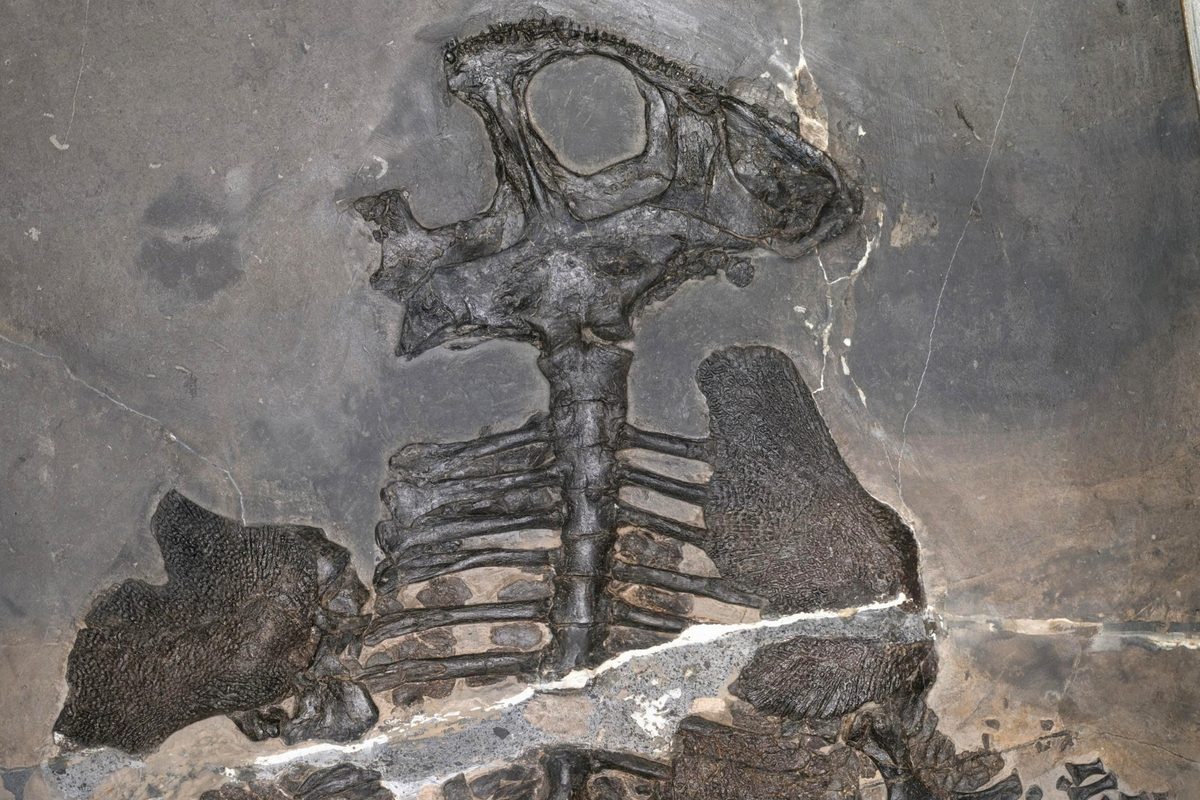
 Discoverwildlife
Discovery of Fully Marine Stem Amphibian Alters Understanding of Evolution
Article Content

- •Gerrothorax maritimus is a newly identified fully marine stem amphibian.
- •The species lived during the Late Triassic, approximately 237 million years ago.
- •This discovery challenges the notion that amphibians cannot adapt to marine environments.
A new species of stem amphibian, Gerrothorax maritimus, has been identified from two skeletons found in China, dating back to the Late Triassic period, approximately 237 million years ago. This discovery suggests that an ancient lineage of amphibians was capable of adapting to fully marine environments, a feat not achieved by modern amphibians due to their salt-intolerant skin. The findings challenge previous beliefs about amphibian evolution and their ecological capabilities. The larger skeleton measures about 75 cm, while the smaller one is approximately 48 cm long. The study, published in Nature Ecology & Evolution, indicates that these amphibians had adaptations such as flattened, heavily armoured bodies that may have facilitated their marine lifestyle. The research was led by Lipin Diao and colleagues, who utilized strontium isotope analysis to support their conclusions about the marine habitat of these creatures.
Ask AI about this cluster
Answers cite the sources they use
Timeline
More articles in this cluster (7)
Common questions
What is Gerrothorax maritimus?
Why is this discovery significant?
What adaptations did Gerrothorax maritimus have?
Continue Reading
 Critical BeyondTrust 9.3 Vulnerability Actively Exploited by Threat Actor A critical vulnerability (CVE-2026-102764) in BeyondTrust Remote Support has been discovered and is actively being exploited by the threat group ARMORY CASTLE, reportedly linked to China. The vulnerability, which has a CVSS score of 9.3, allows unauthenticated attackers to upload files and potentially compromise host…
 Lazarus APT Launches Operation FlashHole Using AI and Post-Quantum Cryptography Kaspersky has identified a cyberespionage campaign, dubbed Operation FlashHole, attributed to the Lazarus APT group, active since July 2025. The campaign has targeted at least three organizations in South Korea's construction, software, and wire-communication sectors. Attack methods include spear-phishing emails…