 Huntress
 Dragon Boss Solutions' Signed Adware Disables Antivirus on 25,000+ Endpoints
Article Content

- •Over 23,500 endpoints were compromised globally due to signed adware from Dragon Boss Solutions.
- •The adware uses an advanced update mechanism to deploy malicious payloads that disable antivirus software.
- •Huntress registered the malicious update domain to prevent further exploitation.
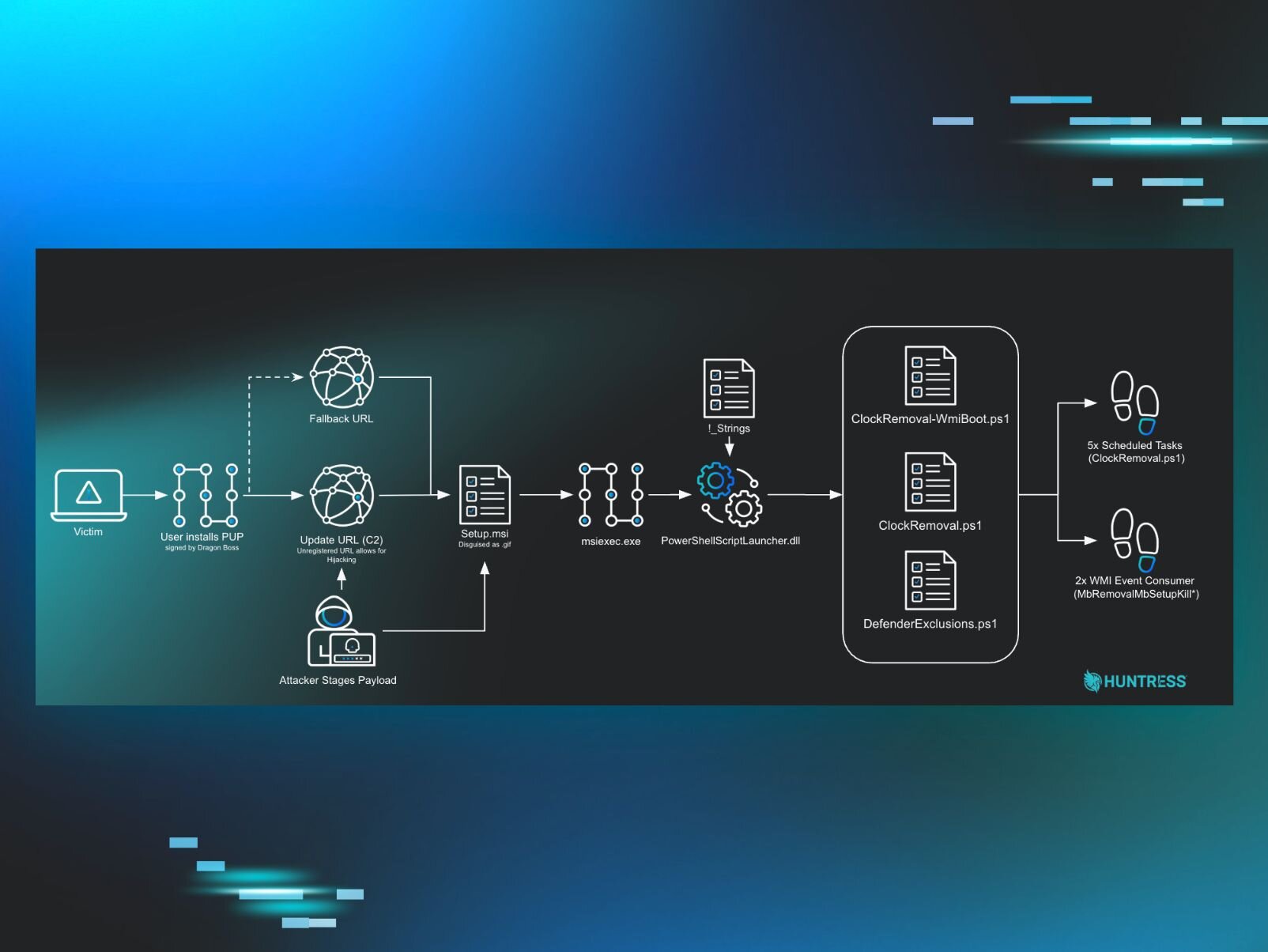
On March 22, 2026, Huntress identified a campaign involving signed adware from Dragon Boss Solutions LLC that disabled antivirus protections on over 23,500 endpoints across 124 countries. The software, marketed as potentially unwanted programs (PUPs), utilized a sophisticated update mechanism to deploy malicious payloads with SYSTEM privileges. The adware's update process, based on the Advanced Installer tool, executed PowerShell scripts to disable security products from major vendors like Malwarebytes and Kaspersky. The malicious payloads were disguised as benign files, and the operation's infrastructure included an unregistered domain that could be exploited for further attacks. The incident highlights a significant supply chain risk, as anyone could register the domain to push harmful updates. Huntress has since registered the domain to prevent further exploitation. The attack primarily affected sectors including education, utilities, government, and healthcare.
Ask AI about this cluster
Answers cite the sources they use
Timeline
More articles in this cluster (7)
Following this threat?
Track Dragon Boss Solutions and Dragon Boss Solutions LLC in your own feed — you're alerted when they show up in new reporting, leak sites or exploitation.
Free account · no card needed
Continue Reading
 Critical BeyondTrust 9.3 Vulnerability Actively Exploited by Threat Actor A critical vulnerability (CVE-2026-102764) in BeyondTrust Remote Support has been discovered and is actively being exploited by the threat group ARMORY CASTLE, reportedly linked to China. The vulnerability, which has a CVSS score of 9.3, allows unauthenticated attackers to upload files and potentially compromise host…
  Lazarus APT Launches Operation FlashHole Using AI and Post-Quantum Cryptography Kaspersky has identified a cyberespionage campaign, dubbed Operation FlashHole, attributed to the Lazarus APT group, active since July 2025. The campaign has targeted at least three organizations in South Korea's construction, software, and wire-communication sectors. Attack methods include spear-phishing emails…