 www.prnewswire.com
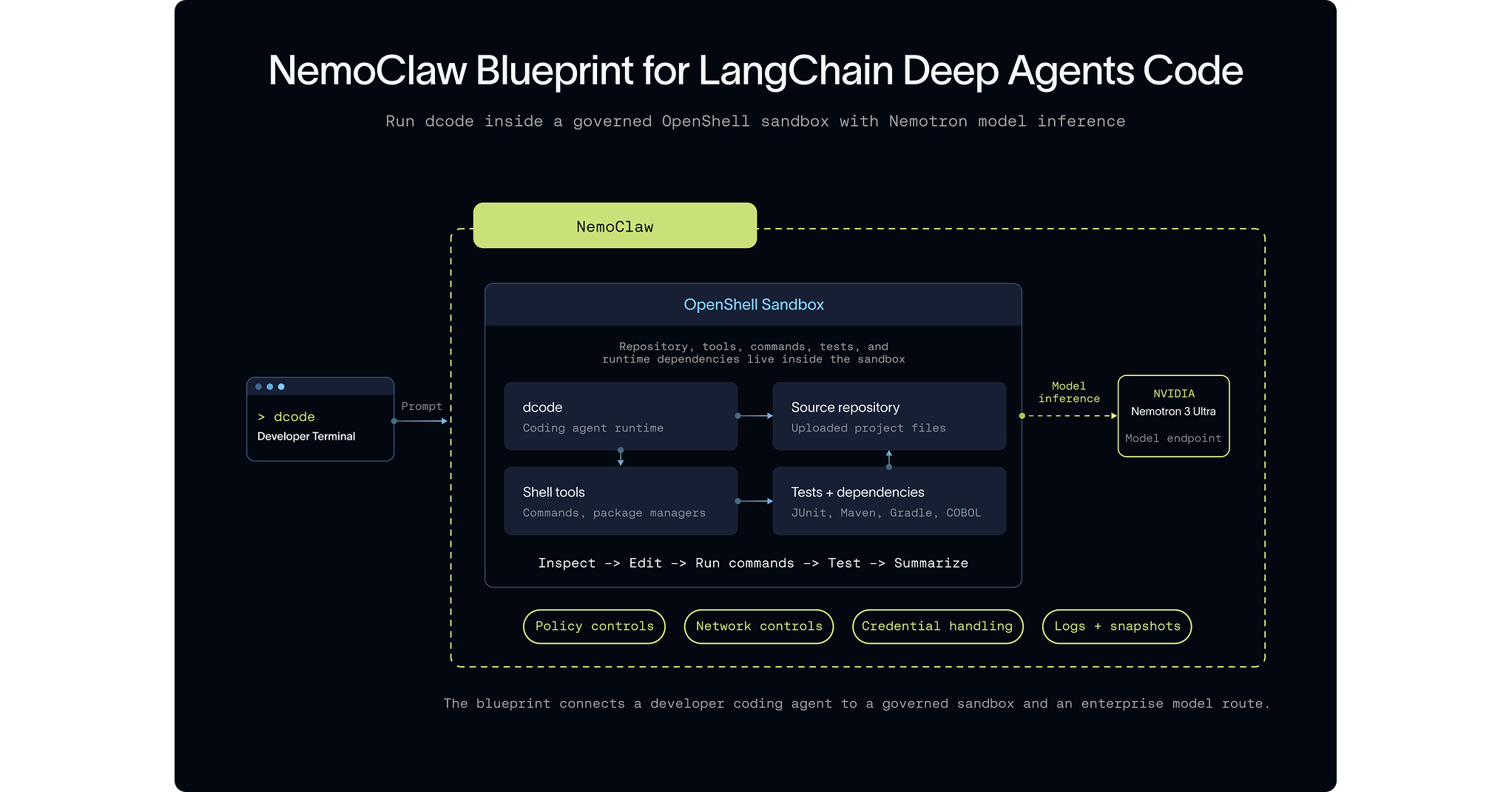
NemoClaw Blueprint Promises 10x Cost Reduction for Enterprise AI Agents
Article Content

- •NemoClaw blueprint claims over 10x cost reduction for enterprise AI agents.
- •Agentic workloads lead to budget overruns, prompting concerns about project cancellations.
- •LangChain's evaluation shows a significant cost advantage but lacks transparency on comparisons.
On July 8, 2026, LangChain and NVIDIA announced the NemoClaw blueprint for building open agent systems, claiming over 10x lower inference costs compared to leading closed-model APIs. This blueprint aims to help enterprises manage AI agent costs, which have surged due to complex agentic workloads. The NemoClaw blueprint reportedly allows enterprises to run production AI agents at a cost of $4.48 per task, significantly lower than the $43.48 per task for competing models. Gartner's analysis indicates that agentic workloads consume significantly more tokens than traditional chatbots, leading to unexpected budget overruns. The announcement comes amid concerns that over 40% of agentic AI projects may be canceled by 2027 due to escalating costs. LangChain's evaluation suite scored the Nemotron 3 Ultra model at 0.86 accuracy, but the lack of transparency regarding the comparison model raises questions about the reliability of these benchmarks.
Ask AI about this cluster
Answers cite the sources they use
Timeline
More articles in this cluster (5)
Following this threat?
Track CVE-2025-68664 in your own feed — you're alerted when they show up in new reporting, leak sites or exploitation.
Free account · no card needed
Common questions
What is the cost per task with NemoClaw?
What are agentic workloads?
What are the implications of the Gartner analysis?
Continue Reading
 Brotli Decoder Vulnerability Patched Across Multiple Linux Distributions A vulnerability, CVE-2026-111497, affecting the Brotli decoder has been patched in various Linux distributions, including Fedora 44 and Oracle Linux 10. The flaw allows for an out-of-bounds write, which could potentially enable attackers to execute arbitrary code. The vulnerability was published on October 22, 2026…