 africacenter.org
 Middle Eastern Powers Influence Somalia's Political Landscape
Article Content

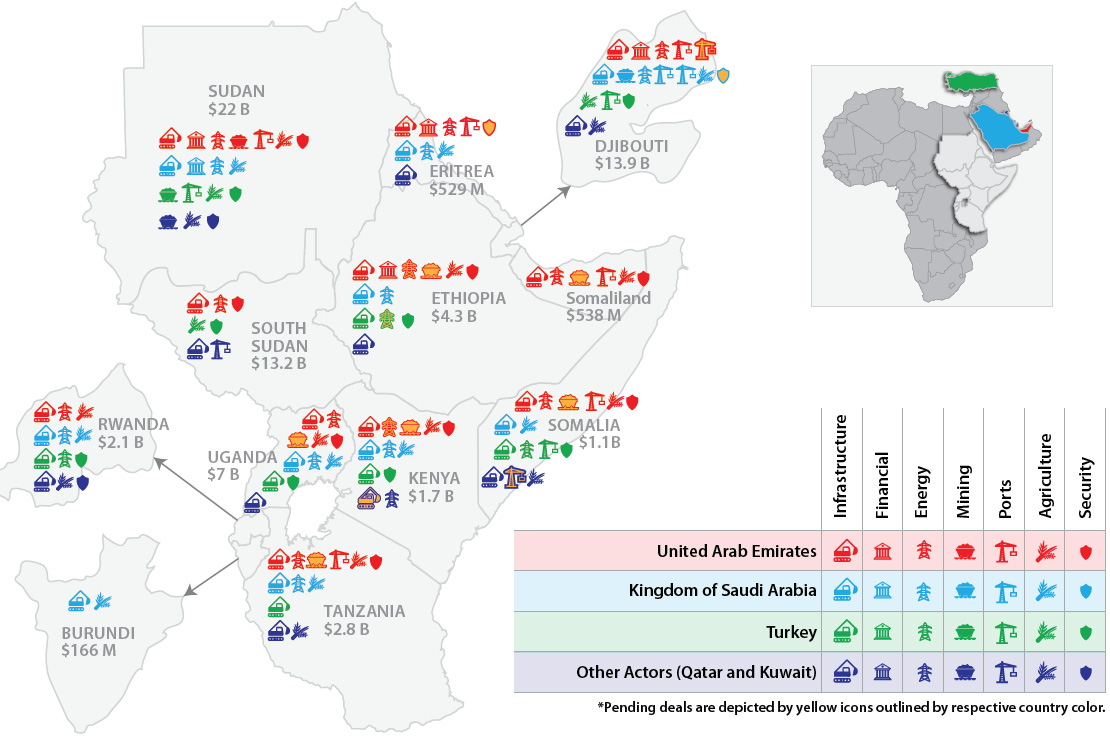
- •Middle Eastern investments in Somalia exceed $75 billion, reshaping political dynamics.
- •The UAE and Turkey are the primary foreign actors influencing Somali governance.
- •Somalia's political authority is fragmented among competing centers, complicating federal control.
Middle Eastern countries, particularly the UAE and Turkey, are significantly reshaping Somalia's political order through substantial investments and military support. An estimated $75 billion has been funneled into East Africa, enhancing the capabilities of various Somali administrations, including Somaliland, Puntland, and Jubaland. This influx of foreign capital is altering the balance of power among competing political centers in Somalia, which are organized around clan coalitions. The UAE has established deep ties with Somaliland, while Turkey has focused on Mogadishu, the federal capital. As these foreign influences grow, the practical authority within Somalia is increasingly fragmented, complicating the federal government's ability to maintain sovereignty. The situation is exacerbated by ongoing disputes involving Ethiopia and security dynamics in the Red Sea region. The U.S. initially viewed these developments as advantageous but is now reassessing the implications of foreign involvement in Somali politics.
Ask AI about this cluster
Answers cite the sources they use
More articles in this cluster (2)
Common questions
What is the extent of foreign investment in Somalia?
How are these investments affecting Somalia's governance?
What role does the U.S. play in this situation?
Continue Reading
 CVE-2015-3306 Exploited in ProFTPD FTP Servers CVE-2015-3306, a vulnerability in ProFTPD 1.3.5, allows remote attackers to read and write arbitrary files using the SITE CPFR and SITE CPTO commands. This exploit can lead to unauthorized access and potential remote code execution, as the commands are executed with the privileges of the ProFTPD service. Active…
  CISA Sets Oct. 11 Deadline for Patching Flaws Exploited by Flax Typhoon The U.S. Cybersecurity and Infrastructure Security Agency (CISA) has added five vulnerabilities to its Known Exploited Vulnerabilities (KEV) catalog after they were exploited by the China-linked group Flax Typhoon. Federal agencies must patch or retire the affected software by October 11, 2026. The vulnerabilities…