 www.vulncheck.com
Multiple vLLM Vulnerabilities Disclosed Affecting Versions 0.10.2 to 0.31.0
Article Content

- •Three vulnerabilities in vLLM versions 0.10.2 to 0.31.0 disclosed today.
- •Vulnerabilities include memory exhaustion, DoS attacks, and cross-tenant issues.
- •No active exploitation reported; users should prioritize patching.
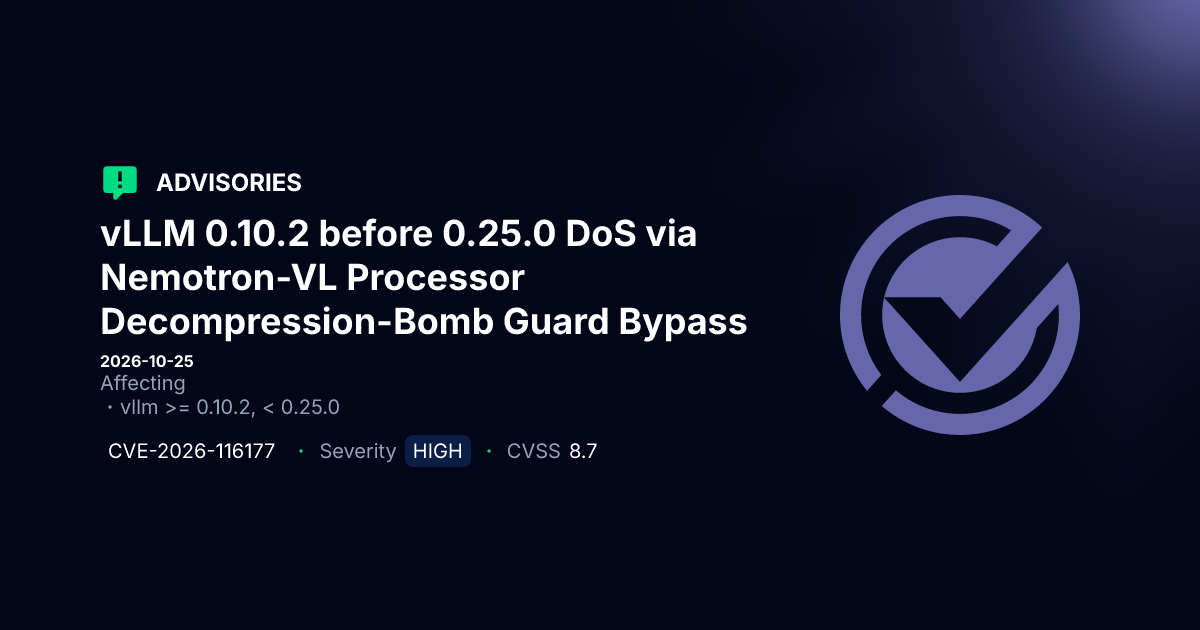
Three vulnerabilities in vLLM versions 0.10.2 to 0.31.0 have been disclosed, affecting users of the library. The first vulnerability allows for memory exhaustion via media_io_kwargs num_frames override (CWE-770). The second vulnerability enables a denial-of-service (DoS) attack through a Nemotron-VL Processor decompression bomb guard bypass (CWE-400). Lastly, a cross-tenant DoS vulnerability exists due to uninitialized logprobstensors. These vulnerabilities impact various versions of vLLM, with the earliest affected version being 0.10.2 and the latest being 0.31.0. No has been reported as of now, but users are advised to prioritize patching. GitHub Security Advisory GHSA-4m6g-h9mv-wqjc and GHSA-mm38-5g96-7j6x provide more details on the vulnerabilities.
Ask AI about this cluster
Answers cite the sources they use
Timeline
More articles in this cluster (3)
Common questions
Which versions of vLLM are affected?
Is there any active exploitation of these vulnerabilities?
What should users do to protect themselves?
Continue Reading
 Critical BeyondTrust 9.3 Vulnerability Actively Exploited by Threat Actor A critical vulnerability (CVE-2026-102764) in BeyondTrust Remote Support has been discovered and is actively being exploited by the threat group ARMORY CASTLE, reportedly linked to China. The vulnerability, which has a CVSS score of 9.3, allows unauthenticated attackers to upload files and potentially compromise host…
 Lazarus APT Launches Operation FlashHole Using AI and Post-Quantum Cryptography Kaspersky has identified a cyberespionage campaign, dubbed Operation FlashHole, attributed to the Lazarus APT group, active since July 2025. The campaign has targeted at least three organizations in South Korea's construction, software, and wire-communication sectors. Attack methods include spear-phishing emails…