 Link.Springer
New Lightweight Algorithm Enhances Vulnerability Detection in Python Code
Article Content

- •AMFKD algorithm achieves high accuracy in detecting vulnerabilities in Python code.
- •The model reduces computational costs while maintaining performance compared to larger models.
- •Results were validated on two benchmark datasets, showing scores above 92%.
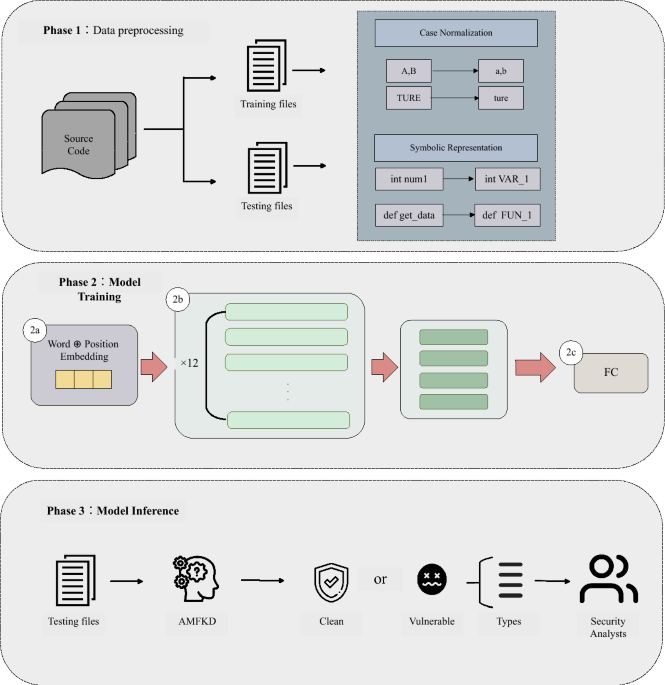
Researchers introduced a lightweight vulnerability detection algorithm named AMFKD, which utilizes adaptive multi-layered fusion knowledge distillation to enhance vulnerability detection in Python source code. This method addresses the challenges of manual vulnerability detection, which is time-consuming and requires extensive expertise, as well as the limitations of traditional deep learning models that are often too resource-intensive for deployment in constrained environments. The algorithm was evaluated on the VUDENC and CVEFixes datasets, achieving Macro-F1 scores of 92.25% and 93.76%, respectively, while consuming fewer computational resources than the larger teacher model. The study emphasizes the practical significance of deploying high-accuracy models in environments with limited memory and processing power. The findings suggest that AMFKD could significantly improve automated code inspection capabilities, although the results are based on specific datasets rather than broader production codebases.
Ask AI about this cluster
Answers cite the sources they use
Timeline
More articles in this cluster (6)
Common questions
What is the AMFKD algorithm?
How effective is AMFKD?
What are the deployment requirements for AMFKD?
Continue Reading
 Binance Hack: $6.3 Billion Stolen in Largest Crypto Heist On October 29, 2026, Binance, the world's largest cryptocurrency exchange, reported a major security incident involving an estimated $6.3 billion in stolen funds. The attack was attributed to a compromised laptop belonging to a DevOps engineer, allowing unauthorized withdrawal transactions. Approximately $3 billion in…
 China-Linked Hackers Exploit PHP2Shell Vulnerabilities to Breach U.S. Government Systems On October 21, 2026, the PHP development team released patches for two critical vulnerabilities in PHP, known as PHP2Shell (CVE-2026-109618 and CVE-2026-109619), which allow unauthenticated remote code execution. These vulnerabilities were actively exploited by a suspected China-linked threat actor who compromised 25…