 hotnews.ro
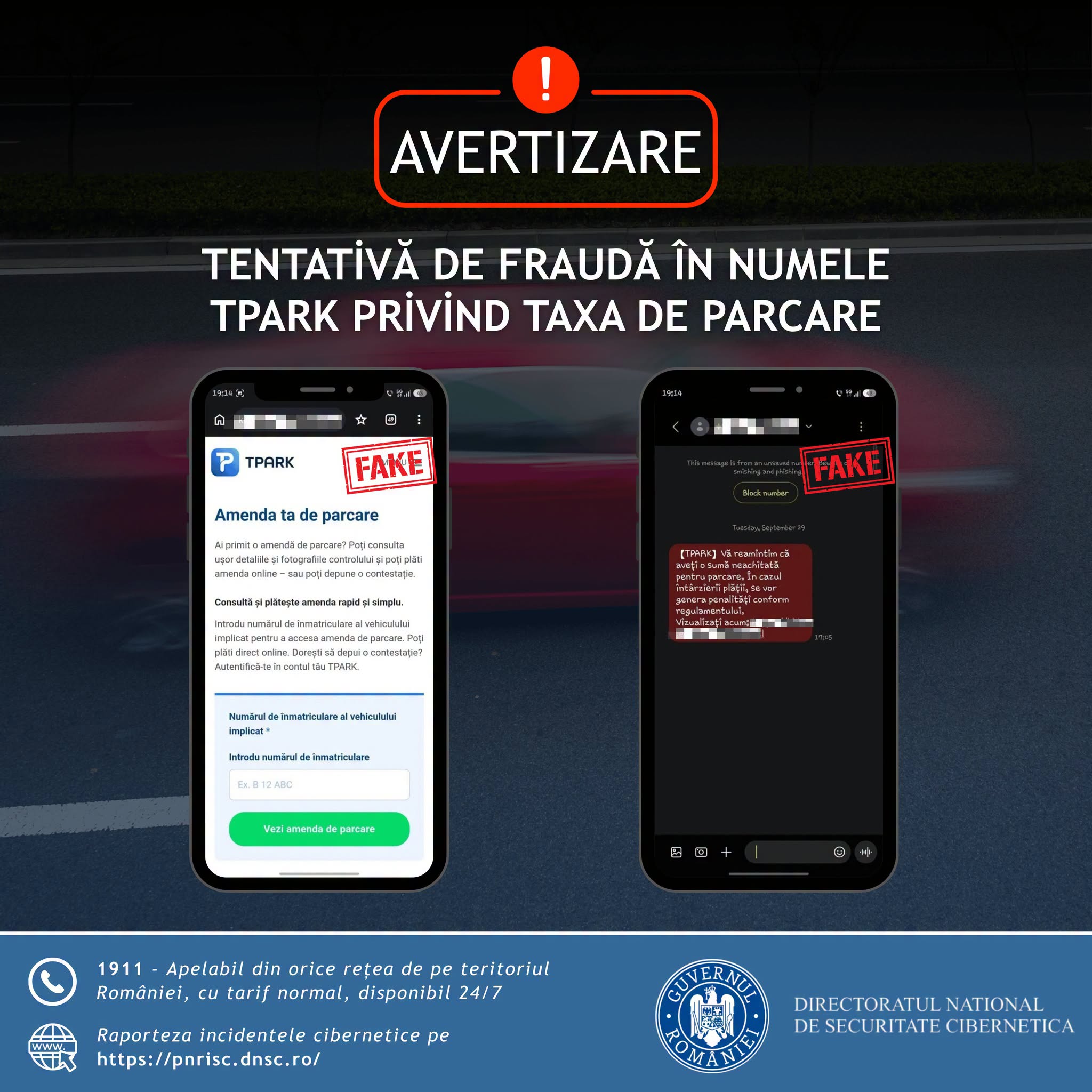
 New SMS Phishing Scam Targeting TPARK Users in Romania
Article Content

- •DNSC warns of SMS phishing targeting TPARK users.
- •Fraudulent messages create urgency with threats of penalties.
- •Users are directed to fake websites mimicking TPARK.
The National Cyber Security Directorate (DNSC) has issued a warning about a phishing campaign involving fraudulent SMS messages claiming to be from TPARK, a parking payment application. Victims receive messages stating they owe parking fines and are urged to pay immediately via a malicious link. The messages create a false sense of urgency by threatening penalties for late payments. The links lead to websites that closely mimic the official TPARK site, using similar logos and graphics to deceive users. Users are prompted to enter their vehicle registration numbers, which are then used in a fraudulent payment process. The DNSC advises users not to click on links in unsolicited SMS messages and to verify the authenticity of any claims before providing personal information. This scam affects individuals who use the TPARK application for parking payments.
Ask AI about this cluster
Answers cite the sources they use
Timeline
More articles in this cluster (5)
Following this threat?
Track DNSC in your own feed — you're alerted when they show up in new reporting, leak sites or exploitation.
Free account · no card needed
Common questions
How can I verify if a message is legitimate?
What should I do if I clicked on the link?
Are there any specific recommendations from DNSC?
Continue Reading
 Critical Citrix NetScaler Zero-Day Vulnerabilities Exploited Citrix disclosed two critical zero-day vulnerabilities, CVE-2026-88771 and CVE-2026-88772, affecting NetScaler ADC and Gateway systems, which are being actively exploited. Both vulnerabilities have a CVSS score of 9.5 and allow unauthenticated attackers to execute arbitrary commands remotely. CVE-2026-88771 arises…
  Critical Authentication Bypass in Cisco Catalyst SD-WAN Manager Exploited On September 30, 2026, Cisco disclosed a critical vulnerability (CVE-2026-76504) in the Catalyst SD-WAN Manager that allows unauthenticated remote attackers to bypass authentication and gain admin-level access to the system. This flaw stems from improper handling of URI encoding in HTTP requests, enabling attackers to…