 link.springer.com
Pink Slime Journalism Exploits Trust in Local News
Article Content

- •Partisan media operations increased ad spending on pink slime journalism sites ahead of elections.
- •These sites produce low-quality content that exploits public trust in local news.
- •Ad spending surged from hundreds of thousands to millions, targeting specific demographics.
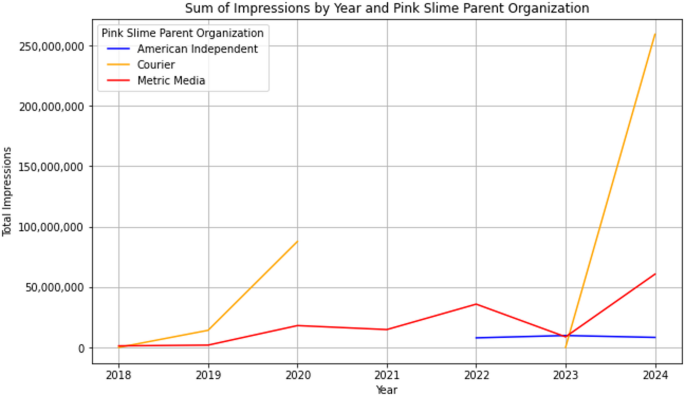
Recent research from Carnegie Mellon University reveals that partisan media operations have significantly increased spending on social media ads to promote pink slime journalism websites, which masquerade as local news sources. These sites, often funded by partisan organizations, produce low-quality, algorithmically generated content that misleads the public by exploiting their trust in local journalism. The study indicates that ad spending for these sites surged from hundreds of thousands to millions of dollars leading up to the 2020 and 2024 elections. Pink slime journalism targets specific demographics and swing states, with left-leaning sites focusing on younger women and right-leaning sites targeting older men. The research highlights the danger of these sites as they can sway public opinion without disclosing their funding sources or true affiliations. As AI-generated content becomes more sophisticated, distinguishing these sites from legitimate news sources is increasingly challenging.
Ask AI about this cluster
Answers cite the sources they use
Timeline
More articles in this cluster (3)
Following this threat?
Track X in your own feed — you're alerted when they show up in new reporting, leak sites or exploitation.
Free account · no card needed
Common questions
How do pink slime sites operate?
What is the impact of these sites on local journalism?
What can be done to combat pink slime journalism?
Continue Reading
 Brotli Decoder Vulnerability Patched Across Multiple Linux Distributions A vulnerability, CVE-2026-111497, affecting the Brotli decoder has been patched in various Linux distributions, including Fedora 44 and Oracle Linux 10. The flaw allows for an out-of-bounds write, which could potentially enable attackers to execute arbitrary code. The vulnerability was published on October 22, 2026…