 doi.org
 Quantum Dots Achieve Telecom Wavelengths with High Photon Emission Rates
Article Content

- •Quantum dots now emit over 40 million single photons per second at telecom wavelengths.
- •The breakthrough addresses previous limitations in integrating quantum technology with fiber-optic systems.
- •This development enhances the potential for secure quantum communications and photonic computing.
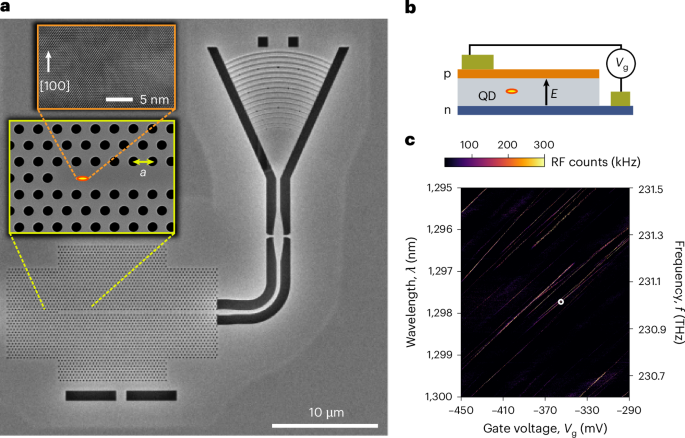
Recent advancements in quantum dot technology have enabled the production of single photons at telecom wavelengths, specifically in the O-band (1260-1360 nm). Researchers demonstrated a quantum-coherent photon-emitter interface that delivers over 40 million single photons per second, significantly improving the coherence and quality of emitted photons. This breakthrough addresses previous challenges in integrating quantum dots with existing fiber-optic infrastructure. The work was conducted using self-assembled indium arsenide quantum dots embedded in gallium arsenide, marking a significant step towards scalable quantum networks. The findings were published in a Nature Nanotechnology paper on August 3, 2026, and highlight the potential for secure quantum communication applications. The implications of this technology extend to quantum key distribution and photonic quantum computing, both of which rely on high-quality single photon sources.
Ask AI about this cluster
Answers cite the sources they use
Timeline
More articles in this cluster (6)
Continue Reading
 Critical Zero-Day Exploited in BeyondTrust Remote Support by China-linked Group A critical vulnerability in BeyondTrust Remote Support, tracked as CVE-2026-102764 with a CVSS score of 9.3, has been exploited by the China-linked espionage group Armory Castle since August 29, 2026. This flaw allows unauthenticated remote attackers to perform file operations, gaining root control and access to…
  CISA Warns of Exploited Vulnerabilities in ProFTPD, ONLYOFFICE, Strapi, and More The U.S. Cybersecurity and Infrastructure Security Agency (CISA) added five vulnerabilities to its Known Exploited Vulnerabilities (KEV) catalog, including critical flaws in ProFTPD, ONLYOFFICE Docs, Strapi, Apache Struts, and ISC BIND. These vulnerabilities are being by Chinese actors for cyber espionage, targeting…