 Global.Chinadaily.Cn
 Advancements in Quantum Technology Transition to Real-World Applications
Article Content

- •Quantum machine learning outperforms classical methods in weather forecasting.
- •Drug screening accuracy for HIV and Alzheimer's improved significantly using quantum technology.
- •Quantum communications networks are operational in over 40 Chinese cities.
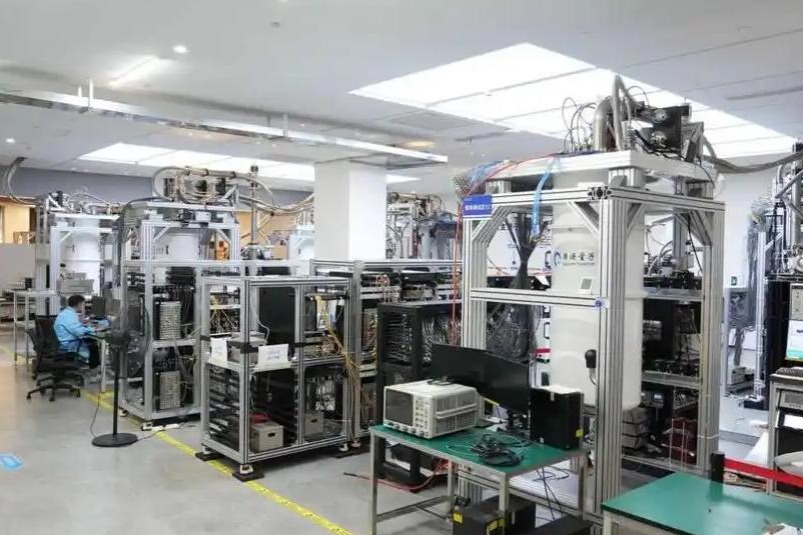
Chinese scientists have made significant strides in quantum technology, particularly in weather forecasting and drug discovery. Researchers from Fudan University and the University of Science and Technology of China demonstrated that quantum machine learning can outperform classical neural networks in urban temperature and humidity predictions. Additionally, a quantum-enhanced graph neural network developed by Origin Quantum and USTC improved HIV antiviral drug screening accuracy from 73% to 97% and Alzheimer's drug prediction accuracy from 64% to 70%. Quantum communications have seen extensive deployment, with over 40 cities in China establishing metropolitan quantum communication networks. China Telecom Quantum Group offers quantum-encrypted calling services to over 7 million users and 5,000 institutional clients. Quantum sensors are also being utilized in healthcare, with CIQTEK's magnetocardiography system enabling rapid cardiac scans. The hybrid quantum supercomputing center in Hefei combines supercomputers with quantum computers to tackle complex computational problems. These developments indicate a shift from theoretical research to practical applications across various sectors.
Ask AI about this cluster
Answers cite the sources they use
Timeline
More articles in this cluster (2)
Continue Reading
 CVE-2015-3306 Exploited in ProFTPD FTP Servers CVE-2015-3306, a vulnerability in ProFTPD 1.3.5, allows remote attackers to read and write arbitrary files using the SITE CPFR and SITE CPTO commands. This exploit can lead to unauthorized access and potential remote code execution, as the commands are executed with the privileges of the ProFTPD service. Active…
  CISA Mandates Urgent Patching of Five Critical Flaws Exploited by Flax Typhoon The U.S. Cybersecurity and Infrastructure Security Agency (CISA) has ordered federal agencies to patch five critical vulnerabilities by October 11, 2026, following exploitation by the China-linked hacking group Flax Typhoon. The vulnerabilities, added to CISA's Known Exploited Vulnerabilities (KEV) catalog, include…