 2-Spyware
 Remote Access Trojans (RATs) Target Users with Stealthy Control
Article Content

- •RATs allow attackers full control of infected systems.
- •A 2015 incident in Ukraine showcased the severe impact of RATs on critical infrastructure.
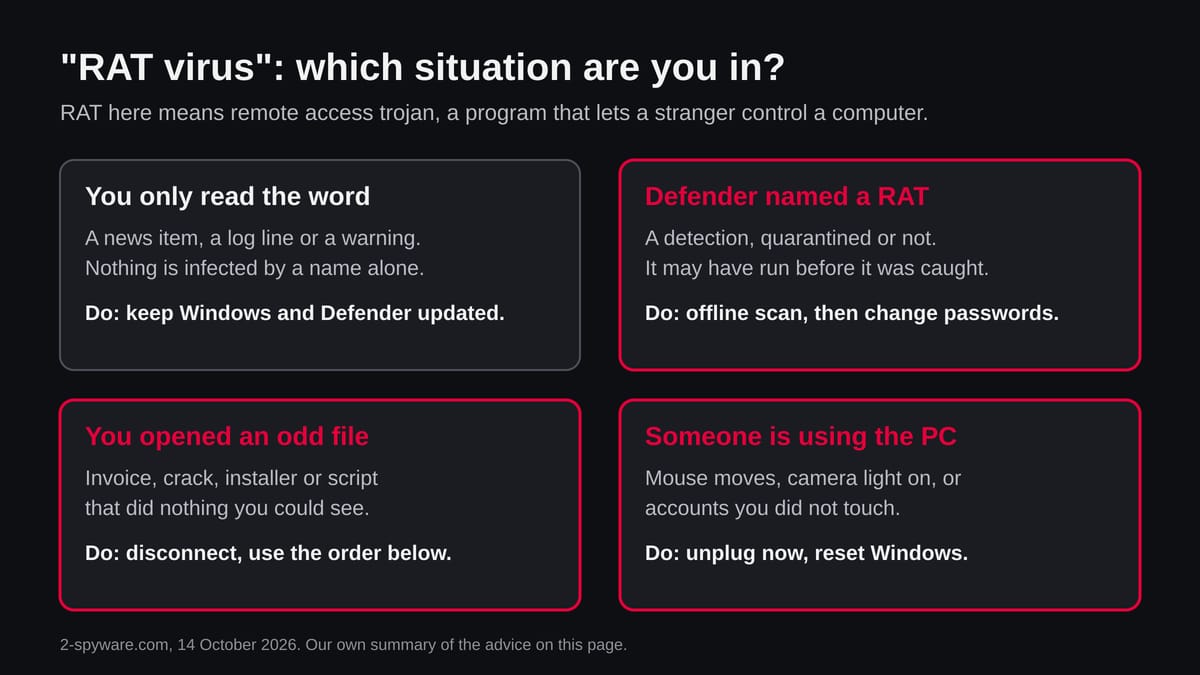
- •Users are advised to scan for and remove RATs to prevent unauthorized access.
Remote Access Trojans (RATs) are malicious software that allow cybercriminals to gain full control over an user's system, including access to files and network resources. Unlike traditional malware, RATs do not typically destroy files but enable attackers to browse applications and bypass security measures. A notable incident in Ukraine in 2015 demonstrated the potential impact of RATs, where attackers remotely accessed systems controlling utility infrastructure, affecting 80,000 people. Current guidance emphasizes the importance of scanning for RATs and removing them promptly to prevent unauthorized access. The articles provide insights into the nature of RATs, their operation, and removal strategies, but do not specify any or CVEs related to this threat.
Ask AI about this cluster
Answers cite the sources they use
More articles in this cluster (3)
Following this threat?
Track AsyncRAT in your own feed — you're alerted when they show up in new reporting, leak sites or exploitation.
Free account · no card needed
Common questions
How do RATs gain access?
What are the signs of a RAT infection?
What steps should I take if I suspect a RAT?
Continue Reading
 AsyncRAT and SideCopy Campaigns Target Users with Multi-Stage Attacks Recent cybersecurity reports detail two significant malware campaigns involving AsyncRAT and SideCopy. The AsyncRAT campaign employs a five-stage infection chain utilizing a socially engineered batch file and the AutoIt interpreter, culminating in a .NET payload that steals information. Meanwhile, the SideCopy group…
  CVE-2015-3306 Exploited in ProFTPD FTP Servers CVE-2015-3306, a vulnerability in ProFTPD 1.3.5, allows remote attackers to read and write arbitrary files using the SITE CPFR and SITE CPTO commands. This exploit can lead to unauthorized access and potential remote code execution, as the commands are executed with the privileges of the ProFTPD service. Active…