 dataexplained.com
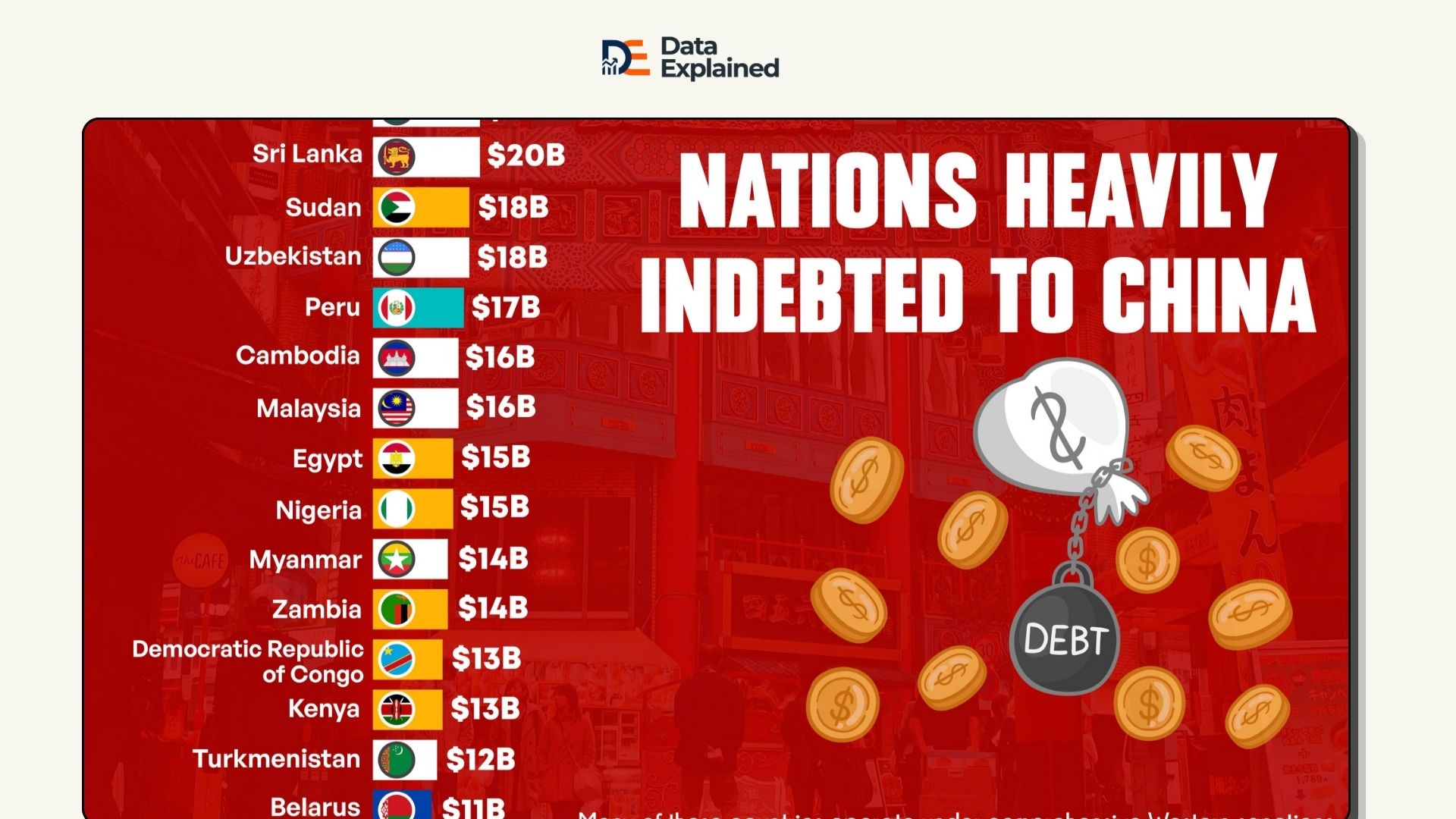
 Russia, Iran, and Venezuela's $310 Billion Debt to China Amid Sanctions
Article Content

- •Russia owes China $169 billion, the largest debt among sanctioned countries.
- •Venezuela and Iran follow with debts of $113 billion and $28 billion, respectively.
- •China's financial leverage over these nations is growing due to their limited access to Western financing.
Russia, Venezuela, and Iran owe China a combined $310.1 billion, representing 30.1% of the $1.031 trillion owed by 30 countries. These nations are under extensive Western sanctions limiting their access to dollar financing, making China a crucial lender. Russia leads with $169 billion, followed by Venezuela at $113 billion and Iran at $28 billion. The reliance on Chinese capital is increasing, as these countries lack alternative financing sources, thereby enhancing Beijing's leverage over them. Analysts suggest this financial dependence could translate into political influence for China, particularly over Moscow, Caracas, and Tehran. The situation reflects a broader trend where sanctioned economies are becoming increasingly aligned with Chinese interests.
Ask AI about this cluster
Answers cite the sources they use
More articles in this cluster (2)
Common questions
How much does Russia owe China?
What impact do these debts have on Russia and its allies?
Why are these countries heavily indebted to China?
Continue Reading
 Critical Citrix NetScaler Zero-Day Vulnerabilities Exploited Citrix disclosed two critical zero-day vulnerabilities, CVE-2026-88771 and CVE-2026-88772, affecting NetScaler ADC and Gateway systems, which are being actively exploited. Both vulnerabilities have a CVSS score of 9.5 and allow unauthenticated attackers to execute arbitrary commands remotely. CVE-2026-88771 arises…
  Critical Authentication Bypass in Cisco Catalyst SD-WAN Manager Exploited On September 30, 2026, Cisco disclosed a critical vulnerability (CVE-2026-76504) in the Catalyst SD-WAN Manager that allows unauthenticated remote attackers to bypass authentication and gain admin-level access to the system. This flaw stems from improper handling of URI encoding in HTTP requests, enabling attackers to…