 Hackread
StealC Malware Revives as Stadia RAT with Enhanced Capabilities
Article Content

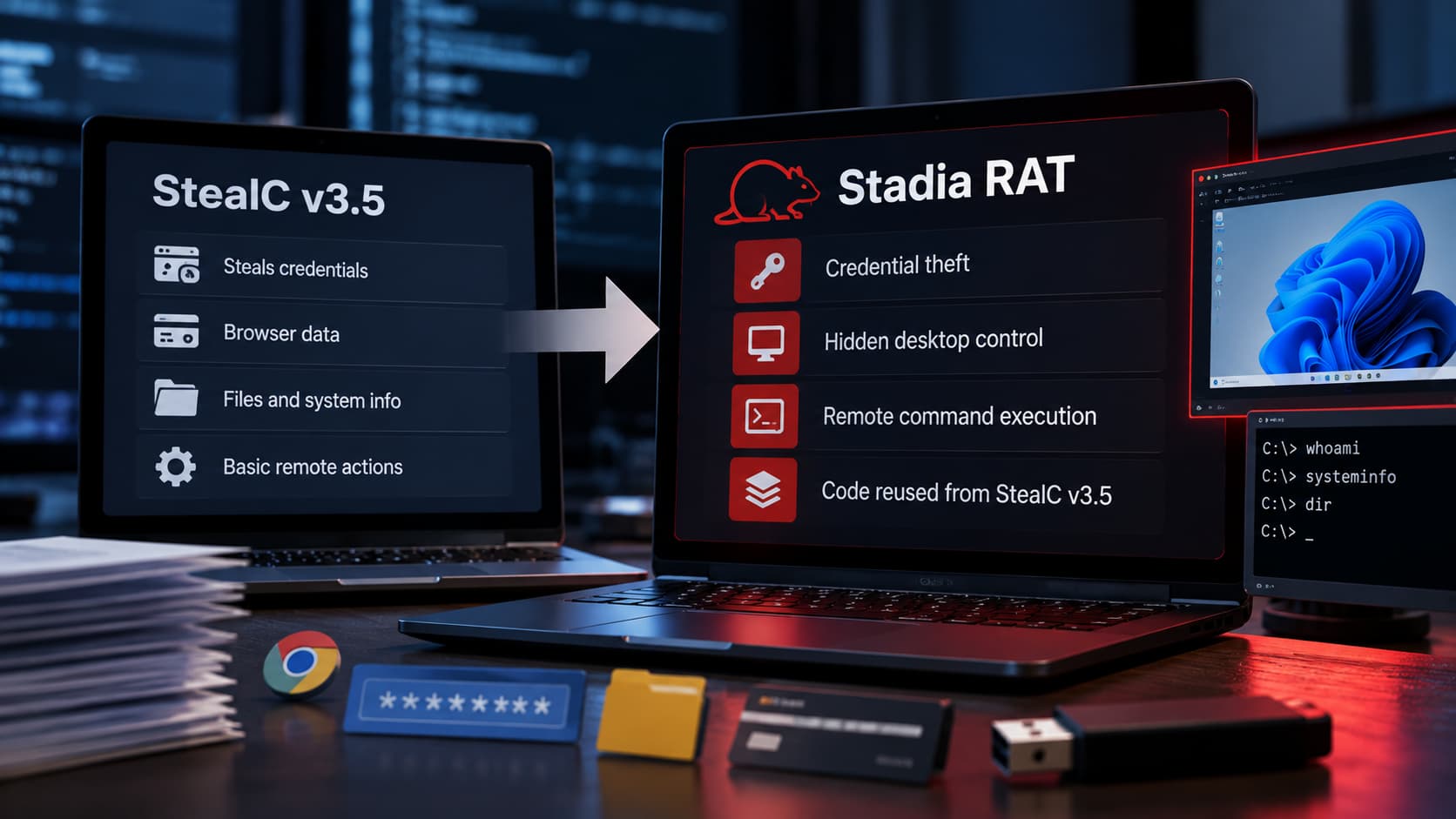
- •Stadia RAT combines credential theft with remote desktop control features.
- •The malware targets a wide range of applications, including over 50 browsers and 120 crypto extensions.
- •Stadia is offered on a subscription basis, with former StealC customers receiving incentives.
Following the takedown of StealC by Europol in June 2026, its seller has re-emerged with a new remote access trojan (RAT) named Stadia. This RAT combines credential theft with remote desktop control and command execution, utilizing code from StealC v3.5. Stadia was advertised on October 16, 2026, and features six modules, including a stealer, hidden virtual network computing (HVNC), and a file explorer. The malware targets over 50 browsers and 120 cryptocurrency extensions, with a subscription model ranging from $300 to $900 per month. Varonis Threat Labs confirmed the reuse of StealC code in Stadia and provided insights into its operation, including self-installation techniques and evasion measures against detection. The malware's infrastructure was rebuilt post-Operation Endgame, indicating a significant threat to users globally, particularly in South and Southeast Asia, Africa, and Latin America.
Ask AI about this cluster
Answers cite the sources they use
Timeline
More articles in this cluster (2)
Following this threat?
Track Stadia in your own feed — you're alerted when they show up in new reporting, leak sites or exploitation.
Free account · no card needed
Common questions
What systems are affected by Stadia?
How does Stadia install itself?
What should organizations do to protect against Stadia?
Continue Reading
 Cybercriminals Target French Retail with Disruptive Attacks Cybercriminals have overridden temperature settings in hundreds of stores across France, causing fridges to heat up to 50°C and spoiling millions of euros worth of food. This incident highlights a growing trend where cybercriminals pursue business disruption alongside financial gain. The World Economic Forum's Global…
 PHP2Shell Vulnerabilities Exploited by AI-Driven Attackers Threat actors have exploited PHP2Shell vulnerabilities (CVE-2026-109618 and CVE-2026-109619) to target a government entity in Europe, gaining access to sensitive data within two hours of the initial breach. The attackers utilized AI tools for reconnaissance and post-exploitation activities, including accessing…